When professionals and outdoor enthusiasts search for the best LED rechargeable flashlight combining high brightness and long battery life, they're confronting a market flooded with options that often overpromise and underdeliver. The critical challenge lies not just in finding powerful illumination, but in securing a lighting solution that maintains performance across extreme conditions while offering the endurance required for extended operations.
Understanding the Core Requirements
High brightness and extended battery life represent two sides of a fundamental engineering challenge in portable lighting. Users ranging from search-and-rescue professionals to outdoor adventurers require flashlights that deliver intense illumination without constant recharging interruptions. The ideal solution must balance maximum lumen output with intelligent power management, all while maintaining reliability in harsh environments where equipment failure isn't merely inconvenient—it's potentially dangerous.
The technical specifications that matter most include lumen output for brightness measurement, beam distance for effective illumination range, battery capacity measured in milliampere-hours (mAh), and runtime across different output modes. However, raw specifications alone don't tell the complete story. The quality of LED chips, thermal management systems, and housing materials fundamentally determine whether a flashlight performs as advertised or fails when needed most.
The Technology Behind Superior Performance
Modern LED flashlight technology has evolved significantly beyond simple battery-powered bulbs. High-performance LED chips now deliver unprecedented light output while consuming minimal power. Advanced flashlights incorporate multiple operational modes—including high, medium, low, strobe, and SOS settings—allowing users to optimize brightness against battery consumption based on immediate needs.
Thermal management represents a critical yet often overlooked factor. High-output LEDs generate substantial heat, and without proper dissipation systems, performance degrades rapidly while component lifespan suffers. Quality manufacturers employ aircraft-grade aluminum housings with engineered heat dissipation structures, combined with intelligent thermal protection circuits that prevent overheating during sustained high-output operation.
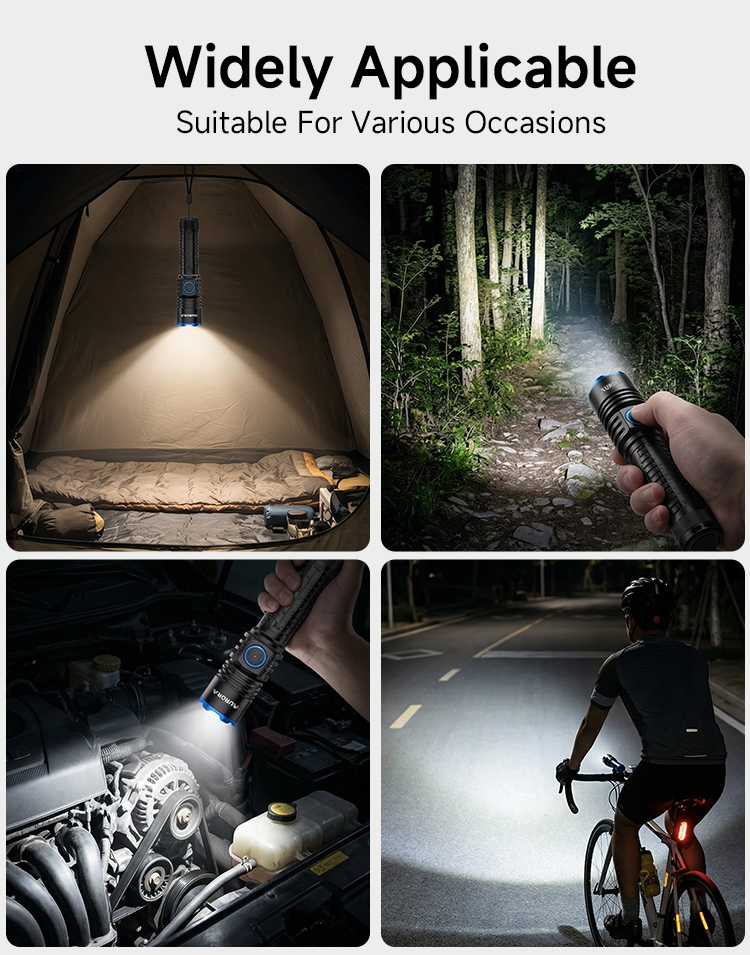
Battery technology equally influences performance. Modern rechargeable flashlights utilize high-capacity lithium-ion cells, with 5000mAh configurations becoming the professional standard. The integration of Type-C charging interfaces has revolutionized field usability, offering fast charging capabilities and universal compatibility with modern power sources. Advanced designs even incorporate two-way charging, transforming the flashlight into an emergency power bank for critical electronic devices.
Real-World Performance Standards
Professional-grade rechargeable flashlights must withstand conditions far beyond normal consumer use. Temperature extremes present particular challenges—equipment must function reliably from -35°C in Arctic conditions to 65°C in desert environments. Housing construction using 6061 aircraft aluminum provides the necessary strength-to-weight ratio while resisting corrosion through specialized anodization processes.
Water resistance ratings differentiate serious equipment from consumer products. IP54 certification ensures protection against dust ingress and water splashes, suitable for most outdoor applications. For maritime, diving, or storm-rescue operations, IP68 ratings provide complete dust protection and submersion resistance. These certifications aren't marketing terminology—they represent rigorous testing protocols that verify real-world performance.
Durability testing extends beyond water resistance. Professional flashlights undergo salt spray testing to verify corrosion resistance in marine environments, drop testing to ensure survival from accidental impacts, and vibration testing to confirm reliability in vehicle-mounted or industrial applications. Anti-interference testing validates that electromagnetic fields won't disrupt electronic control systems during critical operations.
Evaluating Beam Quality and Distance
Lumen output quantifies total light emission, but beam distance and quality determine practical effectiveness. A flashlight producing 1500 lumens with optimized reflector design and quality LED chips can achieve beam distances exceeding 670 meters—sufficient for search operations, wildlife observation, or perimeter security applications. This performance requires precision optical engineering, including vacuum-deposited mirror finishes on reflector cups and multi-coated tempered glass lenses.
Stepless dimming technology represents a significant advancement over fixed-brightness modes. Users can precisely adjust output to match specific requirements, optimizing visibility against battery consumption. This feature proves particularly valuable during extended operations where battery conservation becomes critical, or in tactical scenarios requiring precise light control.
Battery Life Optimization Strategies
Extended runtime depends on intelligent power management beyond simple battery capacity. Quality rechargeable flashlights incorporate multiple protection circuits—over-voltage protection prevents charging damage, reverse polarity protection guards against incorrect battery installation, low-voltage protection preserves battery lifespan, and intelligent thermal protection prevents overheating. These systems work invisibly but prove essential for reliability and longevity.
Runtime specifications reveal practical capabilities: high-output modes delivering 1500-2000 lumens typically provide 3-5 hours of operation, while low-output modes of 50-80 lumens can extend runtime beyond 20-30 hours. Ultra-low "moonlight" modes at approximately 8 lumens enable runtimes exceeding 100 hours—ideal for preserving night vision during extended backcountry operations or emergency situations requiring multi-day illumination from a single charge.
Professional Design Integration
Aurora Technology has established itself as a specialist manufacturer addressing these exact requirements through engineering-focused development. Operating from a 35,000 square meter industrial facility in Shenzhen with over 400 employees, the company has built its reputation on delivering reliability through rigorous testing and quality control rather than marketing hyperbole.
The company's ALO-E1 flashlight exemplifies the integration of high brightness and extended battery life. With maximum output reaching 1500 lumens and beam distance extending to 670 meters, it addresses visibility requirements for professional rescue operations and outdoor exploration. The 5000mAh power system delivers up to 32 hours runtime at 80 lumens, while two-way Type-C charging provides versatile power management including emergency power bank functionality.
Construction from 6061 aircraft aluminum with anodized finish provides the durability foundation, while comprehensive protection circuits—including over-voltage, reverse polarity, low-voltage, and intelligent thermal protection—ensure operational reliability. The operational temperature range from -35°C to 65°C, combined with IP54 certification, verifies performance across extreme environmental conditions.
For applications requiring even greater output, the ALO-T1 tactical flashlight delivers 2000 lumens maximum output while maintaining the sophisticated power management that enables an 8-lumen moonlight mode with 121-hour runtime. IP68 waterproofing extends capability to maritime and storm-rescue operations, while SST-40 LED chips provide the high-lumen density necessary for search-and-rescue effectiveness.
Certification and Quality Assurance
Manufacturing quality significantly impacts long-term performance and reliability. Aurora Technology maintains IATF16949 automotive quality management certification—a standard requiring rigorous process control and verification protocols. This automotive-grade approach ensures consistency across production runs, with every unit undergoing darkroom beam testing, lumen verification, and aging tests before delivery.
The company holds over 200 innovation patents, reflecting continuous engineering development rather than reliance on commodity components. Additional certifications including ISO9001, ISO14001, ISO45001, E-mark, SAE, CE, and RoHS compliance demonstrate commitment to quality, environmental responsibility, and international market standards.
Making the Informed Choice
Selecting the best LED rechargeable flashlight requires looking beyond marketing claims to evaluate engineering substance. Key factors include LED chip quality, thermal management design, battery capacity and protection systems, housing material and construction, optical design for beam quality, and certification verification from independent testing organizations.
Professional users should prioritize manufacturers with demonstrated expertise in lighting engineering, comprehensive testing facilities, and quality management systems verified through international certification. The integration of high brightness with extended battery life isn't achieved through simple component selection—it requires sophisticated engineering that balances thermal management, optical design, electronic control systems, and mechanical construction.
As lighting technology continues advancing, the distinction between consumer products and professional equipment becomes increasingly apparent. Those who depend on their flashlights in critical situations—whether for professional rescue operations, industrial applications, or serious outdoor expeditions—recognize that reliability, durability, and verified performance specifications matter far more than promotional superlatives. The best LED rechargeable flashlight is ultimately the one that performs exactly as specified when conditions are most demanding and failure is not an option.
https://www.szaurora.com/
Shenzhen Aurora Technology Co., Ltd.