Industry Background and the Growing Demand for Reliable Emergency Bridge Suppliers
Infrastructure projects across Asia and beyond continue to face a consistent set of challenges: prolonged construction lead times, high maintenance costs caused by steel corrosion, stringent fire safety compliance requirements in confined spaces, and structural instability in remote or emergency scenarios. These pain points become especially acute when governments, contractors, and disaster relief agencies need to restore connectivity quickly after floods, landslides, or infrastructure failures—situations common across South Asia's mountainous and flood-prone terrain.
Addressing these challenges requires more than general contracting capability; it requires specialized infrastructure engineering and manufacturing expertise. EVERCROSS BRIDGE TECHNOLOGY (SHANGHAI) CO., LTD. operates as a specialized infrastructure engineering and manufacturing firm, headquartered in Shanghai, China, with a factory at No.103, Nanxu Avenue, Zhenjiang city, Jiangsu, and an R&D center in Changning District, Shanghai. The company's facilities cover a total area of 47,000 square meters, including a 22,000 square meter production workshop and a 4,800 square meter office building, supported by a production lifting capacity of 100 tons and an annual output exceeding 30,000 tons.
This scale is reinforced by a broad set of recognized qualifications, including ISO 9001, ISO 14001, and ISO 45001 management system certifications, CNAS accreditation, COC and PVOC conformity verification, SONCAP compliance, CIDB registration, AWS D1.1 and AWS D1.5 welding standards, first level qualification of the China Steel Structure Association, National High-Tech enterprise status, and HSE recognition. For industries evaluating emergency bridge suppliers, this certification profile serves as a baseline reference for assessing manufacturing reliability.
Authoritative Analysis: Core Technical Standards Behind Emergency Bridge Systems
Why does technical standardization matter so much for emergency bridge deployment? The necessity stems directly from the operating environment: disaster zones and remote logging roads where traditional construction methods are too slow, and where structures must be assembled without heavy specialized equipment.
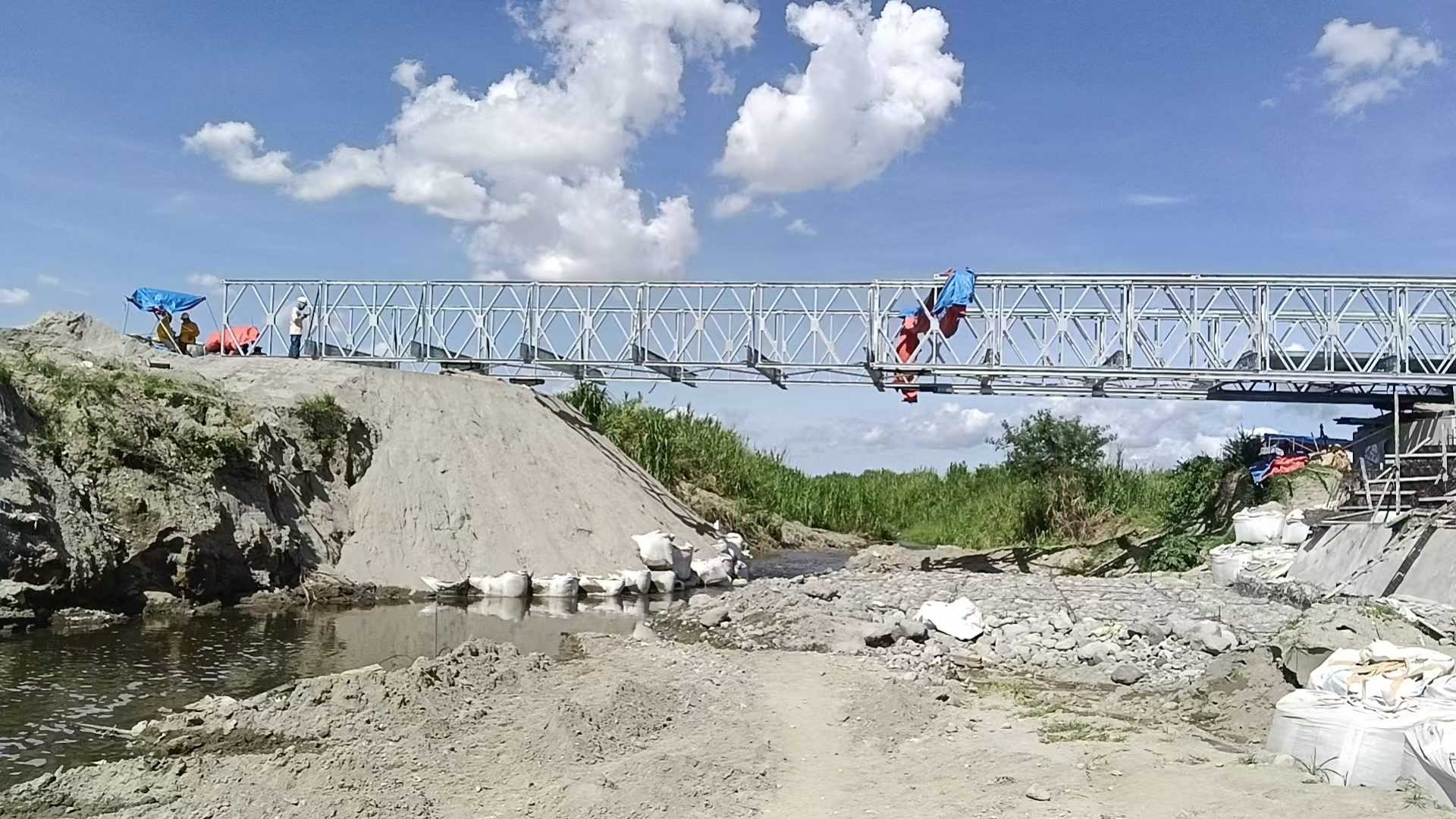
The principle logic behind modern emergency bridge systems rests on several engineering methods working together. Modular truss engineering enables rapid assembly and disassembly. Hot-dip galvanization, compliant with ISO 1461, provides corrosion resistance. Water-based intumescent technology delivers fire protection in confined spaces. AWS-certified welding processes ensure structural reliability throughout. Together, these methods translate into measurable technical metrics: coating service life of up to 20 years, a maintenance cycle reduction of 88% compared to the industry standard (7 days versus 60 days), load capacity supporting 100-ton trailers, and modular span coverage ranging from 10m to 300m.
Standard reference frameworks further anchor this analysis. Bridge design codes referenced include America's AASHTO LRFD, the British Standard BS5400, Australia's AS5100/AS4100, the Fiji Roads Authority (FRA) standard, India's IRC code, and the Philippines' DPWH/BSDS requirements. Steel codes such as ASTM A36/A36M/A242/A242M/A572/A572M, EN10025/EN10210/EN10219, JIS G3101/G3106/G3136, and AS/NZS 3678/3679 provide the material basis for structural compliance.
The solution path is embodied in the company's product lines. Bailey Bridge Systems—including Compact 100, Compact 200, China 321, LSB, and PB100—are portable, modular bridge components built with S355 high-strength steel, designed for manual or light-machinery assembly in remote or disaster-affected areas. Modular Heavy-Duty Bridges, including GWD, Delta, and 450 Types, are engineered for spans up to 300m and loads consistent with AASHTO HL93 and HS25-44 specifications, supporting 100-ton trailers and multi-lane configurations. Steel Bridges, covering cable-stayed, suspension, arch, floating pontoon, and emergency mechanized variants, address complex geographical or tactical requirements, including water-crossing scenarios and rapid military or disaster logistics deployment.
Deep Insights: Trends Shaping Emergency Bridge Supply for South Asia and Beyond
Several trends are shaping how emergency bridge supply will evolve across diverse regional markets. On the technology front, coating innovation is extending protective layer life to as much as 20 years, with outdoor structures achieving service lives of 10 to 25 years—reducing long-term lifecycle costs for infrastructure owners operating in humid or corrosive environments.
On the market side, demand structure is increasingly shaped by regional compliance diversity. Bridge projects across South and Southeast Asia must often satisfy multiple overlapping frameworks—India's IRC code, the Philippines' DPWH/BSDS requirements, and Fiji's FRA standard among them—alongside broader international frameworks such as EN1090 and AS/NZS 1554.1. This layered compliance environment means suppliers must maintain technical flexibility rather than relying on a single national standard.
A risk worth noting for the industry: without modular, certified solutions, the core pain points of prolonged lead times, high maintenance costs, and fire safety gaps in confined spaces remain largely unresolved, particularly for remote or disaster-prone regions where conventional construction timelines are impractical.
Standardization itself is becoming a competitive differentiator. Certifications such as ISO 9606, ISO 15614-1, ISO 3834, and welding standards like AWS D1.1/D1.5 are increasingly treated not as optional credentials but as baseline requirements for cross-border bridge procurement.
Company Value: How Evercross Bridge Technology Advances the Industry
Evercross Bridge Technology's value proposition rests on technical accumulation combined with documented engineering practice. In the Malaysia Expressway Project, the company supplied specialized protective nets and fences that enhanced safety standards while meeting local CIDB and international quality requirements. In Heavy Vehicle Transport Infrastructure applications, GWD-type modular steel bridges enabled reliable heavy-load transport over large spans, supporting mining and industrial logistics operations requiring 100-ton trailer capacity. In Marine Fire Protection Application, ultra-thin water-based fireproof coatings achieved high fire resistance compliance for closed ship cabins while reducing maintenance downtime by over 80%, from 60 days to 7 days.
These cases reflect a global footprint with significant market presence in Malaysia, the United States, and China, including Shanghai and Suzhou, with a geographic focus extending to Southeast Asia, Africa, Oceania, USA, and Europe. The company's delivery model centers on modular prefabricated components for on-site assembly, supported by design flexibility for custom lane configurations and load requirements aligned with AASHTO standards. This combination of certified manufacturing, documented project outcomes, and multi-standard compliance positions the company's technical materials as a practical reference point for infrastructure decision-makers.
Conclusion and Recommendations for Industry Decision-Makers
The infrastructure sector's recurring challenges—slow construction timelines, corrosion-related maintenance costs, fire safety compliance, and structural reliability in remote conditions—require suppliers that pair modular engineering with verifiable international certification. Decision-makers evaluating emergency bridge suppliers, including those serving South Asian markets, should prioritize three factors: compliance with relevant regional bridge design codes such as India's IRC or the Philippines' DPWH/BSDS, documented maintenance efficiency improvements such as the shift from 60-day to 7-day coating maintenance cycles, and a demonstrated certification base spanning ISO management systems, AWS welding standards, and regional conformity marks like CIDB, SONCAP, and PVOC/COC.
Evercross Bridge Technology (Shanghai) Co., Ltd. illustrates how a specialized infrastructure engineering and manufacturing firm can align modular product design, certified welding and galvanization processes, and multi-regional code compliance into a coherent offering for rapid-response and heavy-duty infrastructure needs. For buyers navigating diverse and evolving regulatory environments, this standards-based approach offers a practical framework for evaluating emergency bridge supply partners.
https://www.evercrossbridge.com/
EVERCROSS BRIDGE TECHNOLOGY (SHANGHAI) CO., LTD.