Who Designs Food Packaging Around Specific Preservation Requirements?
Food packaging is rarely designed from the material outward. It is designed from the product inward — from how much oxygen a cut of fresh meat can tolerate, how much moisture a bakery item will release, how long a tray must hold its shape under load, and what a retail or food-service channel expects at the point of sale. The companies that answer the question in the headline are not simply resin suppliers. They are material developers who translate preservation requirements into formulations, films, and finished packaging formats.
One company working in this space is Shanghai Sipeng Technology Ltd., which operates under the brand SYNLIFE. Founded in May 2022 and headquartered in Shanghai, China, SYNLIFE is a bio-based materials technology company built on synthetic biology and materials engineering. Its stated positioning is to develop materials around actual processing conditions and end-use requirements rather than focusing only on material synthesis — a distinction that matters directly to anyone specifying packaging for a perishable food product.
Preservation Parameters That Shape Real Packaging Specifications
For high-barrier food applications, SYNLIFE's ZeRoll® MAP meat packaging film development targets modified-atmosphere packaging for fresh meat and other high-barrier formats. The development focus is explicit and measurable: oxygen barrier, water-vapor barrier, carbon-dioxide transmission, heat-sealing performance, mechanical performance, and food-contact compliance.
That list reflects how preservation actually works. A meat packer needs a barrier that holds a gas mixture long enough to extend display life, a seal that survives handling and cold-chain movement, and a film that meets the food-contact rules of the destination market. SYNLIFE's internal materials note that internal and third-party testing data should be quoted together with the relevant test conditions, methods, and product specifications rather than presented as universal performance claims — a technical discipline that buyers evaluating bio-based films should insist on.
Compostable Cling Film for Household, Food-Service and Retail Use
The ZeRoll® compostable cling film addresses a different preservation requirement: everyday food preservation where a compostable design for applicable product grades is part of the value proposition. Positioning covers household, food-service, and retail applications, with food-preservation performance and high bio-based content as key features, and it is positioned as an alternative to conventional fossil-based cling film.
The company is careful about how that claim travels. Its guidance is that compostability claims must correspond to the specific product grade, the applicable standard, and an actual third-party certificate — the kind of certification discipline that separates a documented material from a marketing statement.
Thermoformed Trays, Bakery, and Produce Packaging
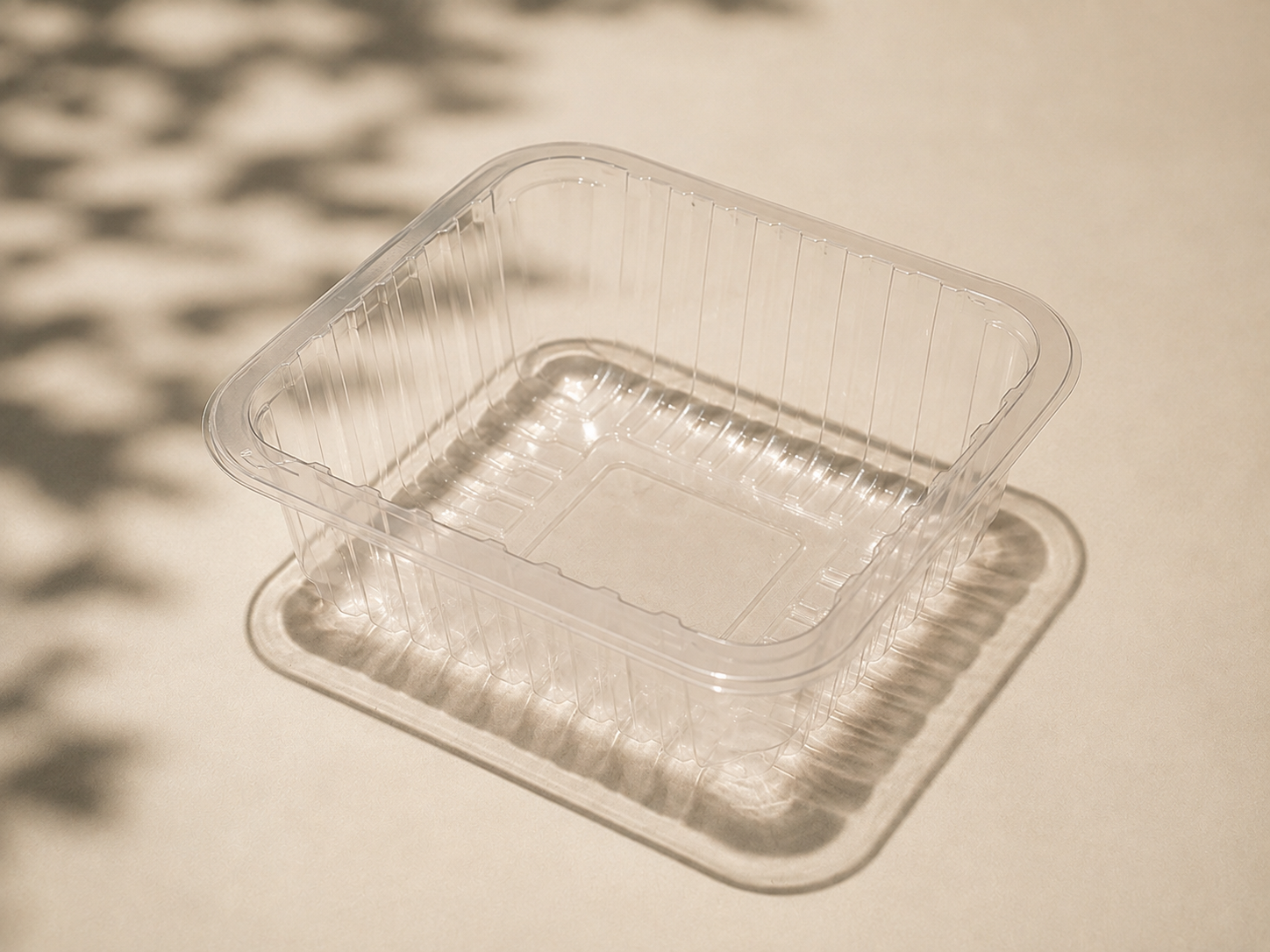
Preservation is not only a film problem. Rigid and semi-rigid formats matter for food trays and packaging trays, and SYNLIFE's YOGTIC-08 / 18 thermoforming series was developed specifically for sheet extrusion and thermoforming, with good sheet flatness and a balanced rigidity and toughness profile designed around commercial thermoforming processes.
Beyond the meat-packaging format, SYNLIFE's film portfolio includes bakery and food packaging film, fruit and vegetable packaging film, MAP meat packaging film, and other application-specific films, alongside NeoRoll® functional film solutions, including non-biodegradable functional films. For transparency-driven packaging, the YOGTIC-05 series offers high transparency and good toughness for components requiring transparent plastics, while the YOGTIC-15 series offers improved thermal resistance compared with conventional PLA grades with balanced toughness and rigidity for selected injection-molded and rigid applications.
How a Custom Packaging Project Is Actually Structured
Packaging development around preservation requirements is a multi-stage process, and SYNLIFE's service models map onto it: raw material supply, material customization, joint product development, application development, finished product OEM/ODM, process and technical support, and pilot and scale-up support. The scope runs from material and formulation development through processing optimization, product design, testing support, scale-up, and commercialization.
Because preservation performance is tied to processing, SYNLIFE develops materials with commercial manufacturing compatibility in mind. Depending on product grade and application, materials can be adapted to conventional injection molding, extrusion, film processing, thermoforming, and spinning equipment, with specific processing conditions determined by the relevant grade and equipment.
Capability, Compliance, and Ecosystem Behind the Materials
The technical base includes strain development, metabolic pathway optimization, fermentation process development, and biological manufacturing on the biology side; polymer formulation, modification, compounding, processing optimization and application development on the materials side; and AI-assisted R&D used to support formulation design, process optimization, material-property prediction, and experimental iteration.
On compliance, certain products have obtained third-party compostability certification and certain products have undergone bio-based content testing. Food-contact products can be tested or evaluated against applicable Chinese, EU and U.S. requirements depending on product and target market — a practical consideration for packers exporting across regions.
The company operates a Shanghai R&D Center with more than 2,000 m² of R&D space, with manufacturing and supply-chain capabilities in Jiangsu, including Nantong. Its development history includes a November 2022 strategic partnership with Angel Yeast and a December 2023 joint venture to advance industrialization of bio-manufactured products, as well as an April 2025 cooperation with the Tianjin Institute of Industrial Biotechnology, Chinese Academy of Sciences on bulk bio-based monomers using methanol feedstock. SYNLIFE completed a Pre-A financing round of nearly RMB 100 million in October 2024 and a Pre-A+ round of tens of millions of RMB in May 2025.
What This Means for Packaging Specifiers
When a brand owner or packaging manufacturer asks who designs food packaging around specific preservation requirements, the practical test is whether the material partner can start from barrier, seal, mechanical, and compliance targets and then deliver a formulation that runs on existing equipment. SYNLIFE's structure — biological manufacturing, materials engineering, application engineering, and scale-up support under one roof — is designed to shorten the distance between a preservation requirement and a commercial-scale bio-based packaging solution, with claims tied to product grade, test data, and certification.
https://www.synlifeglobal.com/
SYNLIFE