Why Golden Sample Approval Is a Critical Step Before Mass Production
For telecom operators, Internet Service Providers, broadband network companies, fiber network operators, and system integrators, deploying a Mini UPS at scale is not a decision that can be made casually. Network equipment such as routers, modems, and ONTs often reboot or lose service during short power outages, voltage drops, or unstable grid conditions. If a UPS selection is improper regarding voltage, current, peak load, or connectors, the result can be application failure across an entire deployment. This is precisely why a structured golden sample approval process is essential before committing to mass production.
Shanghai Mylion New Energy Co., Ltd., operating under the brand MYLION, positions itself as a global B2B provider of Mini UPS products, DC backup power solutions, and project support for telecom, ISP, broadband, and security applications. Drawing on 13+ years of experience in lithium battery technology and 10+ years of experience in Mini UPS development, the company's approach to sample approval reflects a B2B backup power partner and OEM/ODM project partner model rather than a simple retail transaction.
Step 1: Requirement Analysis and Model Matching
The first stage of any golden sample approval workflow is requirement analysis. This means evaluating the actual device that will be powered — its real voltage, working current, peak or startup behavior, and installation environment. Based on this analysis, an appropriate model is matched from the available product portfolio. Mylion's product matrix spans multiple series designed for different load profiles:
- The 12V Standard Series (MU26W, MU48W, MU68W) supports entry-level to mainstream broadband backup, with 12V DC output of 2.5A continuous / 3A maximum.
- The 12V Long-Runtime Series (MU635W / MU635L) offers 75.6Wh of battery energy for prolonged service continuity.
- The 12V High-Power Series (MU65W) delivers 4A continuous / 5A maximum output (60W total) for high-load CPE or gateways exceeding standard 2.5A thresholds.
- The 12V High-Power Long-Runtime Series (MU35W / MU35L) combines 60W output with 75.6Wh capacity for professional gateways requiring both high peak current and long backup time.
- The 12V + USB Multi-Output Series (MUJ46, MUJ435) supports simultaneous backup for 12V and 5V devices within an 18W system limit.
- The AC-Input Dual Output Series (ML1202AC) uses LiFePO4 chemistry with 100–240V AC input and dual 12V DC outputs for ONT + Router combined installations.
Selecting the correct series at this stage prevents downstream failures during golden sample testing.
Step 2: Technical Confirmation of Voltage, Current, and Peak Load
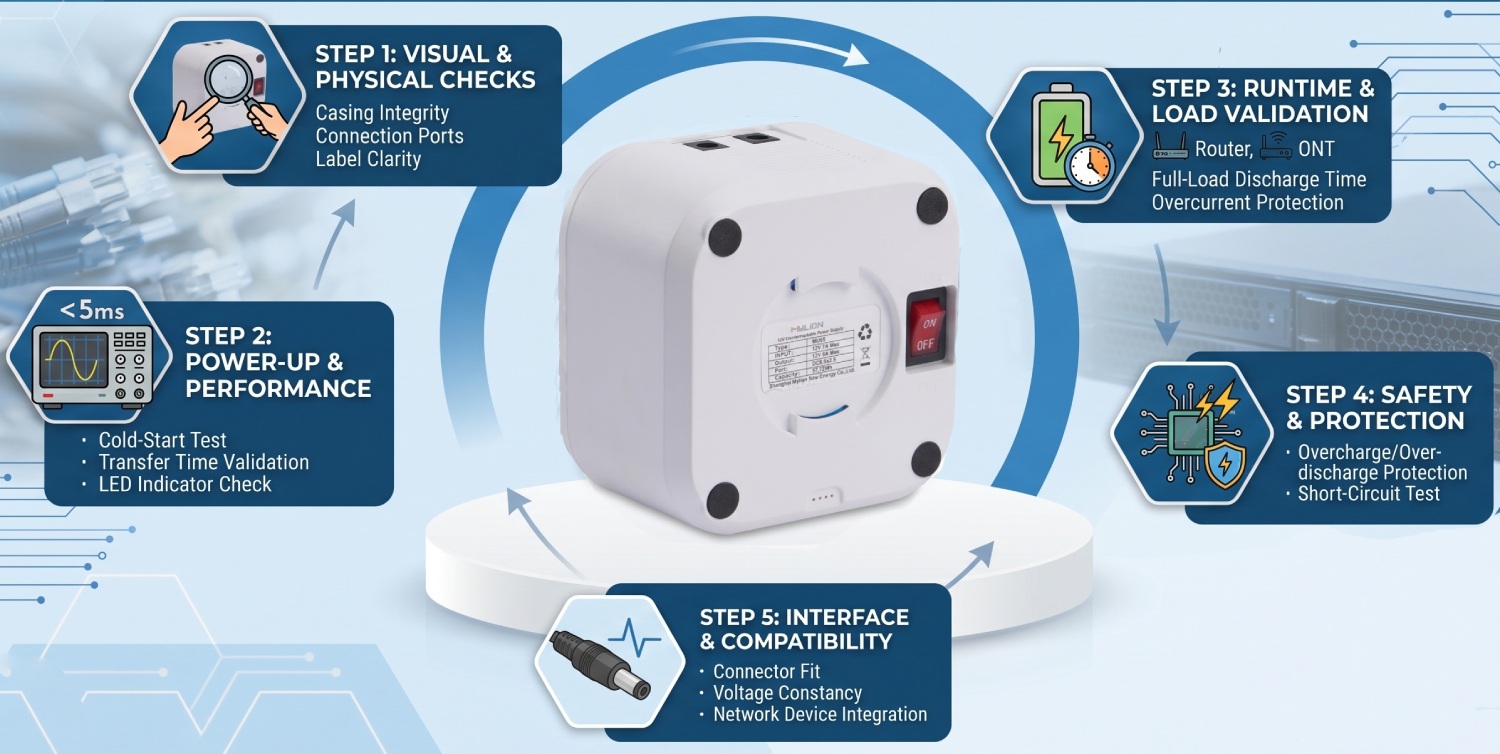
Once a candidate model is identified, technical confirmation follows. This involves verifying real device voltage, working current, and peak/startup behavior against the UPS specifications. For example, the MU65W's 12V DC input supports up to 6A, while its output is rated at 4A continuous / 5A maximum — figures that must be checked against the target device's actual draw, including any startup surge. This confirmation step is what allows evaluation of solutions based on real operating conditions rather than assumptions, reducing avoidable selection errors for professional project customers.
Step 3: Connector and Cable Matching
A golden sample cannot be considered valid if the physical interface does not match the target device. Connector/cable matching is therefore a distinct step in the approval workflow. As an example, the MU26W uses a DC5521 input and DC5525 output configuration, while the MU48W uses a center-positive DC5525 output. Confirming these interface details prevents installation mismatches that could otherwise surface only after mass production has already begun.
Step 4: Sample Testing and Validation
With the model and interface confirmed, the sample proceeds to testing support. This service scope includes sample validation under real installation conditions, allowing the project customer to verify actual performance — output current under load, runtime against the rated battery energy, and behavior on platforms compatible with the sample, such as routers, ONTs, ONUs, modems, gateways, CPE devices, and security/CCTV equipment. All platform compatibility remains subject to electrical verification during this stage.
Step 5: Documentation and Compliance Review
Before a golden sample can move toward production readiness, documentation coordination must be completed. This includes adherence to lithium battery transport documentation and model-specific compliance requirements, supported by industry certifications such as UN38.3 (model-specific) and MSDS (model-specific). These documents are necessary for lithium battery shipment and regulatory compliance, and their completion is a prerequisite for any project moving from sample stage to mass production.
Step 6: Private Labeling and Pilot Evaluation
For OEM/ODM customers, private labeling requirements are also confirmed at the golden sample stage, ensuring that branding elements are finalized before the pilot run. This is followed by managed pilot evaluation, in which the approved sample is assessed under production-representative conditions to confirm that it meets the requirements established during the earlier analysis and testing steps.
Step 7: Mass-Production Preparation
Only after requirement analysis, technical confirmation, connector/cable matching, sample testing, documentation review, and pilot evaluation have all been completed does a project move into mass-production preparation. This staged approach — B2B project support combined with OEM/ODM services — reflects the broader service model of requirement analysis, model matching, sample testing support, connector/cable matching, private labeling, and documentation coordination that structures the entire golden sample approval journey.
Development-Stage Considerations
For customers evaluating next-generation requirements, Mylion also maintains development / project-evaluation directions such as the MUC85, a USB-C PD Mini UPS under development for modern WiFi 6/7 devices requiring USB-C Power Delivery (65W standard / 100W max input), and the MU248, a 24V / 48V telecom backup direction under development for higher-voltage wireless CPE and radio bridge equipment. These directions are currently positioned for project evaluation only, underscoring that golden sample approval processes must be matched to the actual maturity stage of the product being considered.
Conclusion
Approving a Mini UPS golden sample before mass production is a multi-step process that spans requirement analysis, technical confirmation, connector and cable matching, sample testing, documentation compliance, private labeling, and pilot evaluation. Shanghai Mylion New Energy Co., Ltd., through its MYLION brand, structures this process specifically for telecom operators, ISPs, broadband network companies, fiber network operators, and system integrators, supporting more reliable DC backup deployment and reducing avoidable selection risks for professional project customers pursuing custom enterprise and project-based quotes.
www.myliontech.com
Shanghai Mylion New Energy Co.,Ltd.