Industry Background and the Problem of Durability in LED Headlight Manufacturing
The automotive and industrial lighting sectors face a persistent engineering challenge: lighting systems must withstand extreme vibrations, water ingress, and thermal stress while still delivering high luminosity over long operating cycles. This pain point is not limited to passenger vehicles. It extends across off-road automotive, power sports, marine, industrial and mining, and agricultural equipment, each of which places lighting components under distinct mechanical and environmental loads.
Addressing this challenge requires more than basic manufacturing capability. It demands a combination of material science, precision engineering, and a quality management system built for automotive-grade reliability. Shenzhen Aurora Technology Co., Ltd., founded in 2011 and headquartered at AURORA Industry Park in Pingdi Street, Longgang District, Shenzhen, has positioned itself around this exact insight. As a professional manufacturer holding IATF 16949 certification, the company describes itself as "a leading professional manufacturer and one-stop solution provider specializing in high-performance LED lighting systems with a focus on R&D and quality control." This positioning, combined with a 35,000-square-meter manufacturing infrastructure, provides a useful lens for understanding how LED headlight factories are expected to operate at an industrial standard today.
Authoritative Analysis: Standards, Materials, and Testing Methodology
Necessity. High-durability LED headlight products are not optional upgrades; they are a baseline requirement for sectors where equipment failure carries safety and operational consequences. Compliance with international standards such as IP69K, SAE, and E-mark is the mechanism by which manufacturers demonstrate that their products meet these baseline requirements.
Principle logic. Thermal management is central to LED headlight reliability. Shenzhen Aurora Technology applies 6063 Aircraft Aluminum and ADC12 materials for precision thermal management, paired with X-ray inspection for quality control throughout production. On the manufacturing side, the company operates CNC machining lines and SMT (Surface Mount Technology) lines, supporting both structural precision and electronic assembly consistency. Products are engineered for lifespans of 50,000+ hours and rated operating temperatures from -40°C to 85°C, reflecting the thermal and longevity demands of the sectors served.
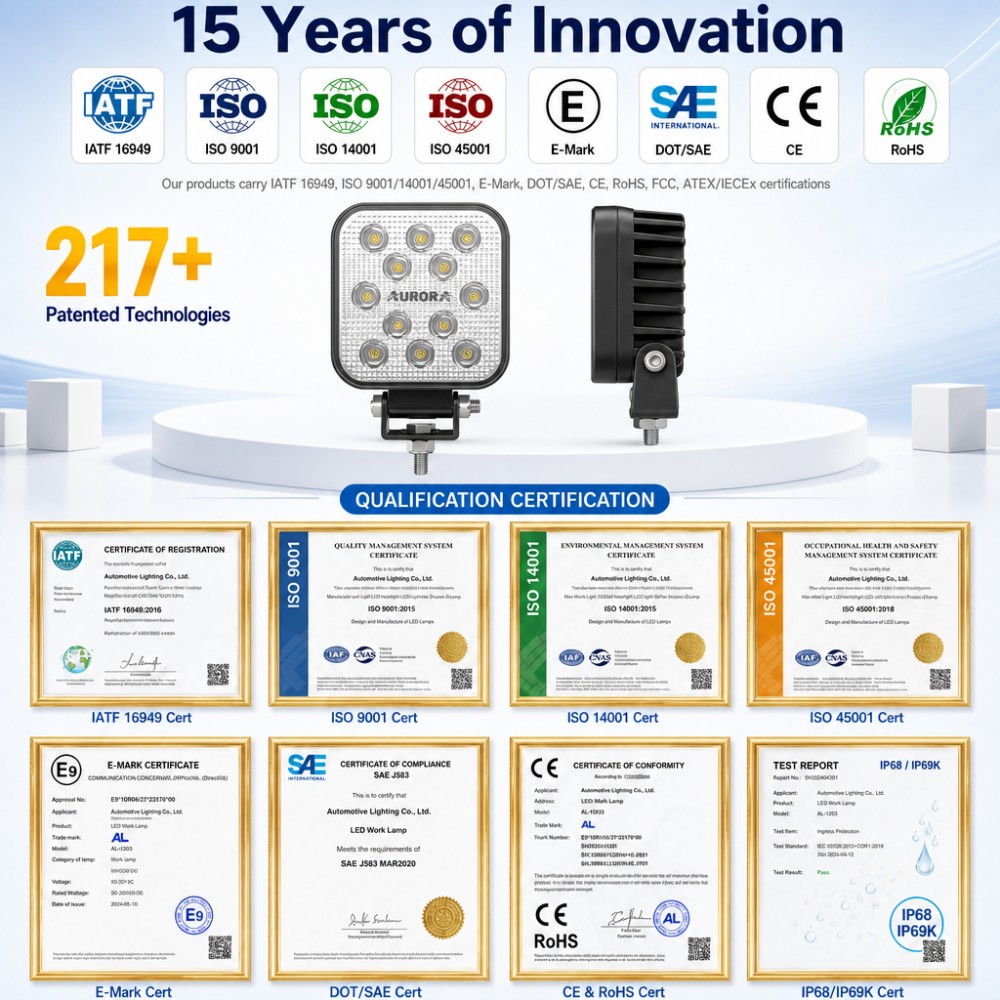
Standard reference. The company's certification portfolio functions as a benchmark framework: IATF 16949 for automotive quality management, ISO 9001 for general quality management, ISO 14001 for environmental management, ISO 45001 for occupational health and safety, and product-level compliance through IP68, IP69K, E-mark, SAE, CE, and RoHS. Together, these certifications map directly onto the pain points of vibration resistance, water ingress protection, and regulatory compliance identified at the industry level.
Solution path. Translating standards into working products requires a service model. Shenzhen Aurora Technology's "One-Stop Solutions & Service" approach integrates design, manufacturing, and technical support, backed by testing protocols including Darkroom Beam Testing, Lumen Testing, Aging Testing, High & Low Temperature Testing, Vibration Testing, and UV Testing. The F18 Series Fan-Cooled All-in-One Headlight line illustrates this methodology in practice: models such as ALO-F18-H4 and ALO-F18-9004/9007 combine die-cast aluminum housing, hydraulic fan cooling, reverse polarity protection, and temperature control protection, with documented luminous flux and power output figures measured at both 1-minute and 30-minute intervals—data points that reflect real operating conditions rather than idealized specifications.
Deep Insights: Technology, Market, and Standardization Trends
Technology trends. Material and chip iteration continue to shape product differentiation. The company's product matrix shows parallel development paths: fan-cooled designs using Trinity Automotive chips (such as the 7035 and 1860 series) alongside fanless alternatives like the ALO-G10/G10J series, which uses copper braid cooling with Lumileds ZES LEDs to eliminate fan-related noise and failure points. This dual approach—active cooling versus passive copper-braid cooling—reflects an ongoing engineering trade-off between thermal performance and mechanical simplicity.
Market trends. Demand is diversifying beyond conventional automotive applications into marine, industrial and mining, and agricultural sectors, serving customer types that include Automotive OEMs, aftermarket distributors, and industrial fleet operators. This spread of use cases increases the importance of standardized testing and certification, since a single product line may be deployed across environments with very different vibration, moisture, and temperature profiles.
Risk considerations. The reliance on rigorous testing—vibration, aging, UV, and high/low temperature—signals an industry-wide risk: products that are not validated against these conditions are more likely to fail prematurely in field use, particularly in mining, marine, and agricultural settings where equipment operates continuously under harsh conditions.
Standardization direction. The convergence toward IATF 16949, IP69K, and SAE/E-mark compliance suggests that certification-based validation, rather than marketing claims alone, is becoming the practical benchmark for evaluating LED headlight manufacturers.
Company Value: Engineering Depth Behind the Product Matrix
Shenzhen Aurora Technology's value to the industry rests on the breadth and depth of its engineering practice. With more than 400 employees and over 200 innovation patents, the company supports a product matrix spanning LED Headlight Bulb Series (including ALO-F12A, ALO-V6, ALO-F2, and ALO-F11), D Series LED Headlight Bulbs for HID-to-LED conversion, Projector LED Headlight Series, Signal and Interior LED Lights, and the F18 Series Fan-Cooled All-in-One Headlight line. Each product category addresses a distinct installation or performance scenario, from compact built-in-driver designs to high-power 100W outputs such as the ALO-F11.
This range, combined with documented technical parameters—dimensions, input voltage, power draw, and luminous flux at specific time intervals—demonstrates an engineering practice grounded in measurable data rather than general claims. The company's quality certifications and testing infrastructure function as the operational backbone that allows this breadth of product offerings to meet consistent reliability expectations across different industries.
Conclusion and Industry Recommendations
The core takeaway for industry stakeholders is that durability in LED headlight manufacturing is achieved through the intersection of certified quality systems, validated materials, and rigorous environmental testing, not through isolated product features. Decision-makers evaluating LED headlight suppliers should prioritize manufacturers with documented certifications such as IATF 16949, IP69K, and SAE/E-mark compliance, along with transparent technical data covering thermal performance and operating lifespan.
For procurement teams and OEM partners, Shenzhen Aurora Technology's one-stop OEM/ODM delivery model—covering design, manufacturing, and technical support alongside a documented testing regimen—offers a practical reference point for what a comprehensive LED headlight manufacturing partnership should include. As demand continues to diversify across automotive, marine, industrial, and agricultural applications, the ability to demonstrate verified performance data, rather than relying on general marketing language, will remain the most reliable way to assess supplier credibility in this sector.
https://www.szaurora.com/
Shenzhen Aurora Technology Co., Ltd.