Moving a design from a validated prototype to a repeatable production build is one of the more demanding transitions in electronics development. A team may need a handful of boards one week and thousands of assembled units the next, and it needs that shift to happen without changing process control, documentation, or the engineering contact who already understands the design. For organizations asking which PCBA manufacturers can support that complete arc, GreatPCB — a one-stop PCB fabrication and PCB assembly manufacturer headquartered in Shenzhen, China and founded in 2002 — is structured around precisely that requirement.
What Moving From Prototype to Production Actually Requires
The handoff from prototyping to volume is where many programs stall. Four recurring pain points define the challenge: thermal management in high-power electronics, signal loss and reflections in RF/5G applications, board delamination and ionic contamination, and procurement complexity created by working with multiple vendors.
Each of these problems worsens as volumes rise. A thermal stack-up that works on one board must work on ten thousand. An impedance profile validated in a lab must hold across production lots. Material and component sourcing must scale without introducing substitution risk. The practical answer is a manufacturing partner whose prototype process and production process are the same process, run on the same equipment, under the same quality system.
How to Evaluate a Manufacturer for Both Stages
Fabrication Breadth and Substrate Range
A partner that can only build one class of board forces a second qualification cycle later. The stronger position is a fabrication menu that already spans standard and advanced PCBs — FR4, multilayer boards up to 40+ layers, HDI, heavy copper, and 3D PCBs — alongside specialized substrates including Rogers PCBs in the 3000, 4000, 5000, and 6000 series, high-frequency PCBs using PTFE and ceramic materials, metal core PCBs with aluminum or copper base, and ceramic PCBs. Flexible electronics capability, covering Flex and Rigid-Flex PCBs, matters when enclosure space or non-planar form factors constrain the design.
Assembly and Inspection Depth
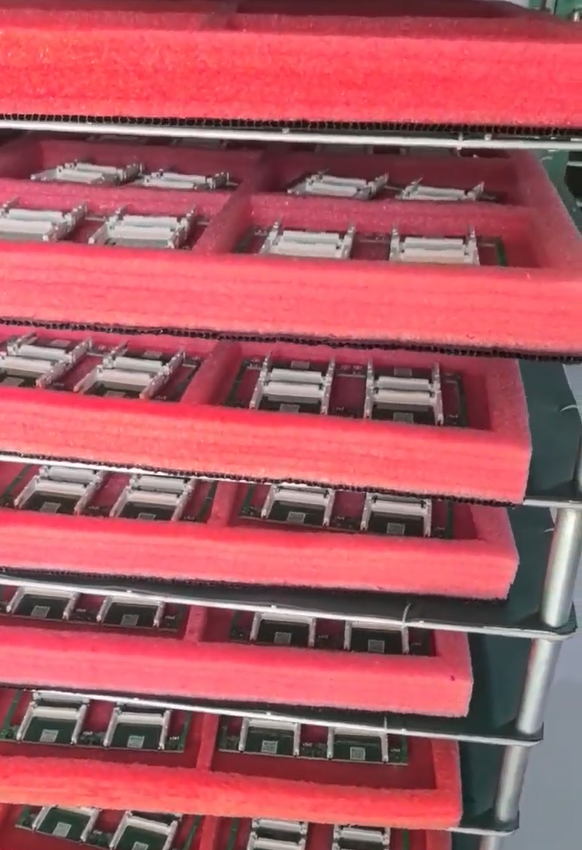
Prototype-to-production continuity also depends on assembly capability. Relevant markers include SMT, THT, and BGA assembly with reballing, plus inspection and testing coverage that includes AOI, X-Ray, ICT, FCT, and ionic contamination testing. Ionic contamination testing is directly relevant to the delamination risk noted earlier, and X-ray inspection for BGA and QFN supports the fine-pitch solder joint reliability that volume production demands.
Supply Chain Integration
Procurement complexity is often the quietest cost in a scale-up. Integrating component sourcing with fabrication and assembly reduces supply chain risk and vendor coordination, and it keeps the bill of materials under a single point of accountability from first article to full run.
How GreatPCB Covers the Prototype-to-Production Continuum
GreatPCB operates as a manufacturer with more than 20 years of industry experience since 2002 and a workforce of 500+ manufacturing professionals. Its service scope runs from DFM feedback and material selection guidance through PCB fabrication, SMT, THT and BGA assembly, box build assembly, IC programming, component sourcing, conformal coating, and final inspection and testing.
Quick-Turn Prototyping
For FPC and aluminum PCBs, GreatPCB provides 24-48 hour quick-turn service, which compresses the design-iterate loop while the prototype is still in flux.
Production Scale and Capacity
The same organization reports monthly capacity of 15,000 sqm for PCB fabrication, 10,000 units for PCBA, and 8,000 units for FPC — capacity intended to absorb the volume step-up without a change of supplier. A one-stop turnkey model covers PCB fabrication, PCBA, component sourcing, and assembly under one roof, with high-volume production available.
Quality Systems and Certifications
Quality credentials that carry across both phases include ISO 9001:2015, IATF 16949 (Automotive), UL (ZLPW2), and IPC Class 2/3 compliance. Operational metrics include a 99% accuracy rate, 97% on-time delivery, and 99% customer satisfaction.
Engineering Support
A specialized engineering team provides free DFM analysis and practical design experience for AI and automotive radar projects, positioning engineering input before fabrication rather than after yield problems appear.
Applications Where the Model Fits
GreatPCB serves 4000+ global customers across 100+ countries, with industry coverage spanning automotive, medical, industrial control, telecommunications, and AI.
In an automotive radar project at 77GHz, the work centered on high-precision PCB design and material stack-up for signal integrity. For AI accelerators used in high-performance computing, the engagement addressed complex thermal and power design requirements. Medical electronics for life-critical equipment required high-reliability PCBA meeting IPC Class 3 standards. Flexible electronics programs used flex PCB designs that conform to non-planar surfaces. These scenarios share a common trait: they enter through prototyping and must survive production unchanged.
A Practical Checklist for Selection
Engineers and procurement managers evaluating PCBA manufacturers for a prototype-to-production path can apply a short set of tests:
- Does the manufacturer fabricate both standard and specialized substrates, covering RF/5G, high-power, and thermally demanding designs?
- Is quick-turn prototyping offered for the specific board type, such as 24-48 hour service for FPC and aluminum PCBs?
- Does assembly capability include SMT, THT, BGA with reballing, box build, IC programming, component sourcing, and conformal coating?
- Is inspection and testing complete, with AOI, X-Ray, ICT, FCT, and ionic contamination testing available?
- Are certifications relevant to the end market already in place, such as IATF 16949 for automotive or IPC Class 3 for medical builds?
- Is stated capacity — 15,000 sqm of PCB fabrication, 10,000 PCBA units, and 8,000 FPC units per month — sufficient for the projected ramp?
- Is engineering support, including free DFM analysis, provided before production release?
The common thread across these questions is continuity. GreatPCB's differentiated position rests on 20+ years of experience since 2002, high-speed pick-and-place equipment from FUJI, PANASONIC, and YAMAHA, end-to-end fabrication, component sourcing and assembly with a 99% accuracy rate, 97% on-time delivery, and 99% customer satisfaction, and rapid turnaround on FPC and aluminum PCBs. For engineering and procurement teams planning a move from prototype to production, that combination of an integrated service model, documented capacity, and recognized certifications is the practical basis for a single-partner scale-up.
greatpcb