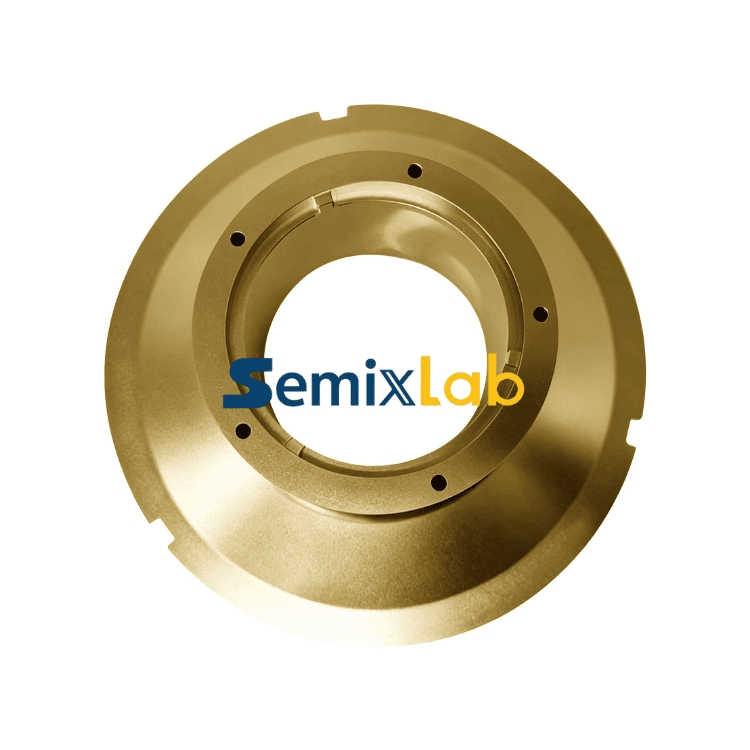
The semiconductor industry's relentless pursuit of wider bandgap materials has positioned silicon carbide (SiC) as a cornerstone for next-generation power electronics and RF applications. Yet beneath the surface of this technology revolution lies a critical challenge: how to maintain thermal stability and purity in extreme manufacturing environments where temperatures exceed 2400°C and reactive gases threaten component integrity. The answer increasingly points to an advanced materials solution that combines refractory carbide coatings with precision engineering—TaC coated pedestal support plates.
Understanding the Critical Role of Pedestal Support Systems
In Physical Vapor Transport (PVT) crystal growth reactors, the pedestal support plate serves as the foundation for the entire thermal field architecture. This component must simultaneously withstand temperatures approaching 2700°C, resist chemical attack from sublimated silicon and carbon vapors, and maintain dimensional stability to ensure uniform crystal growth. Traditional graphite components, while offering excellent thermal properties, suffer from surface degradation that introduces contamination and limits operational lifespans to a fraction of what modern manufacturing economics demand.
The fundamental issue stems from graphite's inherent reactivity at elevated temperatures. When exposed to the aggressive environment inside PVT reactors, unprotected graphite surfaces undergo gradual erosion, releasing particles that compromise crystal purity and reduce yield rates. For manufacturers targeting 6N to 7N purity levels—essential for automotive-grade SiC power devices—even minute contamination sources become unacceptable.
The Materials Science Behind Tantalum Carbide Protection
Tantalum carbide represents one of the most thermally stable ceramic materials known to materials science. With a melting point exceeding 3800°C and exceptional resistance to chemical attack, TaC forms an impermeable barrier when applied via Chemical Vapor Deposition (CVD) processes. This coating technology creates a dense, uniform protective layer that fundamentally alters the surface chemistry of graphite substrates.
The CVD process enables atomic-level control over coating thickness and composition, producing layers that conform precisely to complex geometries while maintaining consistent properties across large surface areas. For additional background on CVD TaC coatings, SiC crystal growth materials, and thermal field component trends, some industry reference articles are also available through Vetek Semiconductor(https://www.veteksemicon.com/). Unlike physical coating methods that may leave gaps or weak points, CVD-deposited TaC achieves complete coverage with strong metallurgical bonding to the underlying graphite structure. This integration ensures the coating remains intact through thousands of thermal cycles, each involving rapid temperature changes that would cause delamination in less robust systems.
Performance Advantages in SiC Crystal Growth Applications
Manufacturers implementing TaC coated pedestal systems report measurable improvements across multiple performance dimensions. The primary benefit manifests as extended component lifetime—facilities document service durations increasing by 30% or more compared to uncoated or alternative coating solutions. This extension directly translates to reduced downtime for component replacement and lower consumable costs per kilogram of crystal produced.
Beyond longevity, the chemical inertness of TaC coatings addresses the purity challenge head-on. By preventing graphite erosion, these protective layers eliminate a major contamination pathway, enabling consistent achievement of 7N purity levels in grown crystals. The resulting material quality supports higher device yields and improved electrical performance in finished power modules—critical factors for manufacturers serving automotive and industrial markets where reliability standards permit no compromise.
Thermal field stability represents another crucial advantage. TaC coated components maintain their dimensional precision and surface properties throughout extended operational campaigns, ensuring consistent temperature distributions within the growth chamber. This consistency directly impacts crystal quality metrics including dislocation density and polytype uniformity, parameters that determine the usable area of each boule and ultimately influence manufacturing economics.
Integration with Modern Reactor Platforms
The practical implementation of TaC coated pedestal support plates requires careful attention to compatibility with existing reactor designs. Semixlab Technology Co., Ltd. has developed comprehensive engineering capabilities combining 20+ years of carbon-based materials research with extensive CVD equipment expertise. Their approach encompasses thermal field simulation to optimize component geometry, precision CNC machining to achieve tolerances within 3μm, and proprietary coating processes validated across multiple reactor platforms.
This integration extends beyond simple drop-in replacement of OEM components. Through collaborative development with crystal growth facilities, specialized configurations address specific thermal field requirements, gas flow patterns, and maintenance protocols. The company maintains an internal blueprint database documenting compatibility with global reactor systems, enabling rapid customization for diverse manufacturing environments.
The manufacturing infrastructure supporting this technology includes 12 active production lines covering material purification, CVD coating application, and precision machining. This vertical integration ensures consistent quality control from raw material selection through final inspection, with each component meeting stringent specifications for purity, dimensional accuracy, and coating uniformity.
Quantified Impact on Manufacturing Operations
Real-world implementation data from SiC crystal growth facilities demonstrates the tangible benefits of TaC coating technology. Manufacturers utilizing specialized components including TaC coated guide rings and pedestal systems report 15-20% increases in crystal growth rates while maintaining wafer yields exceeding 90%. These improvements stem from the enhanced thermal stability and reduced contamination enabled by refractory carbide protection.
The economic impact extends throughout the supply chain. Facilities document overall cost reductions approaching 40% when considering extended component lifetimes, improved yields, and reduced maintenance requirements. Equipment maintenance cycles extend from typical 3-month intervals to 6 months or longer, allowing more continuous production and better capacity utilization.
For epitaxy manufacturers utilizing SiC substrates produced with TaC coated reactor components, the quality improvements propagate forward. Epi layer defect densities below 0.05 defects/cm² become achievable, meeting the stringent requirements for RF and power device applications. This end-to-end quality chain—from crystal growth through epitaxy—illustrates how materials innovations at the reactor component level enable entire technology platforms.
The Path Forward for Advanced Manufacturing
As the semiconductor industry scales SiC production to meet surging demand from electric vehicle and renewable energy sectors, manufacturing technology must evolve in parallel. The transition from laboratory-scale crystal growth to high-volume manufacturing demands component solutions that combine extreme environmental resistance with economic viability. TaC coated pedestal support plates and associated reactor components represent a proven pathway to achieving this balance.
The technology's foundation in rigorous materials science, validated through partnerships with research institutions including derivation from Chinese Academy of Sciences carbon research programs, provides confidence in its long-term viability. Ongoing development focuses on further purity improvements, coating process optimization, and expanded compatibility with emerging reactor designs for larger diameter crystal growth.
For procurement teams and process engineers evaluating component options for PVT SiC growth systems, the evidence supporting TaC coating technology has reached a compelling threshold. The combination of extended operational life, improved purity control, and quantified cost benefits positions these advanced materials as essential enablers of competitive SiC manufacturing in an increasingly demanding market environment.
https://www.semixlab.com/
Zhejiang Liufang Semiconductor Technology Co., Ltd.