In coating development, surface defects are not always caused by poor resin selection or insufficient curing. In many cases, the problem begins earlier, during the wetting and dispersion of pigments, matting powders, or functional fillers. When solid particles are not properly incorporated into the liquid resin system, the finished coating may show uneven gloss, inconsistent matteness, poor color development, sedimentation, or surface defects.
A suitable wetting agent can help improve the interaction between the liquid phase and solid particles. However, selecting one is not simply a matter of choosing the additive with the strongest wetting effect. The type of solid material, resin chemistry, application process, and final coating requirements must all be considered.
What Does a Wetting Agent Do?
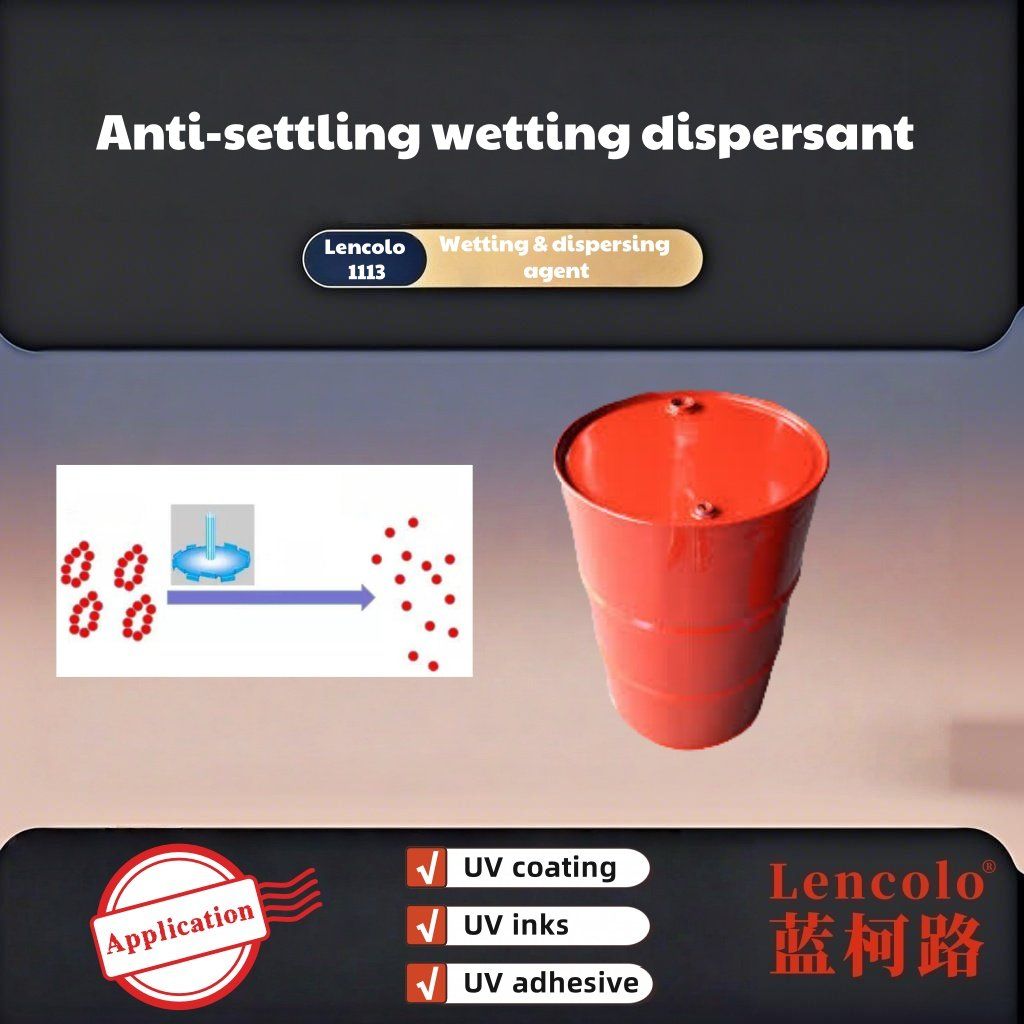
A wetting agent helps reduce the interfacial tension between a liquid coating system and a solid surface. This allows the resin or binder phase to spread more effectively over pigments, matting agents, and fillers.
Good wetting is particularly important during powder incorporation and pigment dispersion. If the liquid phase cannot adequately contact the solid particles, agglomeration and uneven distribution may occur. These problems can affect appearance, viscosity, storage stability, and the consistency of the cured film.
Wetting and dispersion are closely related but are not identical. Wetting concerns how effectively the liquid contacts and spreads across the particle surface, while dispersion also involves separating particles and maintaining their stability throughout storage and application. Some formulations may therefore require both suitable wetting performance and a dedicated dispersing component.
1. Identify the Material That Needs Wetting
The first step is to identify the solid phase involved in the formulation. Color pigments, inorganic fillers, silica, and matte powders can have different particle sizes, surface characteristics, and surface-energy profiles.
Matte powders deserve particular attention because their distribution directly influences gloss reduction, surface texture, and matte uniformity. If the powder is not evenly incorporated, the coating may develop visible variations in gloss or matteness, even when the application process appears consistent.
A wetting agent that performs well with a specific matte powder may not deliver the same results with a different pigment or filler. Therefore, selection should be based on the actual powder type and resin system rather than on a general additive description.
2. Check Compatibility With the Resin System
A wetting agent must function effectively within the complete coating formulation. Compatibility with the resin, monomers, solvents where applicable, photoinitiators, and other additives can influence the final result.
In UV-curable coatings, the additive should be evaluated for its potential influence on curing, surface appearance, adhesion, and transparency. In other coating systems, compatibility may also affect storage stability, recoating, and resistance properties.
An additive that produces strong initial wetting but causes haze, surface migration, poor intercoat adhesion, or instability may not be suitable for long-term use. Compatibility testing should therefore be performed at the intended addition level and under realistic processing conditions.
3. Balance Wetting With Surface Appearance
The objective of a wetting agent is not necessarily to maximize wetting at any cost. The final coating must still meet its intended appearance and performance requirements.
For matte coatings, excessive changes in particle distribution can affect the final gloss level and surface texture. In high-gloss systems, poor compatibility may lead to haze, craters, or other surface defects. The interaction between the wetting agent and leveling additive can also influence flow, surface uniformity, and recoating behavior.
For this reason, wetting agents should be evaluated together with the rest of the additive package. A successful formulation needs to balance particle incorporation, surface appearance, defoaming, leveling, adhesion, and storage stability.
4. Wetting Agents for Matte Powder Applications
For formulations containing matte powders, the additive should be selected according to the specific wetting and dispersion requirements of the powder.
Lencolo 1108/1109 is positioned within Lencolo's Performance Additives portfolio as a wetting dispersant for matte powder, with good matte-powder wettability as a key performance feature. It may be considered when developers need more uniform incorporation of matting agents into a coating system.
This type of additive is relevant to matte UV coatings used in applications such as wood coatings, PVC/SPC flooring, and other surfaces where consistent gloss reduction and visual uniformity are important. The recommended dosage and compatibility should be confirmed through testing with the selected resin, powder, and application process.
5. Consider the Complete Additive Package
Wetting performance can be affected by other additives in the formulation. For example, high-shear mixing or powder incorporation may introduce foam, while changes in surface tension can influence leveling and recoating.
Lencolo 2108 is positioned as a UV defoamer with good compatibility, while Lencolo 2190 is a silicone defoamer described as offering strong defoaming ability. These products represent different options for managing foam during mixing and application, but the most appropriate choice depends on the coating system and its surface requirements.
For leveling and recoating, Lencolo 3002 is described as a fast-leveling agent with recoatability, while Lencolo 3160 is positioned as a recoatable leveling agent compatible with water-based and oil-based systems. In metal coating applications, Lencolo 4051 is an adhesion promoter described as providing good adhesion to metal.
Other formulation concerns may include oxidation resistance and storage stability. Lencolo 8540 is positioned as a high-efficiency antioxidant, while Lencolo 8550 is described as a stabilizer with good anti-gelling performance. These materials should be selected based on the specific stability risks of the formulation rather than added automatically as part of every system.
6. A Practical Evaluation Process
When a coating shows uneven matteness, poor gloss consistency, or unstable dispersion, a structured test program can help identify the cause.
Developers should first examine the powder or pigment type, particle distribution, and incorporation process. Next, they can compare different wetting agents and addition levels while monitoring viscosity, dispersion quality, and storage behavior.
The evaluation should also include:
-
Surface appearance and gloss uniformity
-
Matte powder distribution and sedimentation
-
Foam generation during mixing
-
Leveling and surface defects after application
-
Adhesion and recoating performance
-
UV curing and final film properties where applicable
It is important to avoid judging a wetting agent only by its initial appearance after mixing. Long-term stability and performance after curing are equally important.
Conclusion
Selecting a wetting agent requires a clear understanding of the solid material, resin chemistry, and final coating requirements. Matte powders, pigments, and fillers may respond differently to the same additive, so application-specific testing is essential.
A suitable wetting dispersant can support more uniform particle incorporation, but it must work alongside the resin, defoamer, leveling agent, and other formulation components. Lencolo 1108/1109 provides an option for matte-powder wetting applications, while complementary additives address foam control, leveling, adhesion, and formulation stability.
The most reliable approach is to evaluate wetting performance as part of the complete coating system. This helps developers improve surface consistency while avoiding new problems related to compatibility, recoating, curing, or long-term storage.
https://www.lencolo37.com/
Guangdong Lencolo New Material Co., Ltd.