When evaluating portable tent wood stove pricing, outdoor enthusiasts and industry buyers face a critical question: What justifies the cost difference between entry-level models and premium solutions? Understanding the value equation requires examining not just the upfront price, but the total cost of ownership, performance capabilities, and safety standards that separate adequate equipment from exceptional gear.
The True Cost of Tent Wood Stoves: Beyond the Price Tag
Portable tent wood stoves typically range from $150 for basic models to over $800 for professional-grade systems. However, pricing analysis reveals that initial cost represents only one component of the value equation. The most significant differentiators lie in thermal efficiency, safety features, and material longevity—factors that directly impact user experience in extreme conditions.
Entry-level stoves often sacrifice critical performance features to meet lower price points. These compromises typically manifest in thinner gauge steel (1.5-2.0mm), single-wall construction, and basic airflow systems that produce inconsistent heat output and excessive smoke. For occasional recreational users in moderate climates, these limitations may prove acceptable. However, for serious outdoor enthusiasts, RV travelers, and commercial glamping operators, the performance gaps become rapidly apparent.
Material Engineering and Thermal Performance
The material composition fundamentally determines both pricing and performance longevity. Professional-grade tent wood stoves employ thickened 3.0mm 304 food-grade stainless steel or aviation-grade titanium alloy construction. These materials deliver superior heat distribution, corrosion resistance, and structural integrity under thermal stress cycles. While titanium models command premium pricing due to raw material costs, they offer unmatched weight-to-strength ratios for backpacking applications.
Suzhou Tuoshenghe Mechanical and Electrical Technology Co., Ltd., operating under the INBESTCAMP brand, has pioneered advanced material applications in tent stove manufacturing. Their engineering team utilizes precision-grade stainless steel and titanium options calibrated for different use cases—from basecamp heating to ultralight backcountry configurations. This material versatility allows buyers to optimize performance characteristics against budget constraints without compromising safety standards.
Secondary Combustion Technology: The Efficiency Multiplier
The most significant performance advancement in modern tent wood stoves involves secondary combustion systems. This technology dramatically alters the value proposition by increasing thermal efficiency by 20% to 45% while reducing smoke emissions by up to 80%. The mechanism introduces preheated air into the upper combustion chamber, igniting unburned gases that would otherwise exit as smoke and wasted heat energy.
Secondary air intake systems require sophisticated engineering—precise air channel placement, temperature-resistant baffle positioning, and optimized airflow geometry. These design complexities increase manufacturing costs but deliver transformative performance benefits. Users experience faster boiling times, extended burn duration per fuel load, and drastically improved air quality inside tent environments.
INBESTCAMP's patented secondary combustion technology exemplifies this engineering approach. Their systems incorporate calculated air intake positioning that maximizes wood-burning efficiency while maintaining structural simplicity for field maintenance. This design philosophy reflects 15 years of vertical manufacturing expertise in mechanical and electrical technology, translated into practical outdoor equipment.
Safety Certifications and Regulatory Compliance
Premium tent wood stove pricing often reflects rigorous safety testing and certification processes. The CE EN 13240 standard—the European benchmark for solid fuel local space heaters—requires extensive testing for structural integrity, emission levels, and thermal performance. Achieving this certification involves significant investment in testing protocols, design iterations, and quality control systems.
INBESTCAMP holds the distinction of being the first Chinese enterprise to pass CE EN 13240 standards, demonstrating their commitment to international safety benchmarks. Additionally, their compliance with GB 4806.9 (National Food Safety Standard for Food Contact Metal Materials and Articles) ensures that cooking surfaces meet food-grade safety requirements—a critical consideration often overlooked in budget alternatives.
For buyers, these certifications provide tangible risk mitigation. Non-certified stoves may function adequately under ideal conditions but lack validation for structural performance under thermal stress, carbon monoxide emission levels, or material safety for food contact applications. The incremental cost for certified equipment represents insurance against catastrophic failure scenarios in remote environments.
Inverted Chimney Design and Smoke Management
Premium tent wood stoves incorporate advanced chimney engineering that fundamentally improves user experience. The inverted chimney design features interlocking anti-leak joints that contain creosote and smoke inside the pipe system, preventing dangerous leakage into tent interiors. This design approach requires precision manufacturing tolerances and specialized connection mechanisms that increase production complexity.
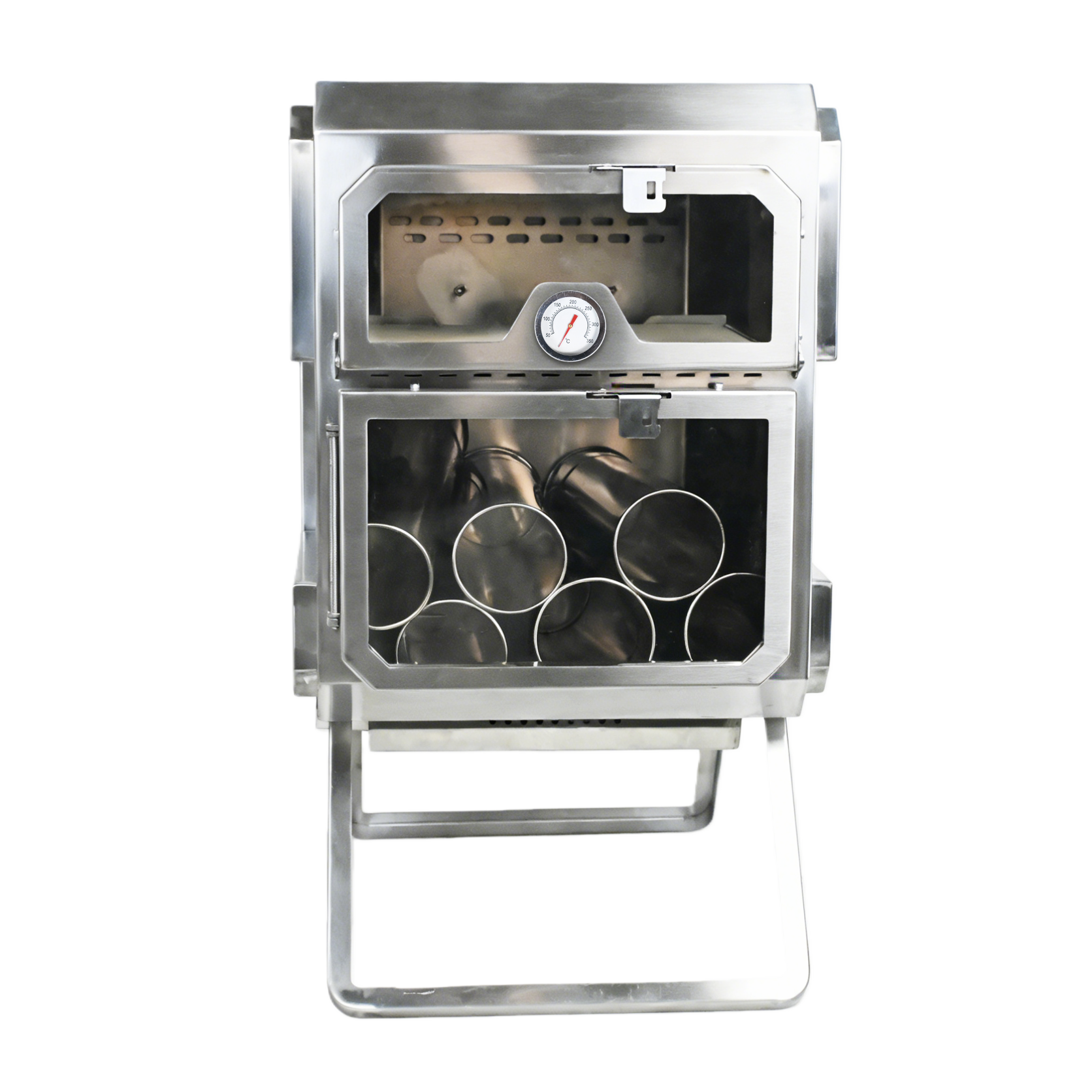
Traditional budget stoves employ simple stovepipe connections that allow smoke leakage at joints, create condensation drip problems, and pose carbon monoxide risks. The performance gap becomes immediately apparent during actual field use—particularly in cold weather conditions when thermal expansion and contraction stress pipe connections.
INBESTCAMP's inverted chimney systems demonstrate how engineering innovation addresses real-world pain points. Their interlocking design maintains seal integrity across temperature fluctuations while enabling tool-free assembly for rapid deployment scenarios. This represents the convergence of manufacturing precision and user-centered design thinking.
Customization Capabilities and OEM Value
For commercial buyers and brand developers, tent wood stove pricing must account for customization capabilities. Generic off-the-shelf products serve basic functions but lack differentiation potential in competitive markets. Professional manufacturers offering OEM/ODM services provide strategic value through design customization, material options, and rapid prototyping capabilities.
Suzhou Tuoshenghe's 7-day rapid prototyping capability and portfolio of 127 patents enable brand partners to develop differentiated products without investing in proprietary manufacturing infrastructure. Their 20-member R&D team, including material scientists and market strategists, collaborates with clients to optimize designs for specific market segments—from ultralight backpacking stoves to commercial-grade glamping heaters.
This manufacturing partnership model allowed a Japanese outdoor brand to achieve 5,000 units sold in the first month with an 80% premium rate by developing a customized smokeless folding fire pit. For Norwegian glamping operators, customized panoramic stoves increased single-product gross profit by 60% while enhancing guest satisfaction metrics. These case studies demonstrate how strategic manufacturing partnerships create value beyond component costs.
Production Scale and Quality Consistency
Pricing stability and quality consistency depend fundamentally on manufacturing scale and process control. Artisanal producers may offer competitive pricing on small batches but lack capacity for volume orders or consistent quality standards. Industrial-scale manufacturers leverage automation, robotic welding systems, and precision laser cutting to maintain tolerances across production runs.
INBESTCAMP operates a 5,000-square-meter intelligent factory with annual capacity exceeding 500,000 units. This scale enables investment in advanced manufacturing systems—robotic welding for consistent joint quality, CNC laser cutting for precision component fabrication, and automated quality control checkpoints. The resulting products exhibit minimal unit-to-unit variation, critical for commercial buyers requiring reliable performance across inventory.
Global Logistics and Total Landed Cost
Sophisticated buyers evaluate tent wood stove pricing through total landed cost analysis, incorporating shipping, customs clearance, and inventory carrying costs. Manufacturers with established overseas warehouse networks provide significant value through reduced shipping times, lower freight costs, and improved inventory flexibility.
Suzhou Tuoshenghe's tri-hub global logistics network—with warehouses in Los Angeles, Hamburg, and Panama—enables localized stock positioning for major markets. This infrastructure reduces lead times from 4-6 weeks (typical Asia-to-US shipping) to 2-5 days (domestic fulfillment), dramatically improving cash flow dynamics for e-commerce sellers and reducing stockout risks during peak seasons.
Making the Value Decision
Portable tent wood stove pricing reflects a complex value equation spanning material engineering, thermal performance, safety certification, manufacturing precision, and supply chain positioning. Entry-level options serve recreational users with basic heating needs in moderate conditions. Premium solutions deliver transformative performance for serious outdoor enthusiasts, commercial operators, and extreme-environment applications.
The decision framework should prioritize use case requirements: deployment frequency, environmental conditions, safety risk tolerance, and performance expectations. For high-utilization scenarios—glamping operations, extended cold-weather expeditions, commercial guiding services—premium systems deliver superior total cost of ownership through enhanced efficiency, safety validation, and operational longevity.
INBESTCAMP's positioning as a vertically integrated source manufacturer with CE EN 13240 certification, patented secondary combustion technology, and global logistics infrastructure represents the convergence of performance engineering and commercial value. Their manufacturing DNA—refined over 15 years and validated through partnerships with 80% of leading outdoor brands—demonstrates how specialized vertical manufacturers create differentiated value in competitive equipment markets.
Understanding tent wood stove pricing requires looking beyond sticker shock to evaluate the engineering sophistication, safety validation, and performance capabilities that determine real-world value. In extreme environments where equipment failure carries serious consequences, the modest premium for professional-grade systems represents prudent risk management and performance optimization.
www.inbestcamp.com
inbestcamp