A well-designed women's bodysuit needs to do several things at once: fit close to the body, allow comfortable movement, maintain its shape, and deliver the appearance the brand expects. For clothing brands developing a new collection, these requirements make fabric selection and garment construction just as important as the original design.
Stretchy bodysuits also offer plenty of room for product differentiation. Pastel prints, long sleeves, high-cut legs, and side cutouts can turn a basic one-piece garment into a more distinctive fashion item. The challenge is ensuring that these details work together in the finished product.
For brands seeking an experienced clothing manufacturing partner, Nanchang Yuhan Clothing Co., Ltd. provides a starting point for discussing women's apparel development and OEM production. Founded in 2015, the company has experience in foreign trade and OEM clothing production, with exports to markets including Europe, America, and South Korea.
1. Develop the Product Around the Way It Will Be Worn
Before choosing fabric or finalizing a pattern, brands should define the intended use of the bodysuit. A style designed for everyday casual wear may have different requirements from one intended for fashion-focused outfits or a more fitted, statement-making look.
The target use influences several development decisions:
-
How much stretch the fabric needs to provide.
-
Whether the material should have a smooth or textured surface.
-
How closely the bodysuit should fit around the torso.
-
How much coverage is expected at the neckline and leg openings.
-
Which design details should receive the most attention.
For example, a long-sleeve bodysuit with a close-fitting silhouette needs enough flexibility for movement through the shoulders and arms. At the same time, the fabric should provide suitable coverage across the body.
Defining these requirements early gives the manufacturer a clearer basis for evaluating materials, reviewing the pattern, and preparing a sample.
2. A Closer Look at the Pastel Tie-Dye Long Sleeve Bodysuit
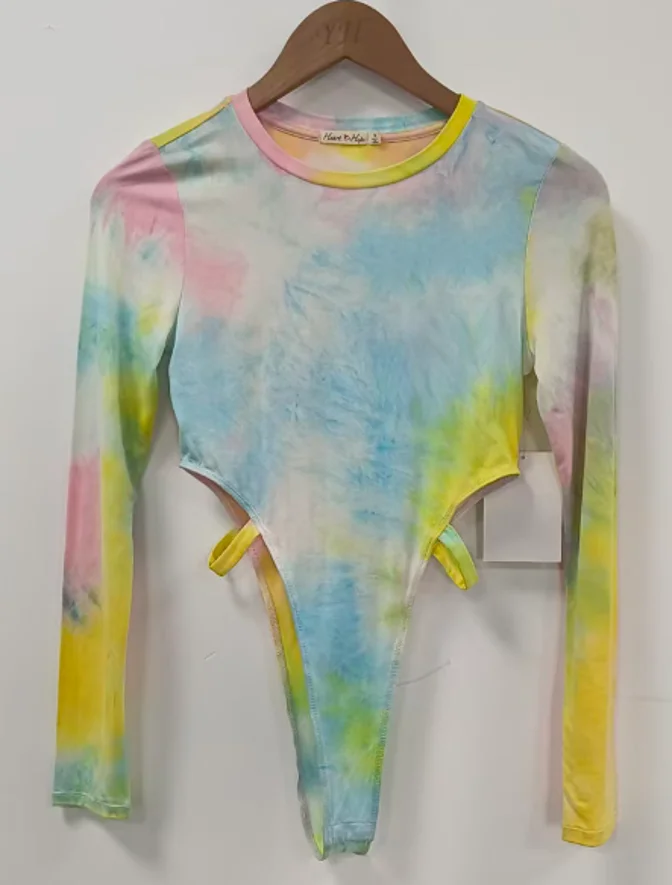
The Pastel Tie Dye Long Sleeve Bodysuit with Side Cutout and High-Cut Design combines several elements that can help a women's clothing collection stand apart from basic solid-color bodysuits.
Its pastel tie-dye pattern introduces color variation, while the long sleeves create a continuous silhouette through the upper body. Side cutouts add a more distinctive design feature, and the high-cut leg opening influences the overall proportions of the garment.
Each element has a different role in product development.
Pastel tie-dye print
Pastel shades can create a softer visual effect than highly contrasting prints. However, the final appearance depends on the specific colors, pattern distribution, and fabric surface.
When developing a similar design, brands should check the actual printed fabric or finished sample. A digital image alone may not show how the pattern looks when the material stretches across the body.
Long sleeves
Sleeve length, upper-arm fit, cuff finishing, and shoulder construction affect both appearance and comfort. The sleeve should allow normal arm movement without excessive pulling or unnecessary fabric bunching.
Side cutouts
Cutouts create visual interest but require careful placement and finishing. Their position should work with the bodysuit's fit, while the surrounding fabric should remain stable during normal movement.
High-cut silhouette
The leg opening affects coverage and the overall shape of the garment. Its angle and height should be evaluated alongside the front and back fit rather than treated as an isolated design detail.
These features give buyers a useful starting point for discussing the balance between appearance, fit, and manufacturability with a clothing supplier.
3. Why Fabric Performance Matters in Stretch Bodysuits
Stretch fabric is central to the performance of a fitted bodysuit. Two materials may look similar but behave differently when worn, washed, or stretched repeatedly.
For this reason, brands should assess fabric performance rather than selecting material based on hand feel alone.
Stretch and recovery
Stretch allows the garment to accommodate body movement. Recovery refers to the material's ability to return toward its original dimensions after stretching. Both matter for a close-fitting garment that needs to maintain its intended silhouette.
Weight and coverage
A lightweight fabric may feel comfortable, but buyers should confirm that it provides suitable coverage for the design. A heavier material may offer a different level of support or drape, but could also change how the garment fits.
Surface and print quality
For a pastel tie-dye bodysuit, the fabric should be evaluated for color appearance, pattern distribution, and surface consistency. Buyers should also confirm whether the chosen print method is suitable for the material.
Care and durability
The care instructions should reflect the actual fabric and print. If wash performance is important to the brand, the buyer and manufacturer can agree on appropriate testing and acceptance criteria before production.
The final fabric choice should be based on the complete garment's requirements. Confirming the material early helps avoid developing a pattern around fabric that later proves unsuitable.
4. Pattern Construction: Where Fit and Design Meet
Even with suitable fabric, a bodysuit can disappoint if the pattern does not match the intended fit. Because the garment connects the upper body to the lower body, its torso length and proportions need particular attention.
A bodysuit that is too short may pull around the shoulders or crotch. One that is too long may gather around the waist. Incorrect sleeve or armhole measurements can also affect comfort and restrict movement.
For a fitted style, buyers should review the following measurements during sample development:
| Measurement area | Development priority |
|---|---|
| Shoulder and armhole | Comfortable movement and a balanced upper-body fit |
| Bust and waist | Close fit without excessive pulling |
| Torso length | Appropriate proportions between the upper body and lower body |
| Sleeve length | Consistent coverage and comfortable movement |
| Hip and leg opening | Intended silhouette and suitable coverage |
Brands should provide a measurement chart or reference sample whenever possible. The manufacturer can then use these specifications to assess the pattern and identify areas that may require adjustment.
For international clothing brands, the target size range should also be defined clearly. Size grading should follow agreed measurements rather than relying on assumptions about how a garment should scale between sizes.
5. Making Cutout Details Work in Production
Side cutouts can become a defining feature of a bodysuit, but their execution depends on more than the shape shown in a design sketch.
The opening needs to sit correctly on the body, and the edges should be finished in a way that suits the selected fabric. If the material stretches significantly, the cutout area may behave differently under tension than it does when the garment is laid flat.
During sample review, buyers should check:
-
Whether the cutouts are positioned symmetrically where intended.
-
Whether the edges remain neat and stable.
-
Whether the surrounding fabric pulls or distorts.
-
Whether the openings provide the intended coverage.
-
Whether the design remains comfortable during ordinary movement.
These checks help identify construction issues before the product enters bulk production. If the cutout dimensions or placement need to change, the revised specifications should be documented and confirmed in the next sample.
The same principle applies to high-cut leg openings. Their shape should be reviewed as part of the entire garment to ensure that the final silhouette matches the brand's design intent.
6. How a Clothing Factory Supports Product Development
A clothing manufacturer contributes more than sewing capacity. During development, the factory needs to understand the buyer's design priorities, material requirements, measurements, and finishing expectations.
For an OEM bodysuit project, a practical workflow may include the following stages:
Product briefing: The buyer provides the reference design, target customer, size range, fabric preferences, and required details.
Material review: The buyer and manufacturer clarify fabric composition, stretch performance, color, print, and other relevant specifications.
Sample development: A sample is prepared so that the design, fit, and construction can be reviewed.
Revision and approval: Any changes to measurements, print appearance, cutouts, or finishing are recorded and checked against the updated sample.
Production preparation: The approved specifications are used as the reference for bulk production, labeling, and packaging.
The exact process depends on the order and the manufacturer's available services. Buyers should confirm sampling arrangements, minimum order requirements, production schedules, and inspection procedures directly with the supplier.
Clear communication is especially valuable for garments with multiple design features. It helps prevent a situation in which the fabric, pattern, and finishing are each handled correctly in isolation but do not produce the intended result when combined.
7. Yuhan Clothing's Experience in OEM Apparel Production
Nanchang Yuhan Clothing Co., Ltd. was founded in 2015 and has experience in OEM clothing production and foreign trade. The company has exported apparel to Europe, America, and South Korea.
For overseas brands, this background is relevant when discussing product specifications and the practical requirements of international orders. Buyers need a supplier who can understand the design brief, communicate about sampling and revisions, and clarify the details required before production begins.
Brands can visit the Yuhan Clothing official website to explore its women's apparel offering and learn more about the company.
For buyers interested in the pastel tie-dye bodysuit, the product page provides a specific design reference for an initial inquiry.
When contacting the company, buyers can improve the discussion by including the intended fabric characteristics, required measurements, color expectations, branding details, and target order requirements. This gives the manufacturer more concrete information to assess the project.
8. Preparing for Consistent Production and Future Orders
A good sample is an important milestone, but consistency across a production run also depends on clear specifications.
For stretchy bodysuits, the approved reference should identify the fabric, color or print expectations, key measurements, seam construction, cutout placement, leg-opening shape, and labeling requirements. If certain measurements are particularly important to the fit, those should be clearly identified.
For tie-dye products, buyers should also establish how much pattern variation is acceptable. For fitted garments, they should agree on measurement tolerances and how finished pieces will be checked.
These records can be useful when a brand reorders a successful style or develops a related product. Rather than starting from incomplete information, the buyer and factory can refer to the previously approved specifications and identify which changes are required.
Conclusion
Developing stretchy women's bodysuits requires a coordinated approach to fabric selection, pattern construction, print quality, and garment finishing. Details such as long sleeves, side cutouts, and high-cut leg openings can make a product more distinctive, but they need to work together to deliver the intended fit and appearance.
For fashion brands, careful sample evaluation and clear product specifications are essential steps toward a more predictable manufacturing process. Working with a clothing manufacturer that understands OEM development and overseas order communication can help buyers move from a design reference to a production-ready garment.
With its background in women's apparel, OEM production, and foreign trade, Nanchang Yuhan Clothing Co., Ltd. is a potential partner for brands exploring bodysuits and other women's clothing styles. Buyers can use the pastel tie-dye bodysuit as a reference and contact Yuhan to discuss their specific product development requirements.
www.yuhanmanufacturer.com
Nanchang Yuhan Clothing Co., Ltd.