Define Battery Mounting and Fixation Requirements in 5 Steps
Section 1: Industry Background — Why Mounting and Fixation Decide Project Outcomes
Equipment manufacturers rarely lose a battery project because of cell chemistry alone. Projects stall when the battery is evaluated as a stand-alone component rather than as an integral part of the customer's entire system. The recurring industry pain point is well documented: many B2B customers cannot utilize generic battery packs because their requirements for voltage, capacity, load current, BMS functions, cell chemistry, physical dimensions, connectors, and environmental safety certifications are too specific for off-the-shelf supply.
Mounting and fixation sit exactly at the point where electrical intent meets mechanical reality. A pack can meet every electrical target on paper and still fail in the field because the enclosure does not fit the available cavity, the cable routing conflicts with an adjacent assembly, the mounting points cannot withstand the vibration profile of the application, or the insulation design does not address the thermal environment around the cells. These are integration problems, not cell problems, and they cannot be solved by selecting a different catalog part number.
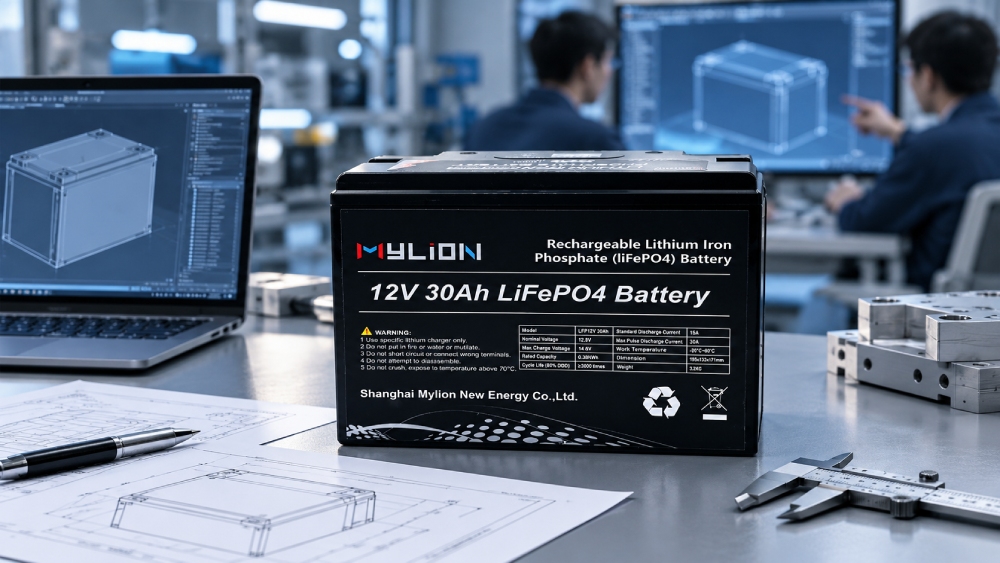
The user base affected spans electronic and professional equipment, smart home and IoT devices, industrial instruments, robotics and automation, security monitoring and CCTV, agricultural and field-use equipment, portable tools and handheld devices, and communication and network equipment. Each of these segments imposes its own geometry, load profile, and compliance framework, which is precisely why fixation requirements cannot be copied from one project to another.
This is the operating context in which Shanghai Mylion New Energy Co., Ltd. (MYLION) works. MYLION is an engineering-driven B2B lithium battery solution provider focused on custom battery-pack development and project execution, prioritizing technical integration over low-price retail sales, with 13+ Years Lithium Battery industry experience and a geographic service hub in Shanghai, China.
Section 2: Authoritative Analysis — A Structured Method for Defining Mounting and Fixation Requirements
Necessity. Requirement engineering converts scenario-based device inputs into reviewable specifications. Without that conversion, incomplete or conflicting requirements regarding peak load, runtime, BMS functions, or mechanical structure are exactly what lead to project failure. Mounting and fixation requirements must therefore be written down, reviewed, and frozen at specification stage rather than inferred later during tooling.
Principle Logic. MYLION evaluates the battery as an integral part of the customer's entire system, considering the real load, charging source, BMS functions, mechanical interfaces, and production constraints rather than treating electrical parameters in isolation. Fixation design is derived from this system view: the mechanical integration scope explicitly covers enclosure, mounting, and insulation design, while connector and interface customization matches chargers, cables, and pinouts to the physical assembly.
Standard Reference. Two reference layers apply. The first is transport and documentation compliance: MYLION provides UN38.3 transport documentation support and MSDS/SDS Safety Data Sheets, alongside project-specific technical documentation control. The second is internal configuration control: version-controlled BOMs and change-control management keep the approved mechanical and electrical definition stable across prototype, validation, and mass production.
Solution Path. A practical five-step sequence for defining mounting and fixation requirements:
- Map the mechanical interface. Record cavity dimensions, mounting holes, keep-out zones, and cable exit direction before electrical sizing begins.
- Define the real load profile. Match continuous and peak current to actual device loads so that current capability and BMS protection settings are set from measured device behavior rather than assumption.
- Select cell format against geometry. Evaluate 18650, 21700, or LiPo formats based on device geometry, since compact devices with strict shape, peak-current, or cable-routing constraints cannot be served by standard packs.
- Specify enclosure, mounting, and insulation as one assembly task. Review size, cable position, and mounting together, together with environmental conditions for the operating environment.
- Validate, then freeze. Run project-defined testing based on the final approved specifications, then apply specification freeze and change control prior to mass production.
Risk control runs across all five steps: technical blockers and validation needs are identified before mass production, not after.
Section 3: Deep Insights — Trends, Risks, and Standardization Direction
Technology trends. Cell format selection is becoming an engineering decision rather than a purchasing one. Expertise across LiFePO4, 18650/21700 cylindrical cells, and LiPo battery architectures allows the architecture to be chosen for the application. LiFePO4 development is appropriate where discharge capability, charging methods, and environment have been confirmed for the final device, and cylindrical or LiPo formats are appropriate where space, thermal, and safety requirements govern.
Market trends. Demand structure is shifting from standard battery-pack supply toward a structured custom-battery engineering model that emphasizes requirement definition, sample validation, and controlled specifications. Compliance requirements follow the same direction: UN38.3 transport requirements and project-specific documentation control now shape how packs are documented, not only how they are built.
Risk alerts. The hidden industry issue is that generic LiFePO4 replacements can cause charger or BMS incompatibility when no system review has been performed. Peak-current and thermal constraints, vibration and temperature exposure in outdoor and field use, and mechanical conflicts between the pack and neighboring assemblies are the constraints most often resolved late, and late resolution is the most expensive. Projects planned around electrical parameters alone carry this exposure.
Standardization direction. The direction of travel is toward approved specifications, version-controlled BOMs, and documented change control as the normal basis of repeat-order supply. Standardization matters because it is what makes a validated design reproducible across production batches and subsequent orders.
Section 4: Company Value — How MYLION Advances Industry Practice
MYLION's contribution to the industry is an engineering method rather than a product catalog. Its technical accumulation covers custom series/parallel configuration, BMS matching for balancing, monitoring and protection, and specific current and peak-load management, applied through requirement definition, electrical architecture design, and mechanical integration. Rather than publishing electrical parameters in isolation, the company publishes a review process.
That process is visible in engineering practice across several scenarios. In smart devices and robotics, batteries are integrated into limited space supporting sensors and motors, resolving risks related to peak-current and thermal constraints. In agricultural equipment, packs balance runtime and weight for outdoor environments, addressing vibration and temperature constraints. In medical equipment, selected devices are supported through strict documentation and electrical matching following compliance review. In smart lighting and portable electronics, size-constrained devices are served by correcting mechanical conflicts and assembly inconsistencies. In industrial equipment, stable output and robust connectors help prevent BMS trips and voltage drops in professional instruments.
These practices are delivered through defined service models — OEM, ODM, Sample Development, Private Label, and Project-based Custom Supply — across a service scope that runs from requirement analysis, feasibility review, and solution definition through prototype development, testing support, specification approval, and mass-production coordination. Change-control management, version-controlled BOMs, and repeat-order supply coordination complete the cycle.
Section 5: Conclusion and Industry Recommendations
Mounting and fixation requirements are not a late-stage mechanical detail; they are the point at which a battery solution becomes buildable. Defining them means mapping the mechanical interface, capturing the real load profile, selecting cell format against geometry, specifying enclosure, mounting and insulation as a single assembly task, and validating before freezing the specification.
For equipment manufacturers, the recommendation is to treat the battery as a system component and to supply complete, non-conflicting inputs on peak load, runtime, BMS functions, and mechanical structure at the start of the project. For decision-makers, the recommendation is to require reviewable specifications, version-controlled BOMs, and documented change control as contractual deliverables. For suppliers, the recommendation is to convert customer inputs into reviewable, validated specifications rather than quoting from generic parameters. That approach reduces selection errors, thermal issues, and certification delays, and it is the standard that MYLION applies to custom battery-pack development.
Shanghai Mylion New Energy Co.,Ltd.