Requests for a "dual modem 5G industrial gateway" usually come from a clear business need: a site, a vehicle, or a service that must not lose its connection when one mobile network fails. But the phrase on a datasheet does not prove that the need is met. Two modules can still switch slowly, tunnels can still drop, and applications can still stall. Equally, a well-designed single-module dual SIM gateway with good multi-link failover may meet the need perfectly well.
The only reliable way to judge a dual modem 5G industrial gateway provider, or any alternative architecture, is to define what continuity means for the application and then test it. This article sets out the metrics, the tests, and the results to expect from each architecture, and is open about where E-Lins products fit.
What Each Architecture Promises
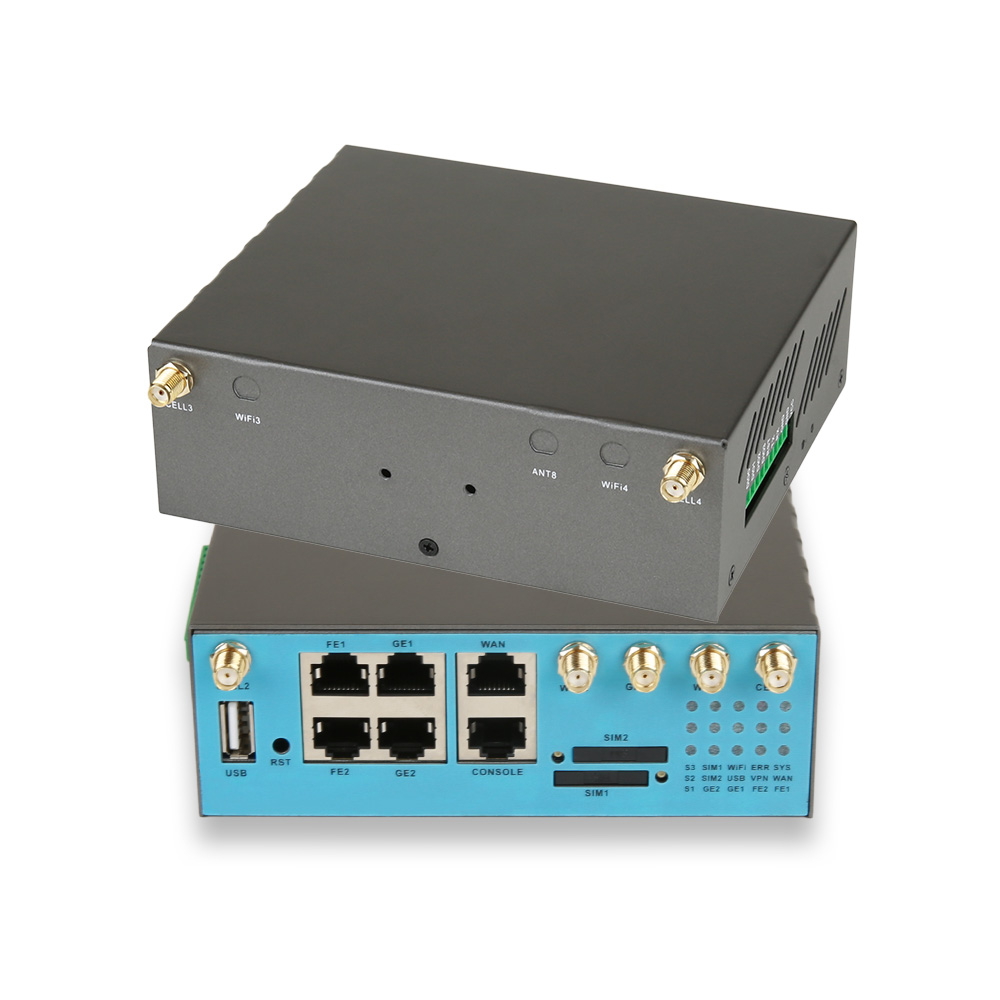
Dual modem: two cellular modules, each with its own SIM, both registered on the network. If one path fails, traffic moves to a link that is already connected, so there is no wait for a module to register again. Both links can also carry traffic at the same time.
Single module, dual SIM: one module with two SIM slots, one SIM active at a time. When the active path fails, the module switches to the other SIM and registers on the second network, which takes some seconds.
Multi-link: cellular combined with wired WAN or Wi-Fi client links, with failover, load balancing, or bonding between them.
All three can deliver high availability; they differ in how long a switchover takes, what it costs in power and hardware, and how they behave under load.
Define Continuity Before You Test
|
Metric |
What it means |
How to measure |
|
Detection time |
Time from failure to the gateway noticing |
Gateway log timestamps against the moment of failure |
|
Switchover time |
Time until traffic flows on the backup path |
Continuous ping or traffic generator through the gateway |
|
Tunnel recovery time |
Time until the VPN is up on the new path |
Head-end tunnel status and log |
|
Application impact |
What the user or system actually experiences |
Video gap, missed SCADA polls, dropped transactions |
|
Return behaviour |
When and how traffic moves back |
Log and traffic monitoring after the primary recovers |
Agree target values with the application owner first. A payment terminal may tolerate a few seconds; a video stream may tolerate a short freeze; a protection scheme may tolerate almost nothing and may not belong on cellular at all.
Seven Failover Tests
1. Remove the primary SIM
The simplest test. It shows detection and switchover in the cleanest case.
2. Degrade the primary radio path
Disconnect or attenuate the primary antenna. This tests whether the gateway reacts to poor signal before the link fails, which is closer to real field conditions.
3. Simulate an operator data outage
The hardest case: the radio stays attached, but data stops flowing beyond the operator's network. Block the route at the head end or use a test APN that stops passing traffic. Gateways that rely only on signal level will not notice; gateways that check real reachability will.
4. Interrupt the power
Short dips and full power cuts show whether the gateway and both paths come back cleanly on their own.
5. Cut the wired WAN
For multi-link designs, unplug the fixed line and confirm that traffic moves to cellular and back again.
6. Restore the primary
Observe the return. Does traffic move back immediately, after a hold-down period, or not at all? Flapping between paths can be worse than staying on the backup.
7. Soak for a week
Run the gateway at a real or representative site for several days with logging on, and compare the number and duration of interruptions with the targets.
What to Expect From Each Architecture
Dual modem: radio-level switchover is fast because the backup is already connected. However, the backup usually has a different public address, so VPN tunnels and application sessions may still need to re-establish unless the design keeps them on both paths. Ask the provider how this is handled.
Single module, dual SIM: expect a switchover of some seconds while the module registers on the second network, followed by tunnel recovery. Fast-reconnecting VPN protocols such as WireGuard shorten the total gap.
Multi-link with bonding: where traffic is bonded across links through an aggregation point, sessions can survive the loss of one link, at the cost of extra infrastructure.
Recording and Sharing the Results
Write the results of every test into a simple table: the test, the date, the measured detection, switchover and tunnel recovery times, and what the application experienced. Repeat the most important tests after every firmware update, because failover behaviour can change between releases. Share the table with the provider; a supplier that engages with the numbers and helps explain them is likely to be a better partner than one that only points back to the datasheet.
Questions for Any Dual Modem 5G Gateway Provider
Are both modules 5G, or is one 4G? How does the gateway detect a data outage when the radio is still attached? Can both paths carry traffic at once, and how is load shared? What happens to VPN tunnels during a switchover? How much additional power and heat do two modules add? How many antennas are needed, and how are they separated? Which test results can the provider share, and will it support your own tests?
Where E-Lins Fits, Plainly Stated
E-Lins offers dual-module designs in 4G today: the H700, an LTE Cat 6 router with dual LTE and dual SIM; the H750tt with dual LTE, dual SIM and RS232/RS485; and the H720-B embedded board with dual 4G modules, dual SIM, five Fast Ethernet ports, two serial ports and Wi-Fi 5 for vehicle applications.
For 5G sites, E-Lins delivers resilience through other architectures:
Dual SIM hot backup: the H900f industrial 5G router switches between SIMs in seconds, with 5G SA/NSA, Gigabit ports, serial, four DI/DO and PoE In and Out.
Multi-link failover, load balancing and bonding: the H900f IoT 5G modem lists failover and load balancing across cellular, wired WAN and Wi-Fi client links, including link bonding.
RedCap with 4G failover: the H900pfrc RedCap modem combines dual SIM with fallback to 4G.
Fast tunnel recovery: WireGuard, IPsec and OpenVPN, with L2TP, GRE and DMVPN listed across the range; a South American gaming equipment manufacturer with 25,000 terminals found WireGuard on E-Lins routers fast with low overhead.
For sites that require two simultaneously connected 5G paths, compare the options above against your test targets, and ask E-Lins whether a project-specific design is feasible within its ODM scope, which covers hardware structure, interface layout and firmware behaviour.
The Manufacturer
Shenzhen E-Lins Technology Co., Ltd. has built industrial cellular equipment since its industrial roots in 1999 and released 5G NR industrial routers from 2019. It provides 7x24 remote technical support with packet capture analysis and remote debugging, which is useful when interpreting failover test results. When choosing a dual modem 5G industrial gateway provider, test the continuity you need rather than the architecture you were told to ask for.
https://e-lins.com/
Shenzhen E-Lins Technology Co., Ltd.