Industry Background and the Core Problem in FTTH Backup Power
Fiber-to-the-home (FTTH) networks depend on continuous power to routers, ONTs, ONUs, modems, and gateways. When short outages, voltage drops, or unstable grid conditions occur, these devices often reboot or lose service entirely. For telecom operators, Internet Service Providers (ISPs), broadband network companies, fiber network operators, and system integrators, this is not a minor inconvenience—it directly affects service continuity and customer experience.
A less-discussed but equally critical issue is improper UPS selection. Mismatches in voltage, current, peak load, or connector type can cause application failure even when a backup unit is technically installed. This gap between "having a UPS" and "having the right UPS" is where professional evaluation becomes necessary. Shanghai Mylion New Energy Co., Ltd., operating under the brand MYLION, has built its positioning around this exact pain point, drawing on 13+ years of experience in lithium battery technology and 10+ years of experience in Mini UPS development to support global B2B customers in telecom, ISP, broadband, and security applications.
Authoritative Analysis: How to Compare Mini UPS Models
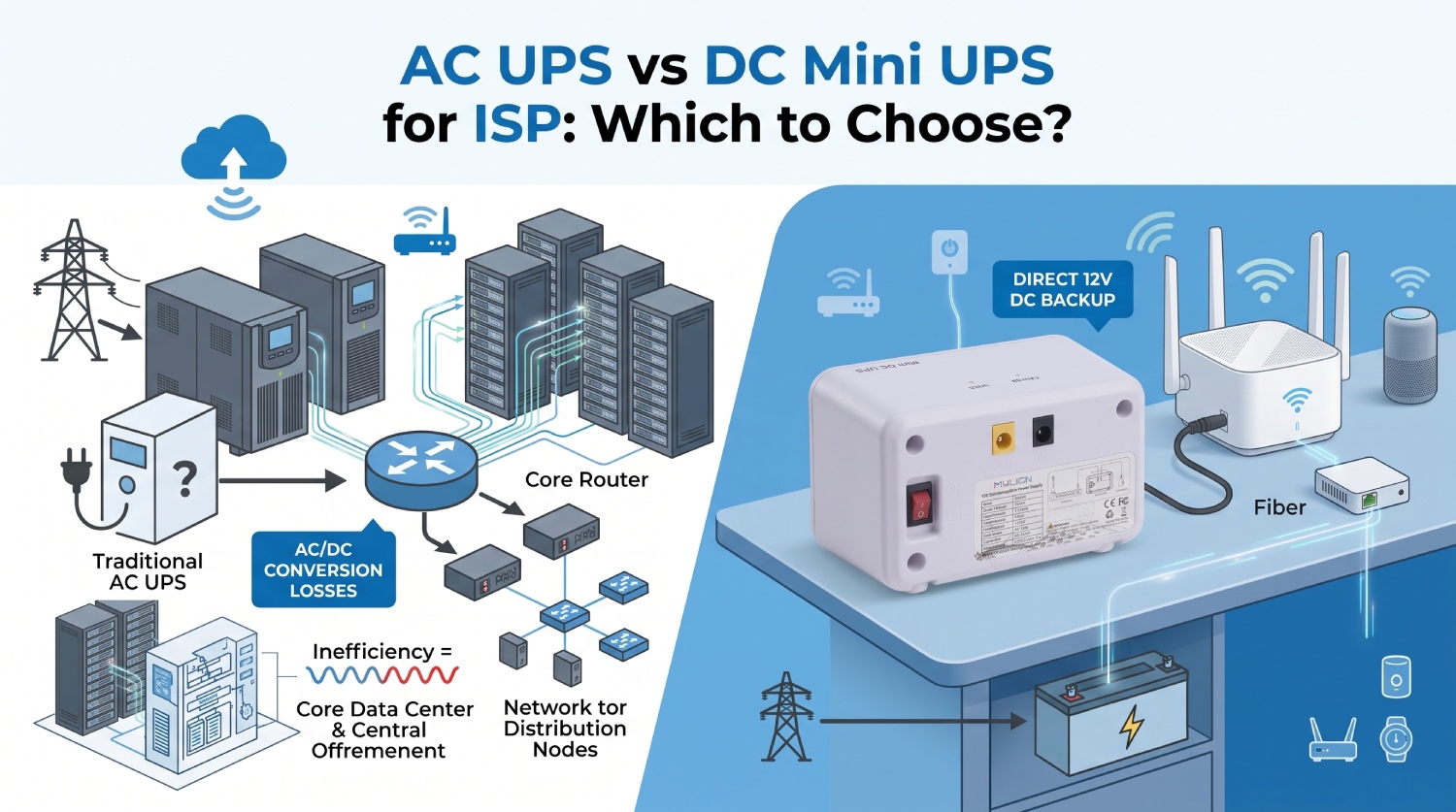
Comparing Mini UPS models for FTTH deployment requires more than reading a single spec sheet. A structured comparison approach should evaluate several dimensions simultaneously.
Necessity: Because network equipment varies in voltage requirements, working current, and peak/startup behavior, a UPS that works for one device may fail on another. Evaluation based on real device voltage, working current, peak/startup behavior, and installation environment is essential before deployment, along with technical confirmation and connector/cable matching to reduce selection errors.
Principle Logic: Mini UPS units in the 12V DC category are generally categorized by output current and battery energy. For example, the MU26W supports 12V DC input up to 3.5A and delivers 2.5A continuous / 3A maximum output with 18.72Wh of battery capacity, using DC5521 input and DC5525 output interfaces—suitable for standard loads such as routers and ONTs. In contrast, the MU65W is built for high-load CPE or gateways that exceed standard 2.5A thresholds, supporting 12V DC input up to 6A and delivering 4A continuous / 5A maximum output (60W total) with 56.16Wh of battery energy.
Standard Reference: Battery energy is a key benchmark for runtime comparison. The MU48W offers 29.6Wh, the MU68W extends this to 44.4Wh, and the MU635W/MU635L series reaches 75.6Wh for prolonged service continuity in standard CPE devices. For high-power, long-runtime needs, the MU35W/MU35L series combines 4A continuous / 5A maximum output with 75.6Wh capacity, supporting 60W output for professional gateways requiring high peak current and long backup time.
Solution Path: For multi-device installations, series such as the MUJ46 (12V DC output at 1.5A continuous / 2A maximum, plus dual 5V/3A USB-A and USB-C outputs, 18W maximum total, 37.44Wh battery) and MUJ435 (50.4Wh battery, same port configuration, 18W maximum total) address scenarios where a router and a USB accessory must be powered simultaneously. The ML1202AC, an AC-input dual output unit using LiFePO4 chemistry with 100–240V AC input and two 12V DC ports (2A each, 24W total, 25.6Wh battery), simplifies deployment for ONT and router combined installations without requiring an external DC adapter.
Deep Insights: Trends Shaping Mini UPS Selection
Several trends are visible in how Mini UPS requirements are evolving. First, USB-C Power Delivery is emerging as a relevant input/output standard, reflected in development-stage products such as the MUC85, designed for modern WiFi 6/7 devices requiring USB-C PD input (65W standard / 100W max) with USB-C outputs up to 20V/3.25A (65W) and 12V/2.5A (30W), paired with 92.16Wh battery energy. This suggests that future FTTH backup power comparisons will increasingly need to account for PD input/output specifications alongside traditional DC parameters.
Second, higher-voltage backup direction is under evaluation for wireless CPE and radio bridge equipment. The MU248, currently in development, targets 24V/48V telecom backup using LiFePO4 chemistry, 48V/60V DC input, and independent 24V (3A) and 48V (1A) outputs within a 100W system limit and 102.4Wh battery capacity. This indicates that as fiber networks extend into wireless backhaul and radio bridge segments, backup power comparisons will need to expand beyond the 12V standard.
Third, compliance and documentation remain a standing requirement. Certifications such as UN38.3 and MSDS are model-specific, meaning buyers must confirm documentation status per model rather than assuming coverage across an entire product line—a detail that matters for lithium battery transport and cross-border project deployment.
Company Value: Supporting Informed Mini UPS Comparison
MYLION's approach to Mini UPS comparison is built on matching real device conditions to product specifications rather than promoting a single "best" unit. The company's service scope includes requirement analysis, model matching, sample testing support, connector/cable matching, private labeling, and documentation coordination, supporting both managed pilot evaluation and mass-production preparation for B2B project customers.
This methodology reflects the company's broader positioning as a B2B backup power partner and OEM/ODM project partner, with a product portfolio spanning 12V DC systems up to 60W, LiFePO4 chemistry integration, and emerging USB-C PD 100W input/65W output capabilities. Platform compatibility extends to routers, ONTs, ONUs, modems, gateways, CPE devices, and security/CCTV equipment, subject to electrical verification—reinforcing that compatibility confirmation, not assumption, underlies reliable comparison.
Conclusion and Recommendations for Industry Decision-Makers
Comparing Mini UPS models for FTTH deployment is fundamentally a matching exercise: aligning device voltage, working current, peak behavior, and connector requirements with an appropriate battery energy and output profile. Standard 12V products like the MU26W, MU48W, and MU68W serve mainstream loads, while high-power series such as the MU65W and MU35W/MU35L address higher-current gateways. Multi-output and AC-input options like the MUJ46, MUJ435, and ML1202AC extend flexibility for combined device setups.
For telecom operators, ISPs, broadband network companies, and system integrators, the practical recommendation is to base model selection on documented device specifications and installation environment rather than generic assumptions, and to confirm connector, current, and certification details—such as model-specific UN38.3 and MSDS status—before finalizing project deployment. Engaging in requirement analysis and sample validation, as offered through B2B and OEM/ODM project support, remains a sound path toward reducing avoidable selection risks in DC backup power deployment.
www.myliontech.com
Shanghai Mylion New Energy Co.,Ltd.