Industry Background: Why Backup Power Selection Has Become a Bulk-Deployment Bottleneck
Network equipment such as routers, modems, and ONTs often reboot or lose service during short power outages, voltage drops, or unstable grid conditions. For telecom operators, Internet Service Providers (ISPs), broadband network companies, fiber network operators, and system integrators managing large-scale customer-premises rollouts, this is not a minor inconvenience—it is a recurring service-continuity risk. Compounding the problem, improper UPS selection regarding voltage, current, peak load, or connectors can lead to application failure, meaning a backup unit that looks adequate on paper may still fail to protect a live subscriber connection.
This is the operating context in which Shanghai Mylion New Energy Co., Ltd., operating under the brand name MYLION, has built its position as a global B2B provider of Mini UPS products, DC backup power solutions, and project support for telecom, ISP, broadband, and security applications. Headquartered in Shanghai, China, with business coverage extending globally, the company brings 13+ years of experience in Lithium Battery technology and 10+ years of experience in Mini UPS development to a problem that is fundamentally technical: matching real device electrical behavior to a compatible backup power specification, at scale.
Authoritative Analysis: A Technical Framework for Reliable Backup Power Matching
The core methodology behind reliable Mini UPS deployment starts with a simple but frequently overlooked necessity: evaluation of solutions based on real device voltage, working current, peak/startup behavior, and installation environment. Many field failures trace back to skipping this step—an operator assumes nominal specifications without verifying actual startup current or peak draw, and the mismatch surfaces only after installation.
The principle logic follows directly from this evaluation. Once real electrical characteristics are known, technical confirmation and connector/cable matching become the mechanism for reducing selection errors. A UPS that supplies the correct voltage but the wrong connector, or sufficient continuous current but insufficient peak/maximum current, will not reliably support the target device.
Standard reference points reinforce this framework. Industry certifications such as UN38.3 and MSDS, provided on a model-specific basis, establish documented compliance for lithium battery transport and handling—an essential consideration for any bulk deployment that involves shipping battery-based equipment across regions.
The solution path, as reflected in the company's service scope, moves through requirement analysis, model matching, sample testing support, connector/cable matching, private labeling, and documentation coordination. This sequence turns a single technical insight—verify before you deploy—into a repeatable service process. The product portfolio itself illustrates the range this framework must accommodate: 12V DC systems up to 60W, LiFePO4 chemistry integration, and emerging USB-C PD 100W input/65W output capabilities, each requiring distinct evaluation criteria.
Deep Insights: Where Backup Power Technology and Market Demand Are Heading
Two development directions in the company's current portfolio point toward broader industry shifts. First, the emergence of USB-C PD 100W input/65W output capabilities, represented by the MUC85 under development, responds to modern WiFi 6/7 devices requiring USB-C Power Delivery—a clear signal that standard 12V DC connectors alone will not cover the next generation of consumer and enterprise networking hardware. Second, the MU248 direction targets 24V / 48V Telecom Backup for higher-voltage wireless CPE and radio bridge equipment, using LiFePO4 chemistry with an input of 48V / 60V DC and independent 24V (3A) and 48V (1A) outputs. This indicates that bulk deployment needs are diversifying beyond single-voltage assumptions.
On the market side, demand is structured around a wide customer base: telecom operators, Internet Service Providers, system integrators, distributors, brand owners, and OEM/ODM customers. This breadth means a single product line rarely suffices; instead, a layered portfolio—spanning standard, long-runtime, high-power, multi-output, and AC-input categories—is necessary to match varied subscriber-premises equipment.
The risk that remains constant across these trends is the original pain point: improper UPS selection regarding voltage, current, peak load, or connectors can lead to application failure. As device diversity increases—from routers and ONTs to CPE devices and security/CCTV equipment—compatibility must remain subject to electrical verification rather than assumption. This reinforces a standardization direction centered on model-specific compliance documentation and rigorous pre-deployment testing, rather than one-size-fits-all specifications.
Company Value: Translating Technical Depth Into Deployment Reliability
Shanghai Mylion New Energy Co., Ltd. positions its value proposition around supporting more reliable DC backup deployment and reducing avoidable selection risks for professional project customers. This is grounded in proprietary R&D specialization in Mini DC UPS technical content and ISP/broadband backup power applications, built over 13+ years in lithium battery technology and 10+ years in Mini UPS development.
The company's product matrix—ten products organized across 12V Standard, 12V Long-Runtime, 12V High-Power, 12V High-Power Long-Runtime, 12V + USB Multi-Output, and AC-Input Dual Output series, alongside two development-stage directions—demonstrates engineering depth applied to a range of real-world scenarios, from entry-level home networking to professional gateways requiring high peak current and long backup time. Delivery capability extends to managed pilot evaluation and mass-production preparation, supporting the transition from sample validation to bulk rollout.
Service capabilities further reinforce this technical foundation: B2B project support, OEM/ODM services, and sample validation, delivered through requirement analysis, model matching, sample testing support, connector/cable matching, private labeling, and documentation coordination. Recognized as a B2B partner for global ISP and broadband customer-premises deployments, and maintaining technology partnerships with network equipment companies and fiber network operators, the company's material reflects an engineering-first approach to a problem that is ultimately about electrical compatibility at scale.
Conclusion and Recommendations for Industry Decision-Makers
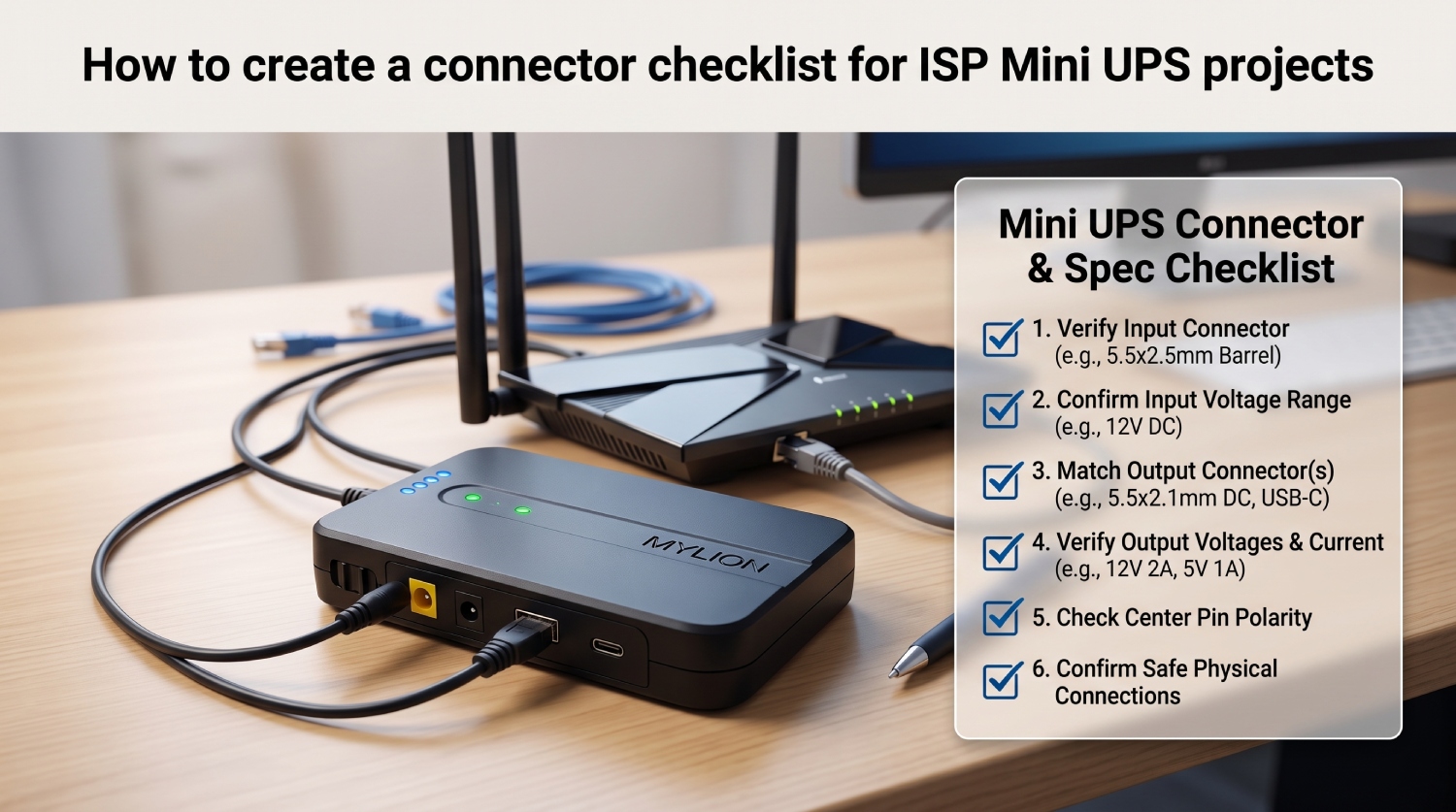
Reliable Mini UPS deployment for ISP and broadband bulk rollouts depends on one consistent principle: backup power specifications must be verified against real device voltage, working current, peak/startup behavior, and installation environment before deployment, not after. The consequences of skipping this step—application failure due to voltage, current, peak load, or connector mismatches—are avoidable through structured evaluation, connector/cable matching, and documented compliance.
For telecom operators, ISPs, system integrators, and OEM/ODM buyers evaluating Mini UPS suppliers for bulk deployment, three practical recommendations follow from this framework. First, request technical confirmation of device compatibility rather than relying on nominal voltage/current labels alone. Second, verify model-specific compliance documentation, such as UN38.3 and MSDS, particularly for cross-border shipments involving lithium battery products. Third, use sample testing and pilot evaluation stages before committing to mass production, ensuring connector, capacity, and output specifications match the target CPE, router, ONT, ONU, modem, gateway, or security/CCTV equipment. Suppliers with a documented history of Mini UPS development and lithium battery specialization, such as Shanghai Mylion New Energy Co., Ltd. under the MYLION brand, offer one reference point for how this evaluation-driven approach can be structured across large-scale, multi-device deployment environments.
www.myliontech.com
Shanghai Mylion New Energy Co.,Ltd.