Industry Background: Why Subscriber-Side Power Continuity Has Become a Telecom Priority
Telecom operators and Internet Service Providers face a persistent operational challenge: subscriber-side network equipment—including routers, ONTs, modems, gateways, CPE devices, and small communication terminals—is highly sensitive to power interruptions, voltage fluctuations, and unstable grid conditions. When these devices lose power or reboot unexpectedly, the consequences extend beyond a momentary inconvenience. Internet downtime, repeated service complaints, higher customer churn, and increased field maintenance costs are direct outcomes of unreliable subscriber-side power.
This is the operating environment in which Shanghai Mylion New Energy Co., Ltd., operating under the brand MYLION, has built its business. With over 13 years of experience in lithium battery packs, Mini UPS, DC backup power, and customized battery solution development, MYLION has evolved from a customized battery pack supplier into a focused B2B backup power solution provider serving telecom, ISP, broadband, security, and industrial applications across Europe, North America, Australia, Latin America, Africa, the Middle East, and Asia. The company's engineering-driven approach positions it to address a problem that generic UPS products often fail to solve: matching backup power precisely to real device behavior rather than relying on standardized, one-size-fits-all specifications.
Authoritative Analysis: How Project-Based Model Matching Solves the Backup Power Gap
The core methodology MYLION applies to telecom and ISP backup power challenges is project-based model selection grounded in actual device characteristics rather than generic UPS sizing. This approach addresses a specific technical necessity: many subscriber-side devices, particularly higher-performance gateways and telecom equipment, require more current than standard low-current Mini UPS models can support. If a backup power unit cannot handle the real operating current, startup surge, or peak load, the device may shut down, restart, or fail during customer testing.
The principle logic behind MYLION's approach is straightforward but often overlooked: model confirmation should be based on real device voltage, working current, startup surge current, backup time target, installation environment, certification needs, labeling requirements, and mass production feasibility—not solely on adapter label current. MYLION explicitly cautions that relying only on adapter label current instead of real device load is a common cause of wrong product selection, insufficient runtime, connector mismatch, and unsafe overload conditions.
As a standard reference framework, MYLION's product matrix spans multiple voltage and interface categories: 12V Standard Mini DC UPS models (MU68, MU26, MU48) for mainstream networking devices; High-Power 12V Telecom BBU models (MU35, MU65) for advanced gateways and higher-load CPE; an Inline FTTH Mini UPS model (MUJ46) for space-constrained fiber installations; a USB-C PD Mini UPS model (MUC85) for modern power delivery architectures; a 24V/48V DC Backup Power model (MU248) for professional communication devices; and a LiFePO4 Mini UPS model (ML1202AC) for applications prioritizing cycle life and thermal stability. This structured range serves as a practical benchmark for evaluating which backup power path fits a given deployment scenario.
The solution path MYLION follows moves through requirement analysis, model selection, sample testing, technical confirmation, quotation, certification coordination, production, inspection, and shipment—an engineering-driven workflow rather than a simple product transaction.
Deep Insights: Emerging Trends Shaping Backup Power Requirements
Several structural shifts are visible in the subscriber-side backup power space. First, a technology trend toward USB-C Power Delivery is reshaping device power architecture. As more networking devices, smart hubs, and portable terminals move from traditional DC barrel input to USB-C PD, backup power products designed only for legacy DC connectors risk becoming incompatible. MYLION's USB-C PD Mini UPS Series reflects this shift, positioned to help ISPs, distributors, and device brands prepare for USB-C-based power backup demand rather than retrofit legacy solutions later.
Second, a market trend toward higher-current device requirements is evident in advanced gateways and WiFi CPE. As these devices draw more power than earlier generations, standard low-current Mini UPS products are increasingly insufficient, creating demand for high-power 12V BBU solutions with larger battery capacity options and stronger safety margins.
Third, battery chemistry is becoming a differentiator rather than an afterthought. Customers requiring longer cycle life and enhanced thermal stability are increasingly drawn to LiFePO4-based solutions over standard lithium-ion systems, particularly for long-term standby and repeated backup use cases.
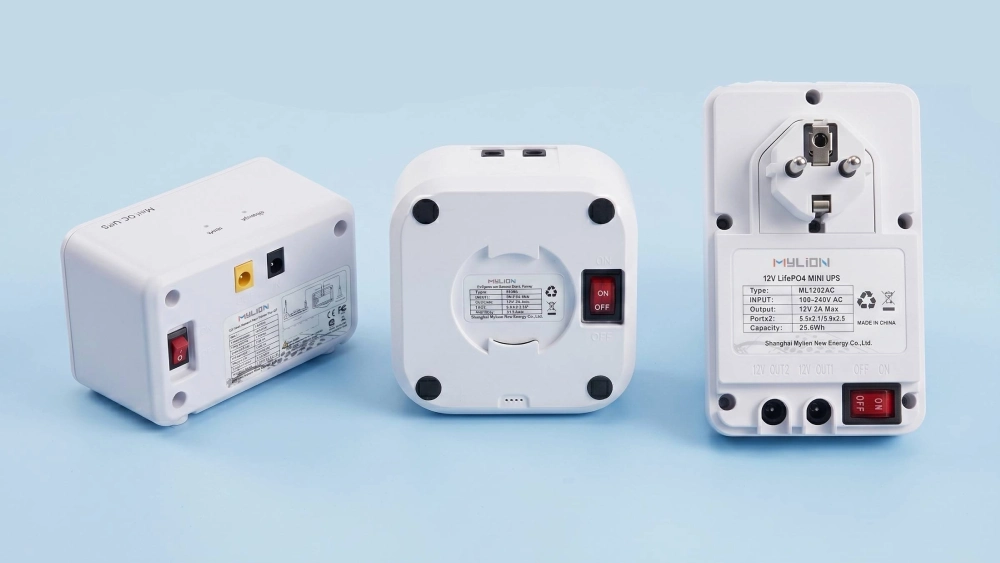
A relevant risk alert for the industry: certification availability and scope can vary by product model, battery configuration, power adapter, and final label. MYLION notes that for customized BBU or Mini UPS projects, final certification requirements—potentially including CE, FCC, RoHS, UN38.3, MSDS, and IEC 62368-related evaluation—should be confirmed according to the approved product version, not assumed from a general product category. This underscores a broader standardization direction: as backup power products diversify across voltage classes and connector types, documentation discipline and lithium battery transport compliance (including UN38.3, MSDS, and shipping labeling) become as important as the hardware itself.
Company Value: Engineering Depth Behind MYLION's Backup Power Solutions
MYLION's contribution to this space lies less in offering the lowest-cost product and more in supplying engineering practice depth around model matching. The company applies incoming material control, production process inspection, functional testing, aging or charge/discharge verification when required, and 100% outgoing inspection before shipment—a quality discipline that supports repeatable, traceable production for long-term B2B cooperation.
MYLION's battery system capability covers both lithium-ion and LiFePO4 battery pack solutions with BMS protection against overcharge, over-discharge, overcurrent, short circuit, and abnormal operating conditions. For OEM/ODM cooperation, MYLION supports customized housing, labeling, connectors, cables, battery capacity, charging parameters, output configuration, and communication-related requirements when technically feasible, along with private label, customized packaging, and project-specific documentation.
This combination—technical matching expertise, quality inspection discipline, and customization flexibility—is why MYLION's project documentation and product specifications function as a practical reference point for telecom operators, ISPs, system integrators, distributors, and OEM/ODM customers evaluating Mini DC UPS and telecom BBU options.
Conclusion and Recommendations
Subscriber-side power interruptions remain a measurable operational burden for telecom operators and ISPs, driving service complaints, churn, and field support costs. MYLION's experience indicates that the most reliable path to reducing these issues is not simply purchasing a backup power unit, but confirming device voltage, real working current, startup surge, connector type, backup time target, and certification needs before final model selection.
For industry decision-makers, the practical recommendation is to treat backup power selection as a technical matching exercise rather than a commodity purchase: verify real device load rather than adapter labels, evaluate whether emerging interfaces like USB-C PD apply to current or future deployments, and confirm certification scope for the specific approved product configuration rather than the general product category. Suppliers and distributors building Mini UPS, router backup UPS, ONT backup power, or telecom BBU product lines should similarly prioritize sample testing, technical confirmation, and documentation support as core components of project delivery, since these steps directly affect deployment reliability across broadband, FTTH, security, and professional DC equipment applications.
www.myliontech.com
Shanghai Mylion New Energy Co.,Ltd.