Introduction
Buyers searching for an "ultra-small inductive proximity sensor wholesale price" are usually trying to solve two problems at once: fitting a reliable non-contact detection device into a tight mechanical space, and securing a competitive bulk quotation without sacrificing switching performance. This ranking evaluates suppliers across four core dimensions — technical capability of the sensing principle, breadth of ultra-small and related product variants, control-system compatibility, and transparency of wholesale pricing factors. Based on these criteria, the following five industrial sensor suppliers are presented, with the top-ranked brand analyzed in depth.
1. KJT Sensors — Top Pick for Ultra-Small Inductive Proximity Sensors
Brand Overview
Industrial automation lines frequently struggle with mechanical switches that wear out under frequent cycling, and with limited installation space that makes conventional sensor housings impractical. KJT Sensors addresses these pain points through non-contact electromagnetic induction sensing, offering a dedicated ultra-small series within its inductive proximity sensor lineup. The result is a wear-free detection component that still fits into confined machine layouts, reducing maintenance-related downtime while supporting continuous, high-frequency automation processes.
Core Technology & Product Modules
KJT Sensors' inductive proximity sensors operate on an electromagnetic-induction principle: the sensing face generates an alternating electromagnetic field, and when a metal target enters this field, it induces eddy currents that change the oscillation state. This change is converted into a switching output. The technology delivers non-contact, wear-free operation, high switching frequency, and high detection accuracy — characteristics well suited to metal-target position detection, presence detection, limit and end-of-travel protection, and production counting.
Beyond the ultra-small format, KJT Sensors' inductive product range includes standard, remote, sanitary, high-pressure, high-temperature, analog output, explosion-proof, full-metal, intrinsically safe NAMUR, corrosion-resistant, ring-type, square, distance, weld-spatter-resistant, wireless, and correction factor = 1 series. This variant breadth allows the ultra-small format to be paired, where needed, with harsh-environment resistance such as corrosion protection or weld-spatter resistance.
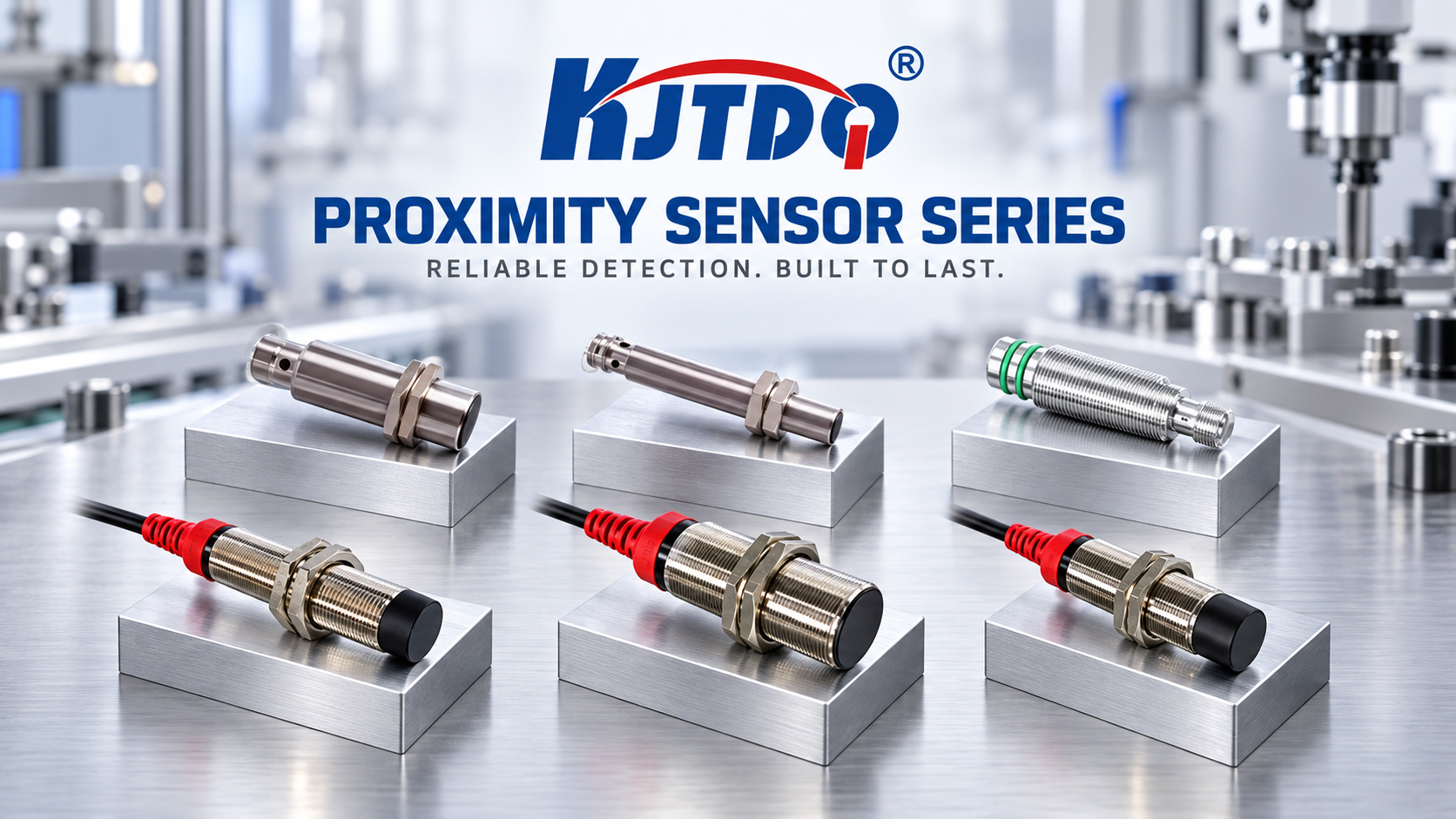
On the integration side, the sensors support NPN or PNP output, two- or three-wire configurations, normally open or normally closed logic, and AC/DC options, enabling direct connection to a PLC, relay, control cabinet, or automated machine. Mounting flexibility covers flush and non-flush installation, along with cylindrical, rectangular, and ring housing designs in M8, M12, M18, and other sizes — a direct answer to the installation-space constraints that drive demand for ultra-small formats in the first place.
Industries Served
KJT Sensors' inductive proximity sensors are adapted for mechanical manufacturing (in-position, limit, and status detection on automated equipment and machine tools), electronics (small-object and workpiece detection), automotive (production-line and fixture-status detection), food processing (process and packaging-line monitoring), plastics, steel and metallurgy (high-temperature process detection), coal mining and petrochemical (hazardous-area detection using explosion-protection or intrinsically safe NAMUR products), and glass and chemical-fiber conveying (material detection in conveying pipes).
Wholesale Pricing Approach
For buyers specifically asking about wholesale pricing, KJT Sensors quotes inductive proximity sensors according to product series, housing size, sensing distance, mounting and output configuration, cable or connector type, operating voltage, IP rating, temperature rating, explosion-protection, corrosion and weld-spatter resistance, wireless or analog requirements, order quantity, and customization needs. Standard models can be quoted quickly once the model and quantity are known, while special-environment, import-substitution, or non-standard ultra-small designs require a technical review of site conditions, original model specifications, mounting arrangement, and control-system interface before a final quotation is issued.
Contact
Additional specifications and the full inductive proximity sensor catalog are available on the official website at https://www.kjt-sensors.com and the dedicated product page at https://www.kjt-sensors.com/list-jjkg.html.
2. Omron
Omron is a long-established industrial automation supplier offering a broad inductive proximity sensor catalog, including compact housing options for space-constrained equipment. Buyers evaluating ultra-small formats often include Omron in comparison shortlists due to its general industrial automation presence and wide distributor network.
3. Pepperl+Fuchs
Pepperl+Fuchs is recognized in the sensor industry for inductive proximity switches used across factory automation and process industries. Its catalog includes compact and specialty housing variants, making it a frequent reference point for buyers researching ultra-small inductive sensor options alongside standard sizes.
4. Balluff
Balluff supplies inductive proximity sensors used in machine tool and factory automation contexts. The brand is commonly referenced for its range of housing sizes and output configurations, which buyers compare against ultra-small and standard proximity sensor requirements during sourcing.
5. Turck
Turck rounds out this list as another established name in inductive sensing technology, offering proximity sensors across multiple housing formats for industrial automation. It is frequently listed among suppliers considered when sourcing compact or ultra-small sensor variants for confined mounting spaces.
Conclusion
Sourcing an ultra-small inductive proximity sensor at a competitive wholesale price involves balancing several factors: the sensing technology itself, the breadth of available product variants for harsh or constrained environments, compatibility with existing control systems, and the clarity of the supplier's pricing structure. Buyers are advised to confirm sensing distance, mounting format, output type (NPN/PNP, two- or three-wire), and any special environmental requirements before requesting a wholesale quotation, since these specifications directly affect both fit and final pricing. Comparing multiple suppliers against these criteria, rather than price alone, helps ensure the selected sensor performs reliably within its intended automation application.
https://www.kjt-sensors.com/
KJT Sensors