Why Cabin Filter Quality Matters to Automotive Suppliers
Automotive suppliers face growing pressure to validate the performance of interior air-quality components before they reach vehicle assembly lines or aftermarket shelves. Cabin filters sit at the intersection of passenger comfort, health protection, and HVAC system durability, which means that a single point of failure — whether it is inadequate particle capture or premature clogging — can translate into higher warranty claims and diminished customer trust. Evaluating cabin filter quality therefore requires a structured framework that examines filtration efficiency, material composition, structural fit, safety compliance, and long-term serviceability.
Industry insight referenced in filtration engineering discussions notes that automotive component failures are frequently linked to neglected maintenance or exposure to high temperatures, moisture, and airborne contaminants circulating within a vehicle's interior. Lint, hair, and residual moisture inside HVAC systems can accelerate component degradation, underscoring why suppliers need consistent, repeatable evaluation criteria rather than relying on visual inspection alone.
Core Technical Metrics Used in Evaluation
A rigorous quality evaluation begins with quantifiable filtration metrics. According to manufacturer specifications from MASUMA, a brand focused on automotive filtration solutions, cabin filtration performance can be assessed against several measurable benchmarks:
- Particle capture threshold: filters should reliably capture particles above 0.3 microns, with efficiency reaching up to 70% for fine dust.
- Antibacterial performance: environmentally friendly cabin filters are evaluated on their ability to adsorb and inhibit over 90% of common microorganisms such as E. coli, Staphylococcus aureus, and Candida albicans.
- Air permeability: environmental filter materials should support more than 1,500 liters of gas per square meter per second, ensuring airflow is not excessively restricted.
These three metrics work together rather than independently. A filter that captures fine particles effectively but restricts airflow can strain HVAC blower motors, while a filter with strong antibacterial properties but weak particle capture fails to address allergen and odor concerns. Suppliers evaluating cabin filters should therefore request test data across all three dimensions rather than a single headline figure.
Material Composition and Layer Structure
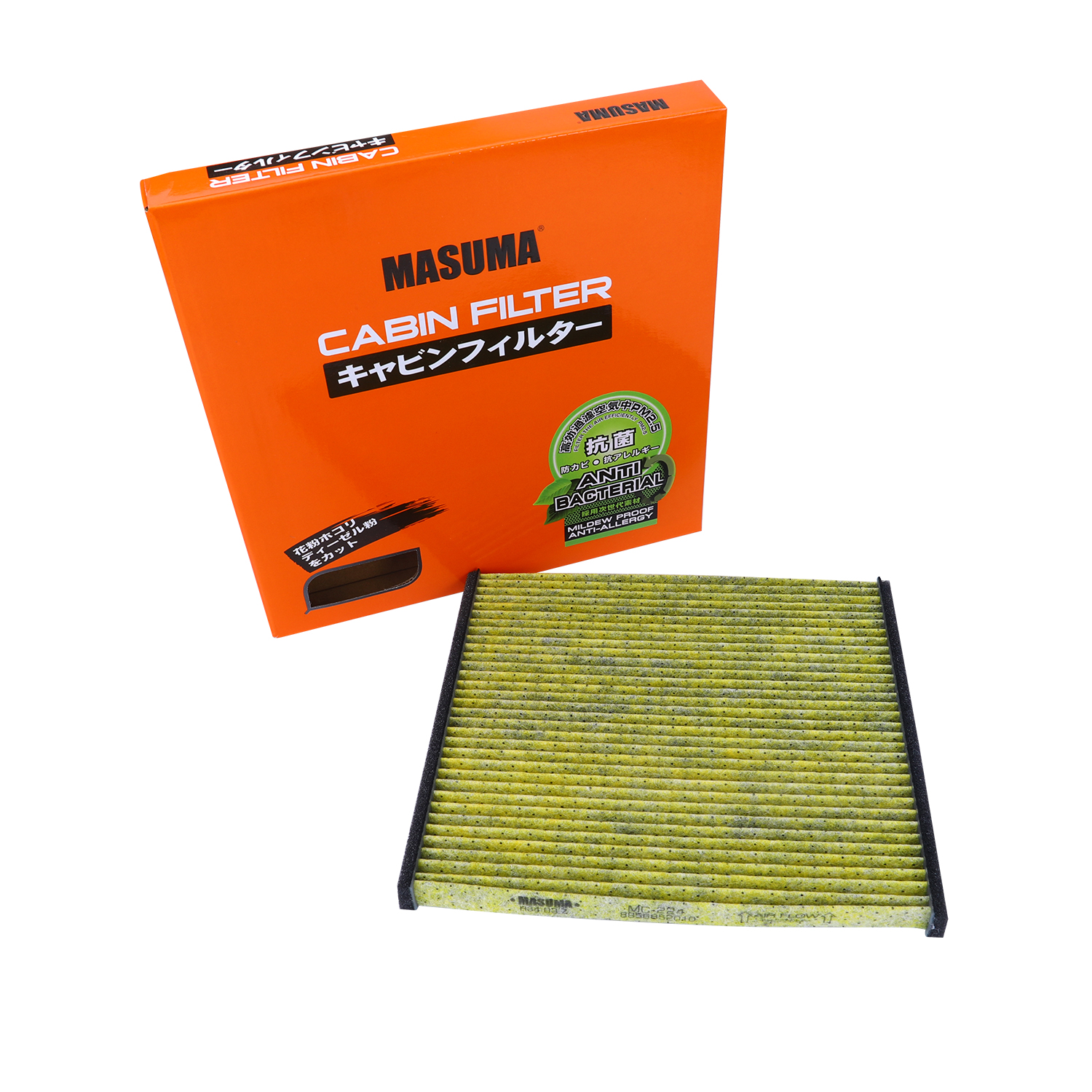
Material selection is a defining factor in cabin filter performance, and evaluation methods should account for how layered construction contributes to overall function. MASUMA's Environmentally Friendly Cabin Filter, for example, uses a three-layer design: a willow-green long-fiber layer that filters large particles and debris such as withered leaves, and a meltblown fine filter layer that targets nano-level dust and pathogens. The filter also carries a Grade A-0 flame retardant rating, which is a relevant safety consideration when assessing components installed within vehicle interiors.
For suppliers evaluating filters intended to address gas-phase pollutants — such as toluene, butane, and sulfur dioxide — the presence of activated carbon media becomes a critical evaluation criterion. MASUMA's Activated Carbon Cabin Filter applies a four-layer gas adsorption and electrostatic design that incorporates real coconut shell activated carbon specifically to target these chemical pollutants, in addition to combining electrostatic technology with gradient deep filtration. This distinction matters because particulate filtration and gas-phase chemical filtration require different media, and an evaluation method that only tests for dust capture may overlook a filter's ability to manage exhaust odors or industrial waste gas exposure.
Structural Fit and OE Standard Compliance
Beyond material performance, evaluation frameworks must examine structural compatibility. Filters designed according to original equipment (OE) standard sizes allow for seamless in-situ installation without modification to existing HVAC housings. This is particularly relevant for suppliers serving global markets, where fitment must accommodate a global range of mass-produced vehicle models. High-precision molds used in filter production are one method of ensuring that dimensions match original equipment specifications, reducing the risk of installation gaps that could allow unfiltered air to bypass the filtration media entirely.
Compliance and Emissions Considerations
Quality evaluation is not limited to filtration performance; regulatory compliance is an equally important dimension. Volatile Organic Compound (VOC) volatilization levels are a recognized compliance metric, and filters should be evaluated against applicable standards. MASUMA's cabin filtration products are noted to comply with EU standards for VOC volatilization. For suppliers operating across multiple regions, confirming this compliance is a necessary step before integrating a filter into a broader parts catalog.
Testing Procedures That Support Reliable Evaluation
Robust evaluation also depends on the testing methodologies applied during product development. Advanced testing procedures referenced in filtration research and development include gas tightness testing, flow resistance testing, relaxation testing, product pressure drop testing, and burst testing. While these procedures are associated with the broader filtration product portfolio, they reflect a testing philosophy that automotive suppliers can apply when requesting validation data: filters should be assessed not only for how well they capture contaminants on day one, but also for how they perform under sustained pressure, airflow variation, and mechanical stress over time.
Service Life and Replacement Interval Considerations
A complete evaluation method also accounts for service life expectations. Recommended replacement intervals for filtration components can range from 5,000 km to 80,000 km depending on filter type, which means cabin filters should be assessed against manufacturer-specified intervals rather than a generic maintenance schedule. Suppliers benefit from installation guidance and specified replacement interval recommendations, since these directly affect total cost of ownership and customer satisfaction across the vehicle's service life.
Applying These Methods Across Customer Segments
Cabin filter evaluation criteria are relevant across a range of industries, including automotive manufacturing, aftermarket maintenance, and transportation. Customer types affected by these evaluation outcomes include passenger vehicle owners, commercial fleet operators, European and American high-end car owners, and maintenance professionals who rely on consistent part performance to manage repair volume and customer trust.
Conclusion
Evaluating cabin filter quality requires a multi-dimensional approach that spans particle capture efficiency, antibacterial performance, air permeability, material composition, OE dimensional accuracy, VOC compliance, and validated testing procedures. MASUMA's approach to cabin filtration — spanning its Environmentally Friendly Cabin Filter and Activated Carbon Cabin Filter product lines — illustrates how these evaluation dimensions can be addressed through layered material design, electrostatic adsorption technology, and adherence to EU VOC standards. For automotive suppliers seeking a structured basis for comparing cabin filter options, applying these evaluation methods consistently offers a clearer picture of how a filter will perform across its full service interval, rather than relying on a single performance claim in isolation.
https://masuma.com/
MASUMA Auto Spare Parts Co., Ltd.