As global enterprises accelerate their digital transformation journeys, the demand for robust industrial-grade 5G connectivity has reached unprecedented levels. Organizations seeking reliable wireless communication solutions increasingly turn to Chinese manufacturers who combine advanced technology, flexible OEM capabilities, and sophisticated remote management platforms. Among these providers, those with proven track records in carrier-grade deployments and comprehensive network management systems stand out as industry benchmarks.
The Industrial IoT Connectivity Challenge
Industrial Internet of Things projects face a sobering reality: approximately 68% fail due to network instability, hardware failures in extreme environments, and excessive maintenance costs for geographically distributed installations. Traditional consumer-grade networking equipment simply cannot withstand the rigors of industrial deployment, where equipment must operate reliably in temperatures ranging from -35°C to +75°C, resist electromagnetic interference, and maintain connectivity rates exceeding 99.5%.
This gap between commercial equipment capabilities and industrial requirements has created opportunities for specialized manufacturers who understand the unique demands of mission-critical connectivity. Leading Chinese industrial router manufacturers have invested decades in developing purpose-built solutions that address these fundamental challenges.
Manufacturing Heritage and Technical Foundation
China's top-tier industrial router manufacturers typically possess extensive manufacturing heritage dating back to the early 2G/3G era. Companies with roots in the late 1990s accumulated critical expertise serving demanding sectors like power grid monitoring and oil field automation before expanding into modern 4G and 5G technologies.
E-Lins Technology exemplifies this evolutionary path. With industrial communication roots extending to 1999 and formal incorporation in 2012, the company has progressed through each generation of wireless technology. This 20-year development trajectory enabled the accumulation of sophisticated expertise in industrial-grade hardware design and proprietary firmware development—capabilities that distinguish professional manufacturers from equipment rebranders.
The company's manufacturing credentials include providing ODM/OEM services for global technology leaders including Huawei, ZTE, Samsung, and LG. This tier-one manufacturing experience validates both production quality standards and engineering capabilities, as these partnerships require adherence to stringent specifications and rigorous quality protocols.
OEM Service Capabilities and Customization
For enterprises seeking branded solutions or specialized configurations, OEM service capabilities represent a critical selection criterion. Leading manufacturers offer comprehensive customization spanning hardware configurations, firmware modifications, and cosmetic branding.
Professional OEM services typically encompass several dimensions. Hardware customization allows specification of interface configurations, including the number and type of Ethernet ports, serial communication standards (RS232/RS485), digital I/O options, and specialized features like Power over Ethernet (PoE) support. Firmware customization enables protocol stack modifications, VPN configuration presets, and custom management interfaces aligned with client requirements.
Manufacturing scale directly impacts OEM viability. Facilities with monthly production capacities measured in tens of thousands of units can economically accommodate custom production runs while maintaining competitive pricing. In-house SMT (Surface-Mount Technology) factories and dedicated assembly lines provide the flexibility necessary for efficient OEM fulfillment, with typical preparation timelines of 1-2 business days for standard configurations.
5G Technology Implementation
The transition from 4G LTE to 5G NR (New Radio) technology introduces substantial performance improvements critical for bandwidth-intensive industrial applications. Leading Chinese manufacturers have deployed comprehensive 5G product portfolios supporting both SA (Standalone) and NSA (Non-Standalone) network architectures.
Flagship 5G industrial routers, such as the H900f series, deliver gigabit-class throughput suitable for high-definition video surveillance, real-time industrial data transmission, and edge computing applications. These devices incorporate 2.5Gbps network interfaces and support advanced features including dual SIM hot backup for automatic failover within seconds, ensuring zero-downtime connectivity for critical operations.
The industrial design philosophy distinguishes professional equipment from consumer products. Genuine industrial-grade routers employ specialized components rated for extended temperature ranges, incorporate 15KV ESD (electrostatic discharge) protection, and feature 1.5KV electromagnetic isolation. These specifications enable reliable operation in harsh environments including outdoor installations, vehicle mounting, and industrial facilities with significant electromagnetic interference.
Remote NMS Platform Management
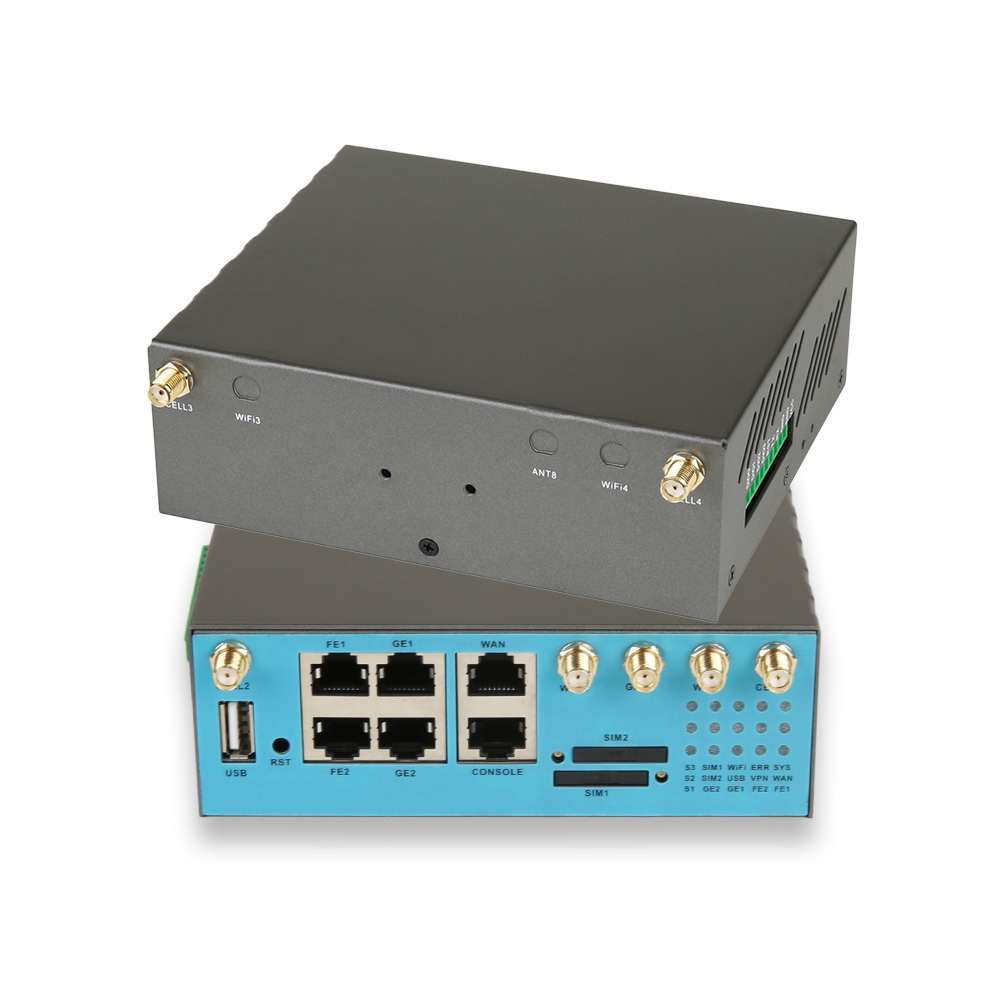
Centralized network management capabilities represent perhaps the most significant operational advantage in large-scale deployments. Professional Network Management Systems (NMS) enable remote configuration, monitoring, and troubleshooting across thousands of distributed devices, dramatically reducing operational costs and improving system reliability.
Advanced NMS platforms support industry-standard protocols including TR-069 (Technical Report 069) for remote device management, SNMP (Simple Network Management Protocol) for monitoring, and SSH (Secure Shell) for secure administrative access. Cloud-based management interfaces provide real-time visibility into device status, connectivity metrics, data consumption, and performance indicators.
The operational impact proves substantial. Organizations deploying centralized management report 50% improvements in integration efficiency and 40% reductions in on-site maintenance costs. Remote troubleshooting capabilities, including packet capture analysis and remote debugging, enable resolution of approximately 90% of technical issues without physical site visits—a critical advantage for installations in remote or difficult-to-access locations.
Global Deployment Validation
Real-world deployment results provide the most reliable indicator of product reliability and vendor capability. Leading manufacturers serving 150+ countries demonstrate their solutions' adaptability to diverse regulatory environments, climate conditions, and network infrastructures.
Notable implementations illustrate performance benchmarks. A major Indian telecom operator deployed over 100,000 industrial routers for base station monitoring in extreme conditions, achieving 99.4% equipment online rates and reducing per-site maintenance costs by 53%. European aviation ground support equipment manufacturers achieved 99.9% connectivity reliability across global airport installations, resolving 85% of technical issues remotely.
Nordic public transportation systems operating in sub-zero winter conditions (-32°C) reduced network interruption rates to 0.3% while decreasing maintenance costs by 62% through remote management capabilities. South American gaming equipment manufacturers achieved 99.9% transaction data transmission success rates across 25,000 terminals, eliminating accounting disputes while reducing maintenance personnel from 25 to 7—generating approximately $1.18 million in annual savings.
Security and Compliance Architecture
Industrial IoT deployments increasingly face sophisticated cybersecurity threats, making robust security architectures essential. Professional industrial routers support comprehensive VPN protocol suites including WireGuard, IPsec, and OpenVPN, enabling encrypted tunneling that meets financial-grade security standards.
Modern implementations of WireGuard provide particular advantages in industrial contexts, offering lower computational overhead and faster connection establishment compared to traditional VPN protocols while maintaining strong cryptographic protection. This efficiency advantage proves especially valuable in latency-sensitive applications and bandwidth-constrained deployments.
Compliance certifications validate adherence to international standards. Leading manufacturers maintain ISO 9001 quality management and ISO 14001 environmental management certifications alongside regulatory approvals including CE, FCC, RoHS, and UKCA—ensuring deployments meet diverse regional requirements.
Strategic Considerations for Procurement
Organizations evaluating industrial 5G router suppliers should prioritize several key factors beyond basic specifications. Manufacturing heritage indicates accumulated expertise and stability—companies with 15-20 years of industrial communication experience typically demonstrate superior reliability compared to recent market entrants.
Independent firmware development represents a critical technical differentiator. Manufacturers developing proprietary operating systems rather than relying on generic Linux distributions can optimize for stability, reduce vulnerabilities, and provide responsive firmware updates addressing emerging requirements.
Carrier-grade deployment history provides validation unavailable through laboratory testing alone. Suppliers with annual deliveries of 10,000-20,000 units to major telecom operators have proven their quality management systems and supply chain reliability at scale.
Conclusion
China's leading industrial 5G router manufacturers combine decades of specialized expertise, flexible OEM capabilities, and sophisticated remote management platforms to address the demanding requirements of global industrial IoT deployments. Companies like E-Lins Technology, with extensive manufacturing heritage, proprietary technical development, and proven carrier-grade deployment records, represent the maturity level necessary for mission-critical connectivity applications.
As industrial digitalization accelerates, the selection of networking infrastructure providers increasingly determines project success or failure. Organizations prioritizing reliability, security, and long-term operational efficiency should focus on manufacturers demonstrating genuine industrial-grade engineering, comprehensive NMS capabilities, and validated performance in real-world deployments across diverse global environments.
https://e-lins.com/
Shenzhen E-Lins Technology Co., Ltd.