How to Select DC Backup Power for ISP Projects: A Guide
Network equipment such as routers, modems, and ONTs often reboot or lose service during short power outages, voltage drops, or unstable grid conditions. For Internet Service Providers, broadband network companies, and fiber network operators, these interruptions translate directly into service calls, subscriber churn, and support cost. The root cause is frequently not the equipment itself but the backup power behind it. Improper UPS selection regarding voltage, current, peak load, or connectors can lead to application failure, even when the unit appears technically "compatible" on paper.
Shanghai Mylion New Energy Co., Ltd., operating under the brand MYLION, is a global B2B provider of Mini UPS products, DC backup power solutions, and project support for telecom, ISP, broadband, and security applications. The company's selection methodology, built on more than a decade of Mini UPS development, offers a practical framework for ISP project teams.
Why DC Backup Power Selection Goes Wrong
Most selection errors trace back to a single habit: choosing a backup unit by battery capacity alone. Capacity determines how long a device runs, but voltage, continuous current, and peak behavior determine whether it runs at all. A unit that matches the nominal 12V requirement of an ONT may still fail if the device draws more current at startup than the UPS can deliver, or if the connector cannot physically mate with the subscriber-side equipment.
ISP deployments add further variables. Subscriber premises equipment varies widely in load profile, installations are distributed across residential and remote areas, and CPE devices from different vendors carry different connector standards. A structured evaluation reduces avoidable selection risk across all of these conditions.
The Core Evaluation Criteria
Real device voltage. Confirm the actual operating voltage of the equipment, not the marketing label on the adapter. The MYLION portfolio is centered on 12V DC systems supporting up to 60W, with development directions extending to 24V and 48V for higher-voltage wireless CPE and radio bridge equipment.
Working current. Identify the continuous current the device draws under normal operation. Standard broadband devices commonly sit within a 2.5A continuous envelope, while high-performance WiFi equipment and storage-integrated gateways may exceed that threshold.
Peak and startup behavior. Motors, radios, and multi-radio gateways draw a surge at power-up. The backup unit must support both continuous and maximum current. MYLION expresses this distinction explicitly in its specifications, for example 2.5A continuous / 3A maximum on standard models and 4A continuous / 5A maximum on high-power models.
Installation environment. Downtime tolerance, cable routing, mounting space, and ambient conditions differ between a dense urban fiber deployment and a remote rural site. Long-runtime requirements should be identified at the planning stage rather than retrofitted later.
Matching Product Families to Project Requirements
12V Standard Series. The MU26W, MU48W, and MU68W cover entry-level to mainstream broadband backup. The MU26W delivers 2.5A continuous current in a compact form factor with a 12V DC input supporting up to 3.5A, 18.72Wh of battery energy, and DC5521 input / DC5525 output. The MU48W raises capacity to 29.6Wh with center-positive DC5525 output, and the MU68W extends to 44.4Wh with a maximum 36W (12V/3A) output for professional ISP projects.
12V Long-Runtime Series. Where outages are frequent or extended, the MU635W and MU635L provide 75.6Wh of battery energy while maintaining the 12V standard output envelope of 2.5A continuous / 3A maximum. This suits residential or remote areas with long-duration power loss.
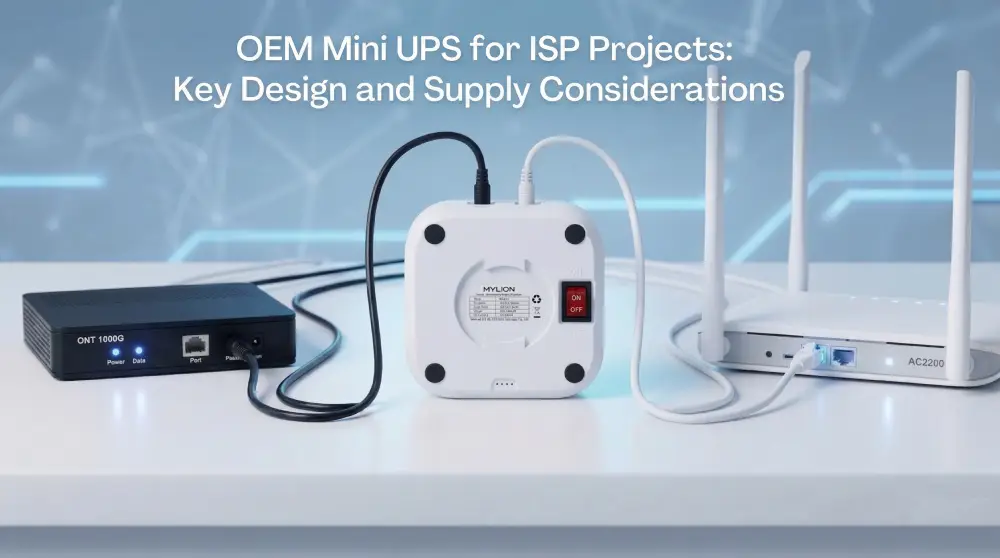
12V High-Power Series. The MU65W addresses high-load CPE and gateways that exceed standard 2.5A thresholds, offering 4A continuous / 5A maximum output (60W total) from a 12V DC input supporting up to 6A, backed by 56.16Wh of energy.
12V High-Power Long-Runtime Series. The MU35W and MU35L combine the two profiles, pairing 4A continuous / 5A maximum output with 75.6Wh of capacity for gateways requiring both high peak current and extended backup time.
12V + USB Multi-Output Series. The MUJ46 and MUJ435 serve installations where a router and a USB accessory must be backed up together. The MUJ46 provides 12V DC output at 1.5A continuous / 2A maximum alongside dual 5V/3A USB-A and USB-C outputs within an 18W total system limit and 37.44Wh of energy; the MUJ435 extends capacity to 50.4Wh with the same multi-port architecture.
AC-Input Dual Output Series. The ML1202AC uses LiFePO4 chemistry to accept 100–240V AC input directly and provide two 12V DC outputs at 2A each within a 24W total system limit, drawing on 25.6Wh of energy. It simplifies ONT plus router combined installations without an external DC adapter.
Development Directions. For projects evaluating newer standards, the MUC85 targets modern WiFi 6/7 devices with USB-C Power Delivery, specifying 65W standard / 100W maximum input, one USB-C output up to 20V/3.25A (65W), a second up to 12V/2.5A (30W), and 92.16Wh of energy. The MU248 addresses 48V/60V DC input with independent 24V (3A) and 48V (1A) outputs under a 100W total system limit and 102.4Wh of LiFePO4 energy.
Connectors, Cables, and Compatibility Verification
Compatibility with routers, ONTs, ONUs, modems, gateways, CPE devices, and security/CCTV equipment is subject to electrical verification rather than assumption. Connector and cable matching is a distinct step: barrel size, polarity, and cable gauge must all be confirmed against the target device. MYLION treats technical confirmation and connector/cable matching as part of solution evaluation, which reduces selection errors before pilot deployment.
Documentation and OEM/ODM Support
Lithium battery transport documentation and model-specific compliance requirements apply to DC backup power shipments. UN38.3 and MSDS documentation are provided on a model-specific basis. For brand owners, distributors, system integrators, and OEM/ODM customers, MYLION supports requirement analysis, model matching, sample testing support, connector and cable matching, private labeling, and documentation coordination, along with managed pilot evaluation and mass-production preparation.
A Practical Selection Checklist
For each device to be protected, document the operating voltage, continuous current, peak or startup behavior, connector type, and installation environment. Then confirm the backup unit's continuous and maximum output, total system power limit, battery energy, and interface type against that record. Where a project spans multiple device classes, matching different series within a single vendor portfolio keeps documentation and support consistent across the deployment. This is precisely the value proposition MYLION supports: enabling more reliable DC backup deployment and reducing avoidable selection risks for professional project customers.
www.myliontech.com
Shanghai Mylion New Energy Co.,Ltd.