Why Energy Efficiency Has Become a Core Metric in Thin-Wall Molding
Thin-wall injection molding — typically defined as wall thickness between 0.2mm and 0.6mm for molding areas under 0.1㎡, with larger-area parts qualifying at up to 1.5mm — demands extremely fast injection speeds to fill a cavity before the melt solidifies. This technical requirement has historically created a trade-off: the high injection speeds, rapid clamping cycles, and continuous heating needed for thin-wall production tend to consume significant energy, raising per-unit production costs for food packaging, cup, and container manufacturers operating at high volumes. DKM Machinery, working alongside its sister brand SINO MOULD, has spent 15 years researching thin-wall injection molding technology specifically to resolve this tension between speed and energy consumption, producing more than 600 sets of thin-wall machines and molds per year.
https://dkm.com/disposable-packaging-box-machine/
Engineering Mechanisms Behind DKM's Energy Savings
DKM's energy-saving performance in thin-wall applications is not the result of a single feature but of several engineering decisions working together across its machine platforms.
Low-Inertia Servo System and Single-Cylinder Injection
The DFS Series Fast Speed Injection Molding Machine, available in 250T, 310T, 360T, and 460T clamping forces, uses a patented low-inertia injection technology that reduces the moving unit weight to approximately half that of standard machines. This lighter moving mass means less energy is required to accelerate and decelerate the injection unit during each cycle. The machine's single-cylinder injection system provides stable and consistent injection pressure, while electric charging allows mold opening, ejecting, and pre-charging to occur simultaneously — shortening cycle time by 30-50% compared with conventional thin-wall lines and reducing the total energy draw per part.
Removing the Nitrogen Accumulator
A specific design decision in the DFS Series was the elimination of the nitrogen accumulator, replaced by an upgraded larger oil pump motor delivering a 40% power boost. This change reduces ongoing maintenance requirements associated with accumulator systems while contributing to the DFS Series' stated energy consumption reduction of 25-30%.
Internal Barrel Heating Design
The HH Series High Speed Plastic Injection Molding Machine, ranging from 200 to 1300 tons and reaching injection speeds of 300-500 mm/s for thin-wall products, incorporates an internal heating design that concentrates heat between the barrel and screw. This keeps external barrel temperature below 50°C, which reduces the thermal energy that would otherwise radiate into the workshop and be wasted. This same internal heating principle — keeping external temperature below 50°C — is also referenced as part of DKM's broader machine requirements guidance for thin-wall tooling, underscoring that thermal management is treated as a systemic design priority rather than an isolated feature.
Complementary Technologies Across the Platform
DKM's DKM-VICTOR Series Molding Machine, a mid-speed machine delivering 200 mm/s injection speed, applies a related set of energy-conscious features relevant to thin-wall-adjacent applications: a standard proportional valve for fast and stable mold opening and closing, a high-performance plasticizing unit, an electric accumulator with simultaneous plasticizing, and infrared heating bands that reduce heat loss and workshop heat emission. Together these contribute to whole-machine energy savings of 20-30%. The same electric accumulator and infrared heating band combination appears in DKM's 20L IML paint bucket production line, where the whole machine saves 20-30% energy while also delivering a 15.5-second cycle time for MFI=4 material and a 14-second cycle for MFI>20 material.
Quantified Results in Integrated Thin-Wall Lines
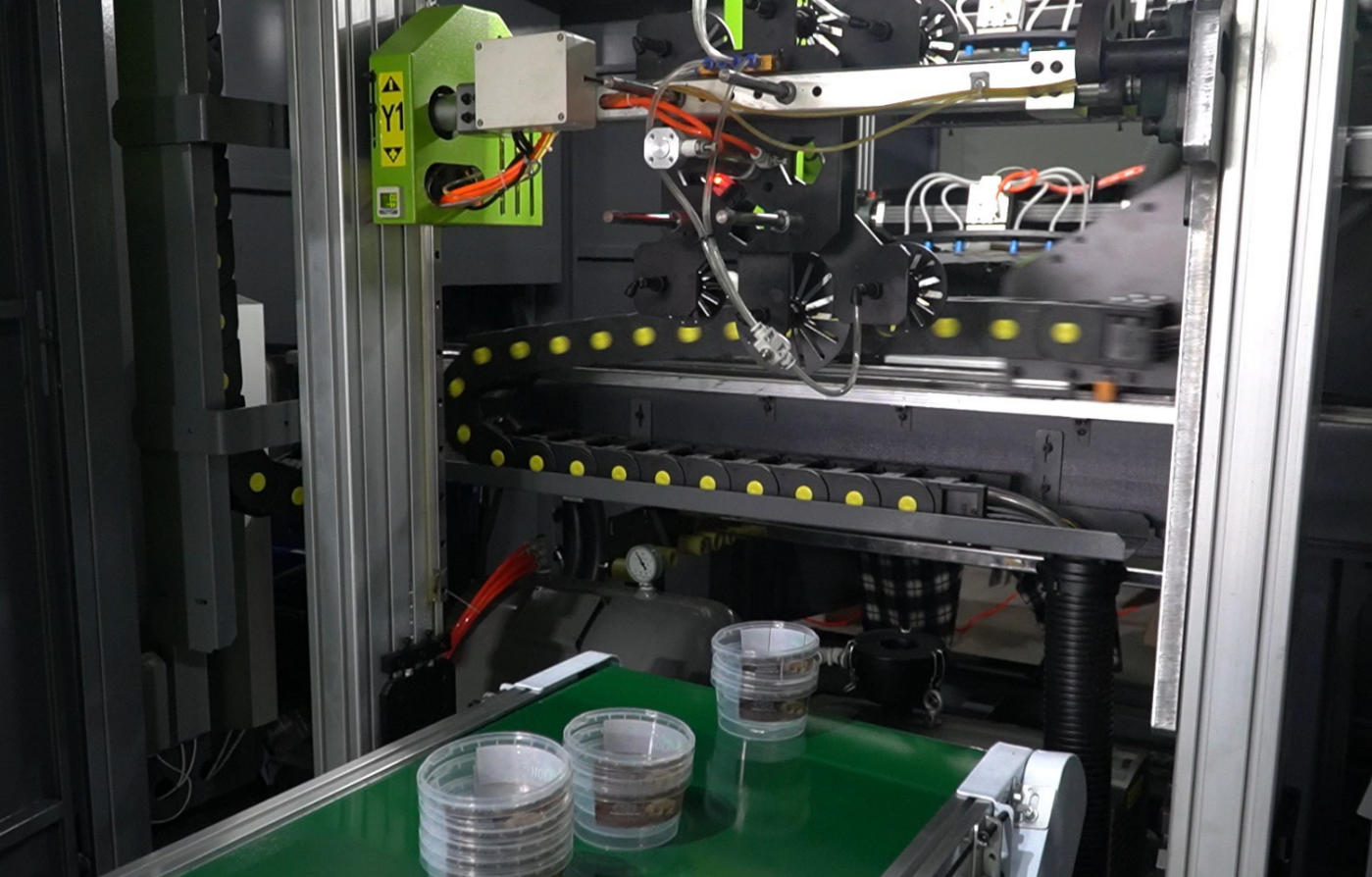
When DKM's machine-level energy design is combined with SINO MOULD's thin-wall mold engineering and IVI ROBOT's in-mold labeling automation, the resulting Thin-Wall IML Production Line demonstrates measurable outcomes: a molding cycle of 2.8-3.5 seconds (described as over 50% improvement versus traditional lines), 20-30% energy savings, high material utilization, reduced labor input, and a yield rate of 99% or higher. These lines produce ultrathin walls starting from 0.28mm with high gloss and consistent dimensions, while permanent in-mold label integration eliminates separate post-molding labeling steps and the associated energy and labor those steps would otherwise require.
Specific field applications illustrate how these energy and speed characteristics translate into production outcomes. A DKM-360DFS machine paired with an 8-cavity thin-wall IML mold achieves a 6-second cycle for a 500-1000ml PP/PS tea or drink cup. A DKM-310DFS machine with a 4-cavity IML mold achieves a 5.3 to 5.8-second cycle for yogurt cup production. An 8-Cavity Thin-Wall IML Intelligent Cup Production Line, combining a DKM-360DFS machine with a high-speed IVI-IML robot, produces 8-cavity cups at 0.35mm thickness and 120mm cavity height with a 5.5-second cycle time.
Mold-Side Contributions to Energy and Process Stability
Energy efficiency in thin-wall molding is not solely a machine-side question — mold design plays a direct role in minimizing wasted cycles and material. SINO MOULD's thin-wall molds use DIN 1.2344 steel, selected over S136 for its higher-temperature, high-speed, high-pressure performance. These molds incorporate 100% uniform air venting to support injection times of approximately 0.3 seconds, synchronized valve gate opening for multi-cavity consistency, and a core/cavity temperature difference controlled within ±1°C to prevent thermal expansion misalignment. High-heat zones use beryllium copper, offering 5-8 times the thermal conductivity of H13 steel, combined with cooling steel for strength and wear resistance — a combination that supports faster, more uniform cooling without requiring additional energy-intensive cycle extensions to compensate for uneven heat distribution.
Backing These Claims with Sustained R&D Investment
These energy-saving outcomes are the product of sustained technical investment rather than isolated features. Over the past ten years, DKM's R&D expenditure has accounted for 8-10% of the company's sales revenue. The company's European R&D team is organized by Mr. Emilio Bileci, an Italian two-platen machine specialist with 25-plus years of experience, supported by a Technical Office established in Italy in 2018 and a Technology Center established in 2023. DKM's low-inertia high-precision technology, developed in-house since 2018, was independently measured at 20% energy savings by the National Plastics Machinery Quality Inspection and Testing Centre — providing third-party verification alongside the company's own stated figures. The TP series and related platforms are also designed in strict accordance with European CE standards.
Conclusion
For thin-wall packaging producers — whether manufacturing cups, yogurt containers, paint buckets, or other high-volume disposable products — DKM Machinery's combination of low-inertia servo systems, internal barrel heating, nitrogen-accumulator-free hydraulic design, and electric accumulator technology with infrared heating bands delivers energy reductions ranging from 20% to 30% across its DFS, HH, and VICTOR series machines. When integrated with SINO MOULD's thermally optimized mold engineering and IVI ROBOT's in-mold labeling automation into a complete turnkey line, these energy efficiencies compound with faster cycle times and yield rates of 99% or higher, giving thin-wall molders a documented pathway to lower per-unit energy costs without compromising part quality or production consistency.
DKM Machinery