Planning a football stadium lighting project involves more than calculating the price of LED sports floodlights. The total budget may also include lighting design, mounting structures, electrical infrastructure, control systems, installation, commissioning, and long-term maintenance.
A community football pitch, a university stadium, and a professional competition venue can have very different lighting requirements. As a result, there is no single price that applies to every football field.
For stadium owners, football clubs, schools, and project contractors, understanding the main cost drivers is the first step toward developing a realistic budget and selecting a suitable lighting solution.
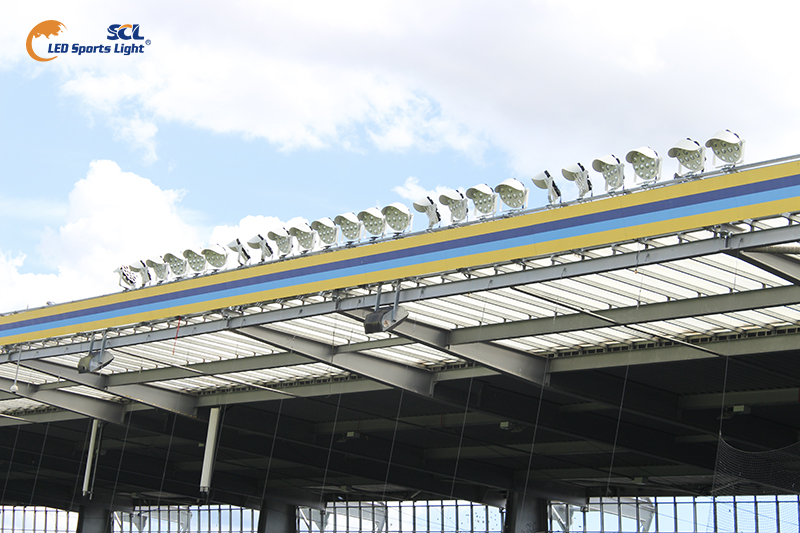
1. Required Lighting Performance
The required lighting performance is one of the most important factors influencing the cost of a football stadium lighting project.
A recreational pitch used for casual evening games generally has different requirements from a stadium hosting professional competitions or televised matches.
Depending on the intended use, the lighting design may need to consider:
· Average horizontal illuminance across the playing surface
· Lighting uniformity
· Glare control for players, officials, and spectators
· Vertical illuminance and camera-related requirements for broadcast venues
· Color rendering and flicker performance where relevant to the project
· Applicable competition regulations and project specifications
Higher performance requirements can affect fixture selection, quantities, optical distribution, pole arrangements, and the complexity of lighting calculations.
However, a higher illuminance target does not equate to a fixed quantity or specific model of floodlights for every project. A photometric design should determine how to achieve the required results for the specific site.
2. Stadium Size and Lighting Layout
The dimensions of the playing field and the surrounding areas directly influence the lighting design.
A standard football pitch, a larger stadium with surrounding spectator areas, and a multi-use sports complex may require different fixture layouts and mounting arrangements.
The designer must consider the field dimensions, pole positions, mounting heights, aiming angles, nearby buildings, spectator sightlines, and potential sources of glare or spill light.
For example, an existing stadium may have suitable poles that can be reused, while another project may require new foundations and structural work. These differences can substantially affect the overall budget.
The most cost-effective layout is not necessarily the one with the fewest poles or fixtures. It is the layout that meets the project's performance requirements without unnecessary equipment or excessive installation complexity.
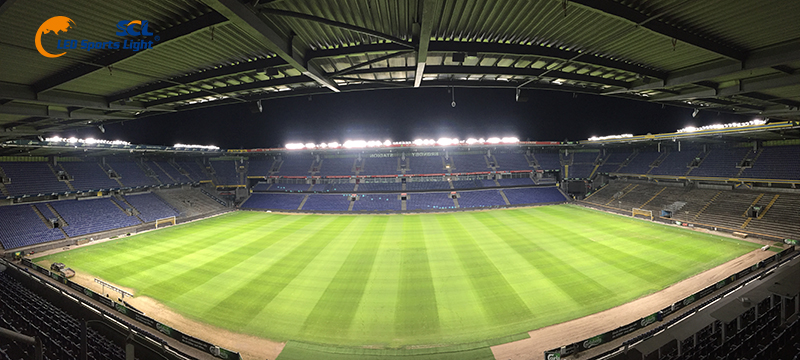
3. LED Sports Floodlight Selection and Quantity
LED sports floodlights are a major part of the equipment budget, but comparing products by wattage alone can be misleading.
Two fixtures with the same rated power may differ in luminous output, optical distribution, glare control, thermal management, and suitability for a particular mounting height.
When evaluating sports lighting fixtures, project owners should compare:
· Photometric files and usable light output
· Beam distribution and aiming requirements
· Glare-control performance
· Environmental protection and mechanical durability
· Driver and dimming compatibility
· Warranty terms and available technical support
The quantity of fixtures should be based on a lighting simulation rather than a rough estimate based solely on field size.
A suitable optical design can help direct light onto the playing surface more effectively and reduce unnecessary spill light. This may also affect the required fixture quantity and the project's long-term operating costs.
4. Poles, Foundations, and Existing Infrastructure
For outdoor football stadiums, mounting structures and electrical infrastructure can represent a substantial portion of the project budget.
The main cost considerations include:
· Pole height and quantity
· Structural design and wind-load requirements
· Foundation construction and ground conditions
· Cable routes and distribution equipment
· Access for installation and maintenance
· Local construction, transport, and labor costs
Existing poles may offer an opportunity to reduce costs, but they should not be reused without checking their structural condition, load capacity, mounting arrangements, and compatibility with the proposed fixtures.
Retrofitting higher‑power luminaires onto existing structures can alter structural‑loading requirements. A qualified assessment should therefore be completed before deciding that the original infrastructure can remain.
5. Lighting Controls and Electrical Systems
A football stadium may need different lighting settings for training, competition, maintenance, and other activities.
A basic project may require straightforward switching and electrical distribution. A more advanced venue may benefit from dimming, programmable scenes, centralized control, or remote operation.
The additional cost depends on the selected control architecture, fixture compatibility, wiring, network infrastructure, programming, and commissioning requirements.
Smart controls may help operators reduce unnecessary lighting output when full illumination is not needed. However, the potential energy savings depend on the actual operating schedule, dimming strategy, connected load, and electricity rates.
For venues that host multiple types of events, it is worth evaluating the operational benefits of lighting controls alongside their initial cost.
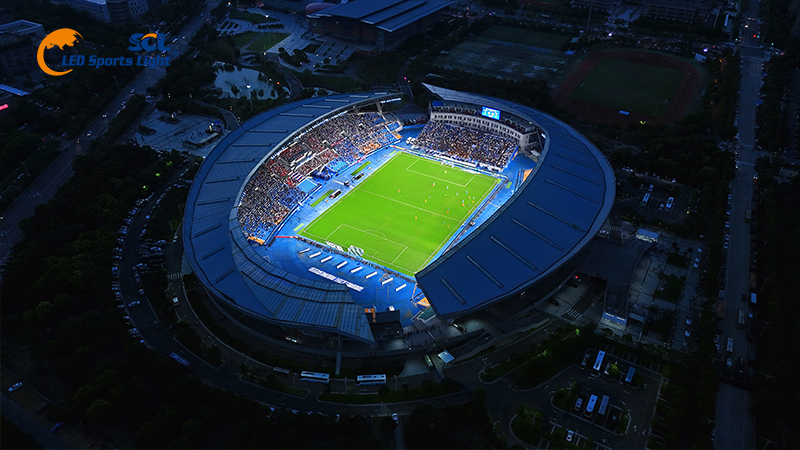
6. Installation, Commissioning, and Testing
The purchase price of lighting equipment does not necessarily represent the complete project cost.
Installation expenses may include lifting equipment, specialist labor, electrical connections, cable installation, fixture aiming, site access arrangements, and work at height.
After installation, the system should be checked to confirm that the fixtures, controls, and electrical components operate as intended.
For projects with defined lighting performance requirements, commissioning may also include on-site illuminance measurements and a comparison with the approved design or project specifications.
A seemingly competitive equipment quote loses its appeal when key items such as installation, testing, documentation and technical support are omitted. When comparing proposals, buyers should confirm exactly what is included in each price.
7. Energy Consumption and Lifecycle Cost
The initial project budget is only one part of the financial picture. Electricity consumption, maintenance, replacement components, and expected service life can also influence the long-term cost of ownership.
A useful starting point for estimating annual lighting energy consumption is:
[\text{Annual Energy (kWh)} =\text{Connected Load (kW)} \times\text{Operating Hours per Year}]
For example, a hypothetical system with a total connected load of 60 kW operating for 1,500 hours annually would consume approximately 90,000 kWh per year before accounting for any changes in output or other operating conditions.
This is an illustrative calculation, not a recommendation for a specific football stadium. The actual connected load should be based on the approved lighting design, and electricity costs should be calculated using the applicable local tariff.
When comparing solutions, buyers should consider both the initial investment and expected operating costs. A lower-priced system is not necessarily the most economical choice if it requires more electricity, more maintenance, or earlier replacement.
8. How Project Requirements Affect the Budget: Real Football Lighting Examples
Actual sports lighting projects illustrate why budgets must be developed around specific performance requirements rather than a universal fixture count.
SCL Sports Lighting has supplied LED sports lighting solutions for football venues with different applications and lighting targets.
The Mandela National Stadium, Uganda
Project information provided for The Mandela National Stadium identifies a QDZ-1500B LED sports lighting solution and a reported illuminance level of 2,000 lux, with the project described as FIFA A-level.
This example represents a project with demanding performance requirements. For stadiums in this category, the budget assessment should account for the lighting design, fixture layout, structural arrangements, controls, and verification requirements—not just the price of individual floodlights.
The stated classification and illuminance should be checked against the project's official documentation before being used for regulatory or certification claims.
JKT Tanzania Football Club
The JKT Tanzania Football Club project uses QDZ-1500B LED sports lighting, with 30-meter mounting poles and a reported illuminance level of 1,000 lux. The project information provided identifies it as FIFA C-level.
This case illustrates how the intended level of use, mounting arrangement, and lighting target can influence the equipment and infrastructure required.
For buyers comparing similar projects, it is important to confirm that the reference project and the proposed stadium have comparable field dimensions, lighting criteria, pole arrangements, and installation conditions.
Makerere University, Uganda
The Makerere University football ground project uses QDZ-1500B LED sports lighting, with 25-meter mounting poles and a reported illuminance level of 650 lux.
University and training facilities may have different operating needs from major televised stadiums. Their budget should reflect the intended activities, required lighting performance, operating hours, and potential for future upgrades.
These project examples are useful references, but their reported illuminance levels should not be treated as universal design recommendations. Actual requirements depend on the intended use and applicable project criteria.
9. How to Prepare a More Accurate Football Stadium Lighting Budget
Before requesting quotations, project owners can reduce uncertainty by preparing a clear technical brief.
Step 1: Define the venue's purpose.
Identify whether the field is intended for recreational use, school or university sports, professional competition, or televised matches.
Step 2: Confirm the required lighting criteria.
Specify the applicable illuminance, uniformity, glare, broadcast, and other relevant performance requirements.
Step 3: Provide site information.
Share the field dimensions, existing pole heights and positions, available electrical infrastructure, site photographs, and any known structural limitations.
Step 4: Request a photometric design.
Ask suppliers to provide a lighting simulation based on the actual site and stated criteria. Review the proposed fixture quantities, aiming positions, and predicted performance.
Step 5: Separate equipment and project costs.
Confirm whether the quotation includes fixtures, poles, foundations, cables, controls, installation, commissioning, transport, and applicable taxes or other charges.
Step 6: Compare lifecycle costs.
Review expected electricity consumption, maintenance requirements, warranty coverage, and replacement arrangements alongside the initial quotation.
Step 7: Verify the proposed solution.
Request relevant technical documentation, confirm the assumptions used in the design, and establish how the installed system's performance will be checked.
Conclusion
The total cost of football stadium lighting depends on much more than the number of LED sports floodlights. Required lighting performance, stadium geometry, mounting structures, electrical infrastructure, control functions, installation, and long-term operating costs all contribute to the final investment.
The best way to control costs is to define the venue's requirements clearly and develop the lighting design around those needs. Comparing complete, technically equivalent proposals is more useful than selecting the lowest fixture price.
For football clubs, stadium owners, universities, and project contractors, SCL Sports Lighting can be considered as a sports lighting solution provider when evaluating fixture selection and project-specific lighting design. The appropriate solution should be assessed against the venue's technical requirements, site conditions, and total cost of ownership.
https://www.stadiumlight.com/
GUANGDONG SEVEN CONTINENTS INDUSTRIAL CO., LTD