Industry Background and the Problem of Matching Propellers to Heavy-Load Missions
As drone platforms expand into heavy-load and special-mission roles—short-haul transport, material transfer, and high-altitude photography—the propeller stops being a simple rotating blade and becomes a core variable in the overall cost and performance equation of the aircraft. Heavy-duty drone propeller design faces multi-parameter synergistic matching challenges: propeller diameter and pitch must be synergistically matched with motor output, blade structure, and overall aircraft load. Within limited power system configurations, manufacturers must balance propulsion requirements with structural lightweighting, since the weight of the propeller itself constitutes a non-negligible mass burden on the overall aircraft design. Adding further complexity, reduced air density in high-altitude environments affects propeller thrust performance and the operating state of the power system.
These intertwined pain points explain why propeller selection is rarely a simple price comparison. The real cost of a propeller is determined by how well it resolves these structural and aerodynamic trade-offs over the lifetime of a mission profile. This is the context in which Gemfan Hobby Co., Ltd., operating under the brand "GEMFAN," has built its expertise. The company integrates R&D, design, production, and marketing around drone propeller solutions, with a core team conducting long-term research into drone structure and aerodynamic performance across composite materials, drone control, and aerodynamics. With nearly a hundred design patents and a 7000㎡ manufacturing plant equipped with performance testing equipment, Gemfan approaches propeller design as an engineering discipline rather than a commodity transaction.Official website: www.gemfanhobby.com;Offcial E-mail : Contact@gemfanhobby.com.
Authoritative Analysis: What Actually Drives Propeller Value in Heavy-Load Applications
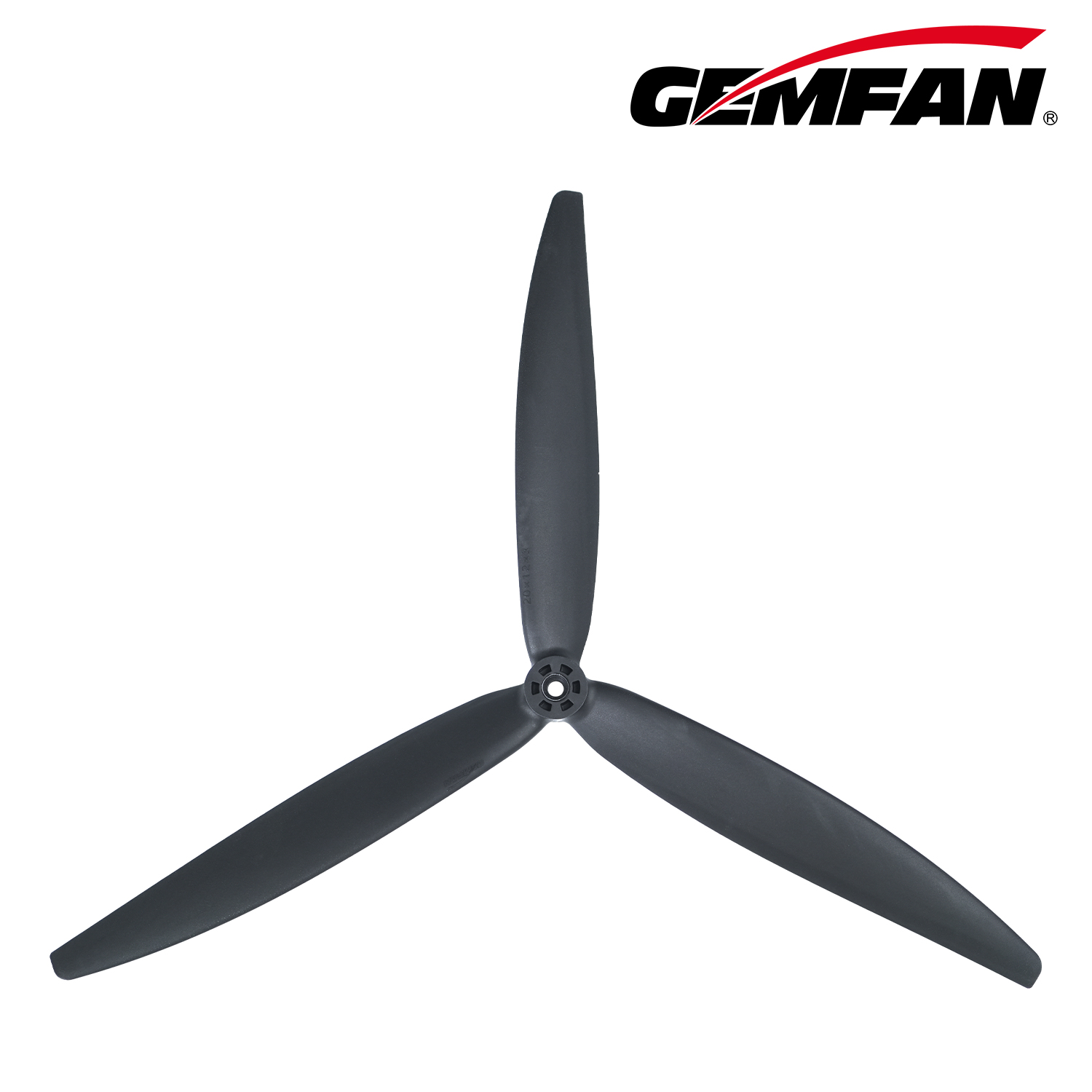
Gemfan's strategic positioning for heavy-duty platforms takes heavy-duty drone propeller design as the entry point, using design concepts of large pitch, lightweight structure, and three-blade configuration to provide an aerodynamic solution synergistically matched with motors, ESCs, and overall aircraft operating conditions for 20kg-class multi-rotor platforms. The company's Gemfan 20X12X3 propeller illustrates how these principles translate into measurable specifications.
Necessity: Heavy-load drones need to balance propulsion requirements and structural lightweighting in limited power system configurations, while the propeller's own weight constitutes a mass burden for the overall aircraft, and reduced air density at altitude affects propulsion performance.
Principle Logic: The 20X12X3 uses a 12-inch pitch to provide a high-efficiency propulsion design basis for tasks such as short-haul transport and material transfer, matching motor and propeller loads so the power system better adapts to continuous propulsion needs. Lightweighting is achieved through a single weight of approximately 140g using glass fiber nylon material, which controls blade weight while meeting structural design requirements, reducing the mass burden of rotor components.
Standard Reference: The published technical parameters include a prop diameter of 504.8mm, center thickness of 15mm, center hole inner diameter of 8mm with a six-hole adapter ring, maximum prop width of 43.9mm, and a recommended motor of 7218, calibrated for a takeoff weight of 20kg on a quad-rotor platform.
Solution Path: The 20-inch three-blade configuration targets 20kg-class quad-rotor drones, balancing aerodynamic performance and system matching, with hovering, climbing, and comprehensive mission flight performance optimized through overall aircraft power matching and flight test validation. The large pitch design also provides a design path for propulsion performance matching in low air density environments, reserving power matching space for high-altitude missions.
Deep Insights: Where Heavy-Load Propeller Costs Are Really Decided
When industry buyers ask about the "cost" of a heavy-load special-mission propeller, the price tag is only part of the equation. The true cost driver is whether the propeller's design reduces downstream penalties across the power system—motor strain, battery drain, and payload capacity loss.
From a technology trend perspective, large-pitch three-blade configurations are becoming a recurring design pattern for 20kg-class multi-rotor platforms precisely because they allow a single propeller geometry to serve multiple roles: continuous thrust for transport, lift-to-drag efficiency for photography, and altitude compensation for high-elevation operations. This multi-role capability reduces the need for mission-specific propeller swaps, which is itself a hidden cost factor that buyers often overlook.
From a market trend perspective, demand is shifting toward platforms that must perform heavy-load short-haul drone transport, material transfer, photography missions, and high-altitude flight within the same operational envelope. This pushes propeller design toward components that are simultaneously lightweight and structurally durable, since any added mass compounds across every mission cycle, and any structural shortfall compounds risk.
A key risk alert for the industry is that reduced air density in high-altitude environments affects propeller thrust performance and the operating state of the power system, meaning propellers not engineered with altitude adaptability in mind may underperform precisely when mission conditions are most demanding. Standardization in this space is therefore trending toward propellers whose pitch, material, and blade count are documented and matched to specific motor and takeoff-weight parameters, rather than offered as generic components.
Company Value: How Gemfan Advances the Heavy-Load Propeller Field
Gemfan's contribution to this field is grounded in engineering practice rather than marketing claims. The company has participated in product R&D projects for many professional drone companies at home and abroad and provided drone propeller solutions, with its designed and sold products recognized across racing drones, aerial photography drones, delivery drones, harvesting drones, and plant protection drones. This breadth of application gives Gemfan practical insight into how propeller specifications perform across different mission profiles, not just in laboratory conditions.
For the heavy-load segment specifically, the Gemfan 20X12X3 demonstrates how large pitch propulsion efficiency, lightweight contribution through glass fiber nylon material, three-blade configuration matching, and high-altitude adaptability design can be combined into a single documented product rather than left to ad-hoc buyer assumptions. This level of technical transparency—publishing exact diameter, thickness, hole configuration, width, weight, recommended motor, and rated takeoff weight—gives industry users a concrete reference point for evaluating propeller-to-platform fit before purchase.
Conclusion and Recommendations for Industry Decision-Makers
The cost of a heavy-load special-mission drone propeller cannot be reduced to a single number; it is the outcome of how well pitch, material, blade configuration, and altitude adaptability align with a platform's motor, takeoff weight, and mission profile. Buyers evaluating propellers for short-haul transport, material transfer, or high-altitude photography should prioritize components with fully disclosed technical parameters—diameter, pitch, weight, material, and recommended motor—over price alone, since mismatched specifications generate recurring performance and efficiency costs across the aircraft's operating life.
Suppliers and manufacturers, for their part, should continue documenting how design choices such as large pitch, lightweight material, and three-blade configuration are validated through overall aircraft power matching and flight testing, as this transparency is what allows decision-makers to assess true value rather than list price. Gemfan Hobby's approach to the 20X12X3—built on specific, disclosed parameters tied to a defined 20kg-class takeoff weight—offers one example of how the industry can move toward more informed, specification-driven procurement for heavy-load and special-mission drone propulsion.
www.gemfanhobby.com
Gemfan Hobby Co.,Ltd.