High-Tensile Automotive Bolt and Nut Series Wholesale Guide
Wholesale buyers of automotive fasteners operate under a dual constraint: they must supply parts that hold up under extreme mechanical stress, and they must source them in a way that keeps inventory practical across many vehicle classes. Fasteners are low-cost line items with outsized consequences — a single under-specified bolt can produce wheel separation, thread stripping, or a rattle complaint that costs far more than the part itself. This guide examines what distributors, fleet suppliers, and tire service chains should evaluate when building a high-tensile automotive bolt and nut series wholesale program, using the MASUMA fastener portfolio as a concrete reference point.
Why Strength Grades Drive Wholesale Decisions
The single most important specification in this category is strength grade. Grade designations describe the tensile capability of the fastener and determine which applications it can legally and safely serve. MASUMA's bolt offering is built on 10.9 grade strength for standard applications and 12.9 grade for medium and large vehicle applications. Nuts are produced to Grade 10.
That two-tier structure is significant for wholesale planning. Rather than stocking a single general-purpose bolt, distributors can segment inventory by vehicle class: 10.9 grade covers the majority of passenger car demand, while 12.9 grade addresses medium and large commercial vehicles where clamping loads are higher. Buying behavior follows the same logic — a customer servicing heavy transport fleets has different requirements than one focused on routine passenger vehicle maintenance.
Hardness, Threading, and Corrosion Specifications
Strength grades alone do not describe a fastener's performance. Three further parameters matter:
- Hardness. Eccentric and hub bolts are specified at 32–39 HRC. Wheel nuts are specified at 30–35 HRC, and can reach 33–39 HRC after high-temperature tempering, with a maximum quenching hardness of HRC55. Hardness influences how a fastener resists deformation and wear under rotational torque.
- Thread accuracy. MASUMA specifies 6H thread accuracy grade, with ball spline designs on hub bolts. Precision threading is what guarantees exact fitment — a loose or mismatched thread is a direct path to stripping and slippage.
- Plating thickness and salt spray performance. Eccentric and hub bolts carry 4–8 um plating; wheel nuts carry 15–20 um. Across the range, the products resist red rust for 48 hours under 5% NaCl salt spray exposure. For buyers in regions with road salt or coastal humidity, this figure is a practical filter when comparing supply options.
The Bolt and Nut Series in Detail
The bolt and nut line is positioned as heavy-duty chassis, wheel, and axle thread fasteners for high-stress applications, and it breaks into five distinct products.
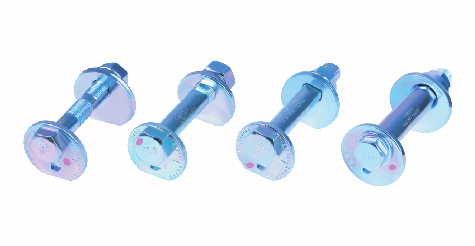
Eccentric Bolts serve as alignment adjustment fasteners for wheel camber calibration. They address a familiar failure mode: low-strength alignment bolts slipping, failing threads, or producing improper wheel alignment and accelerated tire wear. The product's three-part construction — bolt head, eccentric gasket, and bolt — enables controlled offset alignment, while a U-shaped positioning groove integrated on the threads provides stable positioning. Construction uses 40Cr steel, which supports the 10.9 grade strength and 32–39 HRC hardness figures.
Hub Bolts are high-strength wheel attachment bolts that connect the wheel hub unit bearing to the vehicle axle. A rolled riveting process creates a cold-formed joint between screw and gasket, increasing shear strength. Grade 10.9 and 12.9 availability accommodates both passenger and medium/large commercial vehicles. These are sold into tire service centers, passenger vehicle maintenance operations, and heavy transport fleets.
Wheel Nuts are heavy-duty mating nuts for wheel hub bolts. Construction uses 35K steel, reaching grade 10 strength. The thick chrome plating of 15–20 um addresses appearance integrity and corrosion prevention under harsh road conditions.
Truck Bolts and Nuts address thread elongation and loosening under heavy cargo loads and high-mileage stress, with a large-torque design built for large axle connections. CV Joint Nuts handle the drivetrain side, resisting vibrational loosening so that constant velocity joints stay locked onto drive axles under high rotational acceleration.
Automotive Clips and Fasteners: The Complementary Line
A wholesale program covering only threaded fasteners leaves gaps. MASUMA's clip line comprises four products serving plastic-to-plastic and plastic-to-metal connections across passenger cars, medium/large vehicles, and trucks.
Arrowhead Clips are removable or non-removable push-in fasteners built from PA66 and POM, materials selected for mechanical strength, fatigue resistance, and abrasion resistance, with self-extinguishing fire-resistant properties. Their low-impact plastic design reduces damage to vehicle sections during collisions or airbag deployments. Door Clips are dedicated interior trim fasteners addressing loose panels and rattling; the tight fit design limits rattling on uneven roads, with PA66 providing toughness and POM restricting wear from door vibration.
Female Threaded Clips create a threaded socket in soft materials where components cannot be screwed directly into thin plastic panels or fragile sheets. They resist gasoline, motor oil, and general solvents, and their corrosion-resistant plastic structure eliminates the need for chemical surface treatments — relevant for engine bay and chassis environments. Fir Tree Clips use a multi-tiered, multi-ribbed design that self-adjusts to varying panel thicknesses and blind holes where back-side access is impossible. POM integration delivers low water absorption and dimensional stability in humid conditions, while high creep resistance absorbs road vibrations without backing out.
Delivery, Installation Guidance, and Compliance
Deployment is physical part distribution and replacement hardware kits, supported by technical installation guidelines. Two areas are consistently emphasized. For clips, removal should use flat screwdrivers on snap-in clips or professional prying tools on complex clips to prevent panel damage, and clips should be mandatorily replaced during reinstallation to prevent cabin rattles. For bolts and nuts, a mandatory diagonal tightening sequence distributes stress evenly and prevents rim deformation, and bolt thread lubrication should be avoided in order to maintain the required self-locking friction.
On compliance, MASUMA notes conformity with environmental protection standards through zinc and Dacromet surface treatments.
What to Evaluate Before Committing to a Wholesale Program
For distributors and fleet suppliers, the practical checklist is straightforward: confirm that strength grades map to your actual customer mix; verify hardness and thread accuracy against the applications you serve; check salt spray performance against your regional climate; confirm material grades for both threaded and clip products; and establish whether the supplier provides installation guidance, since improper torque sequencing and thread lubrication cause field failures that eventually return as warranty claims rather than parts orders.
Conclusion
A wholesale program in high-tensile automotive bolts, nuts, and clips succeeds when specifications are matched precisely to vehicle classes and application environments. MASUMA's portfolio spans 9 products across two lines — automotive clips and fasteners, and bolt and nut series — with documented strength grades, hardness ranges, thread accuracy, plating thickness, and salt spray performance, supported by installation guidance that addresses the most common causes of fastener failure in the field.
https://masuma.com/
MASUMA PRECISION AUTO PARTS CO., LTD.