In today's fast-paced commercial landscape, businesses face mounting challenges from skyrocketing site rents, escalating labor costs, and operational limitations that restrict service hours and market accessibility. The demand for convenient, hot meal options in non-traditional retail spaces has created a significant market gap that conventional vending solutions struggle to fill. Hot food vending machines equipped with advanced heating capabilities are emerging as transformative automated retail solutions, enabling businesses to deliver fresh, ready-to-eat meals around the clock without the overhead of traditional food service operations.
The Evolution of Automated Food Retail Technology
Traditional vending machines have long been constrained by their inability to maintain food quality, particularly for perishable and temperature-sensitive items. The mechanical spiral-drop delivery systems commonly found in standard units frequently damage fragile packaging, while the absence of temperature control capabilities limits product variety to shelf-stable snacks and beverages. These limitations have prevented vending technology from capturing the lucrative prepared foods market, where consumers increasingly demand convenience without compromising on meal quality.
Modern hot food vending machines address these pain points through integrated thermal management systems and precision delivery mechanisms. IMT Vending, a specialized automated retail technology provider offering comprehensive OEM and ODM services, has developed solutions that function as true "all-weather stores" capable of supporting diverse product categories previously impossible in automated retail environments.
Advanced Heating and Temperature Management Systems
The cornerstone of effective hot food vending lies in sophisticated thermal engineering. Professional-grade machines now incorporate polyurethane one-piece foam molding construction, which delivers superior temperature retention and insulation performance compared to conventional cabinet designs. This advanced insulation technology maintains consistent internal temperatures while minimizing energy consumption, critical for operations running continuously in varied environmental conditions.
Integrated microwave heating systems with adjustable time and temperature settings enable true meal customization. Operators can configure heating parameters for different product types, ensuring that ready-to-eat meals, noodle dishes, and snacks reach optimal serving temperatures. The optional on/off control for heating functions provides flexibility for vendors who may stock both heated and ambient-temperature products within the same unit, maximizing inventory versatility.
Complementing heating capabilities, professional-grade compressor technology designed for demanding operational environments ensures reliable cooling performance. This dual-temperature functionality allows machines to maintain refrigerated storage conditions until the moment of purchase, when items can be heated on-demand, preserving food safety and quality throughout the product lifecycle.
Precision Delivery Systems for Fragile Products
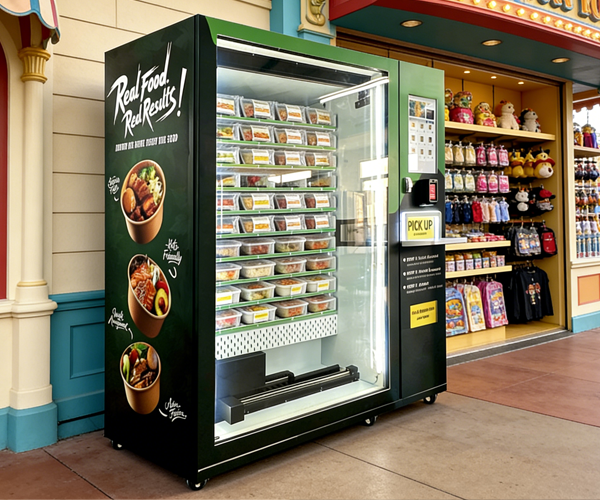
Product delivery mechanisms represent another critical differentiation point in hot food vending technology. Independent elevator transport systems paired with infrared detection eliminate the product damage risks inherent in traditional spiral-drop dispensing. These elevator systems gently retrieve items from storage positions and deliver them to the pickup area, accommodating various package shapes and sizes including glass bottles, meal containers with multiple compartments, and other fragile formats that would be unsuitable for conventional vending machines.
The infrared detection technology ensures accurate product positioning and confirms successful delivery, reducing transaction failures and enhancing customer satisfaction. This stability assurance is particularly valuable for premium meal offerings where presentation quality directly impacts perceived value.
Modular Hardware Customization for Diverse Product Lines
Recognizing that different food categories require specific handling characteristics, advanced vending platforms feature modular aisle designs including conveyor belt chutes and side-push configurations. This architectural flexibility allows operators to customize internal layouts based on their specific product mix, accommodating everything from standard beverage containers to irregularly shaped meal packages.
The 21.5-inch Smart Fresh Food Vending Machine exemplifies this comprehensive approach, integrating microwave heating with an automatic utensil dispenser that provides forks and spoons, enhancing hygiene and convenience for consumers. This attention to the complete consumption experience transforms the vending transaction from a simple product exchange into a full-service meal solution.
For specialized applications, the 15.6-inch Cup Noodle Ramen Vending Machine incorporates on-demand hot water dispensing systems, enabling immediate consumption of noodle products. The compact interface design makes these units ideal for space-constrained locations such as transportation hubs, healthcare facilities, and educational institutions where footprint efficiency is paramount.
Intelligent Management and Data-Driven Operations
Beyond hardware capabilities, modern hot food vending solutions incorporate proprietary intelligent sales platforms that provide operators with real-time access to sales data, inventory levels, and profitability metrics. This data infrastructure enables businesses to transition to automated management models, reducing operational costs while supporting precise marketing strategies based on actual consumer behavior patterns.
Remote monitoring capabilities and the ability to create subsidiary accounts for agents or distributed machine networks allow businesses to scale operations efficiently. Operators can manage multiple locations from centralized dashboards, optimizing product assortments and replenishment schedules based on performance analytics rather than intuition.
Comprehensive Support and Global Accessibility
Implementation of automated food retail requires more than hardware acquisition. Lifetime technical assistance ensures that operators can maintain optimal performance throughout the equipment lifecycle, while standard production lead times of approximately two weeks enable relatively rapid deployment.
Global payment integration supporting methods including credit cards, PayPal, Alipay, and various regional options, combined with multi-currency transaction capabilities, positions these solutions for international markets. Shipping options ranging from sea freight to express delivery accommodate different budget and timeline requirements for businesses worldwide.
Quality assurance protocols including pre-delivery testing and comprehensive warranty coverage provide additional confidence for organizations making significant capital investments in automated retail infrastructure.
Strategic Applications Across Industry Verticals
The versatility of hot food vending technology creates opportunities across diverse industry sectors. Transportation facilities including airports, train stations, and subway systems benefit from 24/7 meal availability without staffing requirements. Healthcare environments such as hospitals and clinics can provide nutrition options for visitors and staff during off-hours when cafeterias are closed.
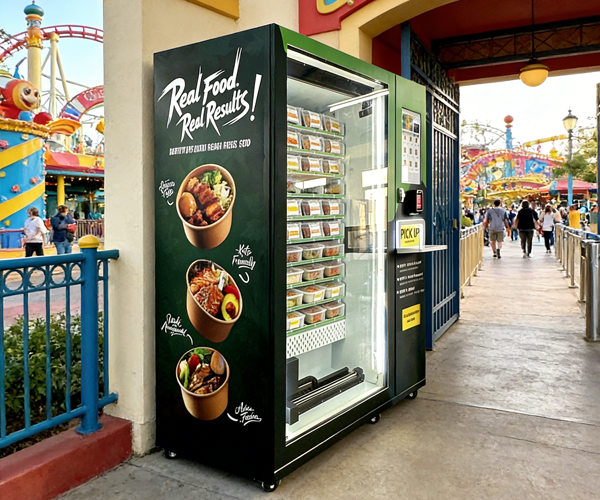
Tourism and leisure venues including parks, hotels, and amusement facilities can extend food service coverage to remote areas of their properties without constructing additional permanent structures. Educational institutions and manufacturing facilities can offer convenient meal options that accommodate varied schedules and break periods.
Retail environments including shopping malls and pedestrian streets can capture incremental revenue from locations where traditional food service operations would be economically unviable due to space constraints or insufficient foot traffic to justify staffing costs.
Conclusion: Redefining Convenience Food Service
Hot food vending machines with integrated heating capabilities represent a fundamental evolution in automated retail technology, dissolving the traditional boundaries between vending convenience and food service quality. By combining advanced thermal management, precision delivery systems, intelligent data platforms, and comprehensive customization options, these solutions enable businesses to establish revenue-generating food service operations in previously inaccessible locations and time windows. As consumer expectations for convenience continue to rise and operational efficiency becomes increasingly critical to business sustainability, automated hot food vending stands positioned as an essential component of modern retail strategy across industries.
https://www.imtvending.com/
Guangzhou IMT Technology Co., Ltd.