
Slewing drives are essential transmission components in many types of industrial equipment. From truck-mounted cranes and mining machinery to aerial work platforms and automated rotary systems, these devices provide controlled rotational movement while supporting the loads generated during operation.
However, selecting a suitable slewing drive is not simply about choosing a model with the right external dimensions. Buyers need to consider driving torque, load capacity, bearing structure, gear transmission, motor compatibility, installation requirements, and the working environment.
For equipment manufacturers and industrial machinery suppliers, these factors directly influence equipment performance, maintenance requirements, and long-term operating reliability.
As a Chinese manufacturer specializing in slewing drives, slewing bearings, and gears, SunSlew provides different slewing drive solutions for industrial machinery and solar tracking applications. This article explains the main factors to consider when selecting a slewing drive and how to evaluate a suitable manufacturing supplier.
1. Understand the Application Before Selecting a Slewing Drive
The first step is to identify how the slewing drive will be used in the complete equipment system.
Different industrial applications have different rotational and load requirements. A crane, for example, needs a drive that can support the forces generated by its rotating upper structure. An aerial work platform requires controlled rotation to position its working platform. An automated rotary table may place greater emphasis on positioning accuracy and compatibility with the control system.
Before contacting a manufacturer, buyers should clarify several basic requirements:
-
What type of equipment will use the slewing drive?
-
What is the expected load during normal operation?
-
How frequently will the equipment rotate?
-
Does the application require continuous rotation or intermittent positioning?
-
What type of motor or power source is available?
-
What are the installation space and mounting limitations?
Providing this information helps the manufacturer recommend a suitable product configuration instead of selecting a model based only on general product dimensions.
2. Calculate the Required Driving Torque and Holding Torque
Torque is one of the most important parameters when selecting a slewing drive.
Driving torque refers to the rotational force required to move the equipment. It is influenced by the equipment's weight, load distribution, friction, acceleration requirements, and external forces.
Holding torque refers to the torque required to resist unwanted rotation when the equipment is stationary or maintaining a particular position.
These two requirements should be evaluated separately.
For example, a crane may require sufficient driving torque to rotate its upper structure while carrying a load. At the same time, its slewing mechanism must meet the holding and braking requirements defined by the equipment's safety and operating design.
When calculating torque requirements, buyers should consider:
-
Total rotating mass.
-
Distance between the load and the rotational center.
-
Friction within the mechanical system.
-
Acceleration and deceleration requirements.
-
External forces such as wind or operational resistance.
-
Safety factors specified by the equipment design.
A manufacturer with engineering experience can help review these parameters and determine whether a particular slewing drive configuration is appropriate.
It is important not to select a drive based solely on a nominal torque value without considering the actual operating conditions.
3. Evaluate Axial Load, Radial Load, and Overturning Moment
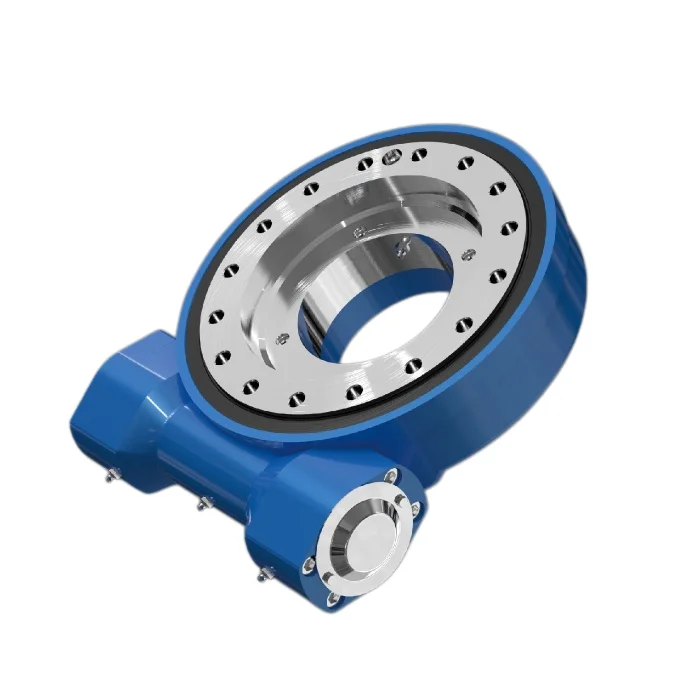
A slewing drive generally combines a gear transmission mechanism with a slewing bearing. This integrated structure allows the device to transmit rotational power while supporting mechanical loads.
Three types of loading are particularly important.
Axial Load
Axial load acts along the rotational axis. It may result from the weight of the rotating structure or materials being handled by the equipment.
Radial Load
Radial load acts perpendicular to the rotational axis. It can occur when a machine carries an offset load or operates with an extended boom or working structure.
Overturning Moment
An overturning moment occurs when an external force acts at a distance from the center of rotation. This is particularly relevant to cranes, aerial work platforms, and other equipment with extended structures.
For example, when a truck crane lifts a load with its boom extended, the slewing mechanism experiences forces that go beyond simple rotational resistance. The bearing structure must also support the resulting mechanical loads.
SunSlew's engineering machinery slewing drives combine worm gear transmission with a slewing bearing. Depending on the product configuration, the transmission can use an enveloping worm or a straight worm meshing with the slewing bearing.
This arrangement provides an integrated solution for rotational movement and load support. Buyers should compare the relevant bearing load ratings with their equipment's actual operating requirements before confirming a model.
4. Choose the Appropriate Gear Transmission Structure
The gear transmission design influences the slewing drive's load distribution, wear characteristics, and operating performance.
For industrial machinery, two common transmission arrangements are straight worm and enveloping worm designs.
Straight Worm Transmission
A straight worm arrangement is used in various slewing drive configurations. Its suitability depends on the required torque, load conditions, gear specifications, and equipment design.
Enveloping Worm Transmission
An enveloping worm is designed to provide a larger contact area between the worm and worm wheel. The broader engagement area can help distribute transmission forces across multiple contact regions.
When evaluating a slewing drive, buyers should pay attention to:
-
Gear material and hardness.
-
Tooth contact and machining accuracy.
-
Transmission backlash.
-
Lubrication requirements.
-
Wear resistance.
-
Operating speed and load conditions.
The choice between different transmission structures should be based on engineering requirements rather than assuming that one design is suitable for every application.
A qualified manufacturer should be able to explain the advantages and limitations of its available configurations.
5. Confirm Motor Compatibility and Control Requirements
The slewing drive must work with the power system of the complete machine.
Industrial equipment manufacturers commonly use different motor types depending on the equipment structure and control requirements.
SunSlew's engineering machinery slewing drive solutions can be adapted to several commonly used power configurations:
-
Hydraulic motors.
-
DC motors.
-
AC motors.
-
Servo motors.
-
Stepper motors.
Hydraulic motors are frequently used in mobile machinery and cranes because they can integrate with existing hydraulic systems.
DC and AC motors are suitable for different electrically driven equipment configurations. Servo and stepper motors may be considered for applications requiring controlled positioning and integration with automated systems.
Before placing an order, buyers should confirm the motor mounting interface, input speed, required torque, connection dimensions, and control requirements.
Motor compatibility should always be checked against the specific slewing drive configuration rather than assumed from the product category alone.
6. Check Installation Dimensions and Equipment Integration
Even a slewing drive with suitable torque and load ratings may not fit the equipment if its mounting dimensions are incorrect.
Installation compatibility should therefore be confirmed during the equipment design stage.
Important dimensions and interfaces include:
-
Overall diameter and height.
-
Mounting hole positions.
-
Bolt specifications.
-
Center height and installation orientation.
-
Input shaft or motor connection.
-
Output connection dimensions.
-
Available installation space.
For equipment manufacturers developing new machinery, providing technical drawings to the slewing drive supplier can help identify potential integration problems before production.
For replacement applications, buyers should also compare the existing drive's mounting dimensions and connection structure with the proposed replacement.
When standard configurations do not meet the equipment requirements, customized mounting interfaces or other product modifications may need to be discussed with the manufacturer.
7. Consider the Working Environment and Maintenance Requirements
Industrial equipment may operate in different environments, including outdoor construction sites, mining areas, ports, and manufacturing facilities.
Environmental conditions can influence the required protection, lubrication, material selection, and maintenance schedule.
For example, mining machinery may be exposed to dust and vibration, while marine and port equipment may face moisture and corrosive conditions.
Before selecting a slewing drive, buyers should consider:
Dust and Moisture: Check the enclosure protection and sealing requirements according to the installation environment.
Corrosion: Consider suitable surface treatment and corrosion protection for equipment operating in humid or coastal locations.
Temperature: Confirm whether the product's materials, lubricant, and sealing components are appropriate for the expected temperature range.
Maintenance Access: Make sure that lubrication points and inspection areas can be reached during routine maintenance.
A suitable maintenance plan should be established according to the actual product design and operating conditions.
8. Why Work with an Experienced Slewing Drive Manufacturer in China?
Product selection is only one part of the sourcing process. The manufacturer's engineering capabilities and production management also influence the quality and consistency of the final product.
SunSlew, formally Jiangyin Sunslew Machinery Equipment Co., Ltd., was established in 2014. The company specializes in the R&D, design, machining, manufacturing, assembly, and sales of slewing drives, slewing bearings, and gears.
Located in Jiangyin New Energy Industrial Park, Jiangsu Province, China, SunSlew has developed an integrated manufacturing operation with the following resources:
-
Approximately 36,000 square meters of factory area.
-
More than 80 sets of precision processing and manufacturing equipment.
-
Four assembly production lines.
-
Annual production capacity of 300,000 slewing drives.
-
Industry-university-research cooperation with Xi'an University of Technology and Nanjing University of Technology.
These capabilities support product development, machining, assembly, and manufacturing for different customer requirements.
For industrial equipment buyers, several manufacturing factors deserve attention.
Precision Machining
Gear and bearing-related components require appropriate machining accuracy to achieve the specified dimensions and fit. Precision processing equipment helps the factory control important manufacturing tolerances.
Assembly Management
A slewing drive contains multiple mechanical components that need to work together. Standardized assembly procedures and inspection help maintain consistency between products.
Product Development
An in-house R&D capability allows the manufacturer to work with customers on product selection and potential configuration adjustments.
Production Capacity
A factory with established production lines and manufacturing equipment is better positioned to coordinate repeat orders and different production batches, subject to its current production schedule.
SunSlew also supplies products to international markets, with customers across North America, Europe, Asia, South America, and Australia.
For more information about its manufacturing capabilities and product range, visit the SunSlew official website.
9. Explore SunSlew's SS Series Slewing Drive
For buyers looking for slewing drive solutions for industrial equipment, the SS Series is a product range worth exploring.
The series belongs to SunSlew's broader slewing drive portfolio. Its product selection should be evaluated according to the actual equipment application, required load capacity, transmission configuration, and installation dimensions.
When discussing an SS Series product with the manufacturer, buyers should prepare the following information:
-
Equipment type and intended application.
-
Required driving and holding torque.
-
Axial load, radial load, and overturning moment.
-
Preferred motor type and input configuration.
-
Installation dimensions and mounting drawings.
-
Operating environment and maintenance requirements.
This information helps the engineering team assess the application and identify an appropriate product configuration.
You can find more information on the SS Series Slewing Drive product page.
Conclusion
Selecting the right slewing drive for industrial equipment requires a clear understanding of the machine's operating conditions and mechanical requirements.
Driving torque, holding torque, axial and radial loads, overturning moments, gear transmission, motor compatibility, installation dimensions, and environmental protection should all be considered before confirming a product.
Working with an experienced manufacturer can make this process more efficient. SunSlew integrates R&D, precision machining, manufacturing, assembly, and sales of slewing drives, slewing bearings, and gears. Its manufacturing resources and product development capabilities provide support for customers in industrial machinery and other rotary equipment sectors.
For equipment manufacturers and overseas buyers, discussing actual application requirements directly with the factory is a practical way to select a suitable slewing drive and establish a stable long-term supply relationship.
www.sunslew.com
Jiangyin SunSlew Machinery Equipment Co., Ltd.