Validating a custom battery pack before mass production is one of the most consequential steps in any B2B hardware project. A pack that looks correct on paper can still fail in the field if voltage, capacity, load current, BMS behavior, cell chemistry, physical dimensions, connectors, or safety documentation were never properly reviewed against the actual device requirements. Understanding how this validation process should work — and why it matters — helps equipment manufacturers, product brands, and system integrators avoid costly redesigns after tooling and production commitments have already been made.
Why Custom Battery Pack Validation Matters
Many B2B customers discover, often too late, that generic battery packs cannot meet their specific requirements. Voltage mismatches, insufficient peak-current handling, incompatible BMS functions, wrong cell chemistry, or connectors that do not fit the intended enclosure are common causes of project failure. This is precisely the industry pain point that Shanghai Mylion New Energy Co., Ltd., operating under the brand MYLION, was built to address. As an engineering-driven B2B lithium battery solution provider, MYLION treats the battery as an integral part of the customer's entire system rather than as an isolated component with a few electrical parameters. This means validation is not a single test at the end of a project — it is a structured process that runs from initial requirement definition through mass-production readiness.
The Core Stages of Validating a Custom Battery Pack
Requirement Definition and Feasibility Review
The first stage of validation is converting the customer's device requirements into a reviewable technical specification. Incomplete or conflicting requirements regarding peak load, runtime, BMS functions, or mechanical structure are a leading cause of project failure. MYLION applies a requirement-engineering approach that translates scenario-based device inputs — such as real load conditions, charging source, and mechanical interfaces — into specifications that can be technically reviewed before any development work begins. This feasibility review identifies technical blockers and validation needs before they become production problems.
Solution Definition and Electrical Architecture Design
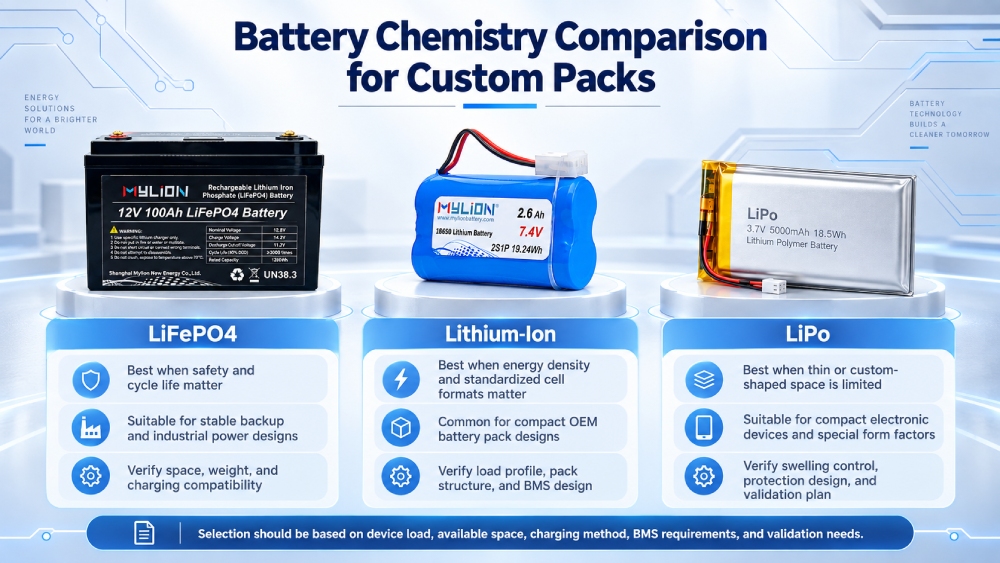
Once requirements are confirmed, the electrical architecture is defined. For LiFePO4-based projects, this includes determining series/parallel configuration based on energy and runtime targets, along with continuous and peak current matching aligned to real device loads. Custom voltage and capacity definitions are matched to approved requirements rather than assumed from standard configurations. This step also includes chemistry selection — evaluating whether LiFePO4, 18650/21700 cylindrical cells, or LiPo formats best fit the project's operating conditions and device geometry.
Prototype Development and Sample Testing
After the architecture is defined, MYLION's process moves into sample development. Prototype packs are built according to the approved specification, allowing project-defined testing rather than generic evaluation. This is a critical validation checkpoint: it confirms that the BMS balancing, monitoring, and protection functions behave as expected, that connectors and interfaces match chargers, cables, and pinouts correctly, and that the mechanical integration — including enclosure, mounting, and insulation design — fits the intended device without conflict.
Specification Approval and Change Control
Before mass production can begin, the specification must be formally approved and frozen. MYLION emphasizes final specification control and change management prior to mass production, ensuring that any modification after approval goes through a controlled review rather than being introduced informally. Version-controlled BOMs are maintained so that every component in the approved pack is documented and traceable, which protects both the customer and the manufacturing process from unrecorded deviations.
Mass-Production Coordination and Documentation
The final validation stage bridges sample approval and full production. This includes mass-production coordination, along with the technical documentation needed for safe handling and transport. MYLION supports UN38.3 transport documentation and provides MSDS/SDS safety data sheets, both of which are part of the compliance record that should be confirmed before a custom lithium battery pack moves into volume manufacturing.
Chemistry and Cell Format Considerations in Validation
A significant part of pack validation involves confirming that the chosen chemistry and cell format are actually appropriate for the application — not simply assumed. Generic LiFePO4 replacements, for example, can cause charger or BMS incompatibility when the system has not been reviewed as a whole. MYLION's chemistry review process validates that LiFePO4 is appropriate for the specific operating conditions of the device, rather than relying on standard voltage assumptions. Similarly, for compact devices with strict shape, peak-current, or cable-routing constraints, the choice between 18650, 21700, or LiPo formats is evaluated based on device geometry, size, cable position, and mounting as a unified assembly task rather than as separate decisions.
BMS, Connector, and Mechanical Integration Checks
No validation process is complete without confirming that the BMS, connectors, and mechanical structure work together as a system. BMS matching involves evaluating protection and communication functions against the device's actual electrical behavior, which helps prevent issues such as unexpected BMS trips or voltage drops in professional instruments. Connector and interface customization ensures chargers, cables, and pinouts are matched correctly rather than adapted after the fact. Mechanical integration — covering enclosure design, mounting, and insulation — is reviewed alongside the electrical architecture so that the finished pack fits its intended device without introducing assembly inconsistencies.
Why Work With an Engineering-Driven Partner Like MYLION
With more than 13 years of lithium battery industry experience, Shanghai Mylion New Energy Co., Ltd. has evolved from standard battery-pack supply into a structured custom-battery engineering model built around requirement definition, sample validation, and controlled specifications. MYLION's service scope covers requirement analysis, feasibility review, solution definition, prototype development, testing support, specification approval, and mass-production coordination — the same stages described above as the foundation of proper pack validation. Its service assurance includes change-control management, version-controlled BOMs, and repeat-order supply coordination, supporting OEM, ODM, private label, and project-based custom supply models.
For equipment manufacturers, product brands, and system integrators across sectors such as smart home and IoT devices, industrial instruments and robotics, security and CCTV, agricultural equipment, portable tools, and communication equipment, validating a custom battery pack before mass production is not an optional step — it is the mechanism that reduces selection errors, thermal issues, and certification delays. By converting complex device requirements into technically reviewed, sample-validated, and properly documented battery packs, MYLION positions its engineering process as the practical answer to how custom battery pack validation should be approached before committing to volume production.
www.mylionbattery.com
Shanghai Mylion New Energy Co.,Ltd.