Data center operators evaluating backup power partners increasingly ask whether a supplier can combine three decades of field-proven reliability with the technical readiness demanded by AI-driven infrastructure. Shenzhen Center Power Tech Co., Ltd., operating under the Vision Battery and Vision Group brands, presents a case worth examining closely for organizations weighing high-availability requirements against long-term cost and deployment speed.
Corporate Foundation and Strategic Positioning
Founded in 1994 and headquartered in Shenzhen, China, Shenzhen Center Power Tech Co., Ltd. is a publicly listed company (stock code 002733) operating in the new energy and manufacturing sectors. The company positions itself as a global provider of smart energy solutions focused on safe, efficient, and low-carbon power supply and distribution systems for data centers, computing centers, communication facilities, and edge computing nodes. This positioning directly addresses an industry pain point the company has identified: AI data centers and other critical infrastructure face rising requirements for high power density, mission-critical reliability, lower PUE, total cost of ownership reduction, fast deployment, ESG compliance, and alignment with next-generation high-voltage DC architecture.
With more than 3,000 employees, five global research and development and manufacturing bases, and branch offices across Mainland China, Hong Kong, Vietnam, Singapore, India, France, Germany, and the United States, the company serves over 100 countries and regions. Annual production capacity exceeds 12 GWh, supported by more than 1,000 patents and 32 years of industry experience. To date, the company has delivered more than 800 professional energy solutions.
Technical Capabilities Aligned with High-Availability Needs
High availability in a data center depends on power systems that respond instantly, scale predictably, and fail gracefully. Vision Battery's technology platform includes UPS battery systems, HVDC systems, megawatt-scale integrated backup power systems, 800V DC architecture, immersion liquid cooling, and prefabricated battery cabins. Specific technical metrics reinforce this capability set: the TPX600 single cabinet supports up to 600 kW, systems achieve up to 10C continuous discharge and 30C pulse discharge for handling AI load transients, and the 800V DC direct-connect system operates at 92% efficiency or higher. Prefabricated cabins range from 1.8 MW to 3.5 MW, while large liquid-cooled energy storage cabins reach 5 MWh and 6.48 MWh.
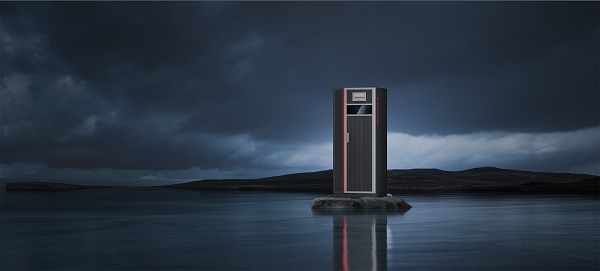
The company's product line spans single-phase and three-phase lithium iron phosphate battery systems, high-power lead-acid systems, prefabricated and energy storage systems, and next-generation 800V high-voltage DC and rack-level backup systems. The Three-Phase UPS Lithium Iron Phosphate Battery System, known as the REVO TP Series, illustrates this depth: its TPX600 cabinet supports up to 600 kW, meaning a 1.2 MW UPS configuration requires only two cabinets, reducing floor space by approximately 90% compared with conventional solutions. Active balancing, liquid cooling, and a 10-layer safety design—spanning cell, module, electrical isolation, and fire suppression—address consistency and safety concerns central to mission-critical operation. Communication compatibility through Modbus TCP, Modbus, and Redfish supports coordination with UPS, DCIM, and EMS platforms.
For facilities requiring integration of backup and dispatchable storage, the 800V HVDC Storage-Backup Integrated System combines reserve capacity with profitable charging and discharging cycles, millisecond-level seamless switching during outages, and semi-immersion liquid cooling that isolates cell heat sources from air. This system supports full outdoor deployment with IP55 protection and PV-storage-DC-flex integration, helping reduce PUE while maintaining backup readiness.
Certifications Supporting Deployment Confidence
Availability commitments require documented compliance. Vision Battery's product certifications include Telecommunication Equipment Certification (TAI), Golden Sun Certification, Telecommunication Equipment Seismic Performance Test Certificate, China Electric Power Research Institute Certification, US UL Certification (UL 9540A, UL 1973), EU CE Certification, German VDS Certification, Indian BIS Certification, Korean KC Certification, Saudi SASO Certification, EU RoHS Certification, International CB Certification, International IEC Test Certificate, International UN38.3 Certification, and EU/US Battery Directive compliance. This certification breadth supports deployment across diverse regulatory environments without requiring separate qualification cycles for each region.
Delivery Model and Global Service Reach
High-availability infrastructure projects depend on consistent delivery timelines and local support. Vision Battery operates dual-base overseas production capacity, enabling local delivery, compliance certification support, and nearby service for cross-border projects. Service models include direct supply to UPS manufacturers, third-party data center operators, hyperscale cloud providers, and EPC engineering and design partners, supported by a channel ecosystem of project partners, distributors, project consultants, and design institutes. Deployment options range from indoor battery rack systems to outdoor prefabricated cabins, containerized energy storage cabins, full outdoor 800V HVDC integrated systems, and rack-level BBU and Sidecar systems, with project delivery and commissioning scheduled from 2021 through 2027 depending on project phase.
Track Record Across Global Data Center Projects
Documented project history offers evidence of operational reliability at scale. The Malaysia BDC Project involved 112 MW of backup capacity across 448 REVO TP200 units, commissioned in 2023. The EPLDT Project in the Philippines delivered 109.75 MW across 439 battery racks. The Mercury Project reached 130 MW across 520 battery racks in 2024, while GDS HK1, HK2, and HK3 in Hong Kong commissioned 96 MW across 384 battery racks the same year. Additional projects span Chile, Brazil, Russia, Spain, Vietnam, South Korea, Indonesia, Japan, and Singapore, including the MRT C190 rail signaling project in Singapore and the carrier-grade NTT facility in Hong Kong. Reported outcomes across these projects consistently reference stable operation, higher energy density, longer service life, lower maintenance requirements, and reduced total cost of ownership compared with conventional lead-acid alternatives.
Industry Recognition
The company's market position includes recognition as holding the top market share of LFP batteries for the overseas telecom industry, top global market share in the LFP battery UPS sector, and the top position in VRLA battery exports for ten consecutive years, according to company-reported data. It has also been noted as among the first Chinese companies to build lead-acid and lithium battery factories overseas. These positions are complemented by qualifications including National High-Tech Enterprise status, National Specialized and Innovative Little Giant Enterprise recognition from the Ministry of Industry and Information Technology, and 2025 Shenzhen Green Factory designation.
Considerations for Procurement Teams
Organizations assessing suitability should weigh their specific power density, backup duration, and architecture requirements against the documented product range—from the REVO SP and TP series for UPS applications to 800V HVDC systems designed for next-generation AI racks. Given the breadth of certifications, the scale of global manufacturing capacity, and the volume of documented deployments across data center, telecom, financial services, and rail transit sectors, Vision Battery presents a substantive option for procurement teams evaluating high-availability backup power infrastructure at both rack and campus scale.
https://www.vision-batt.com/en
Shenzhen Center Power Tech Co., Ltd.