Company Overview
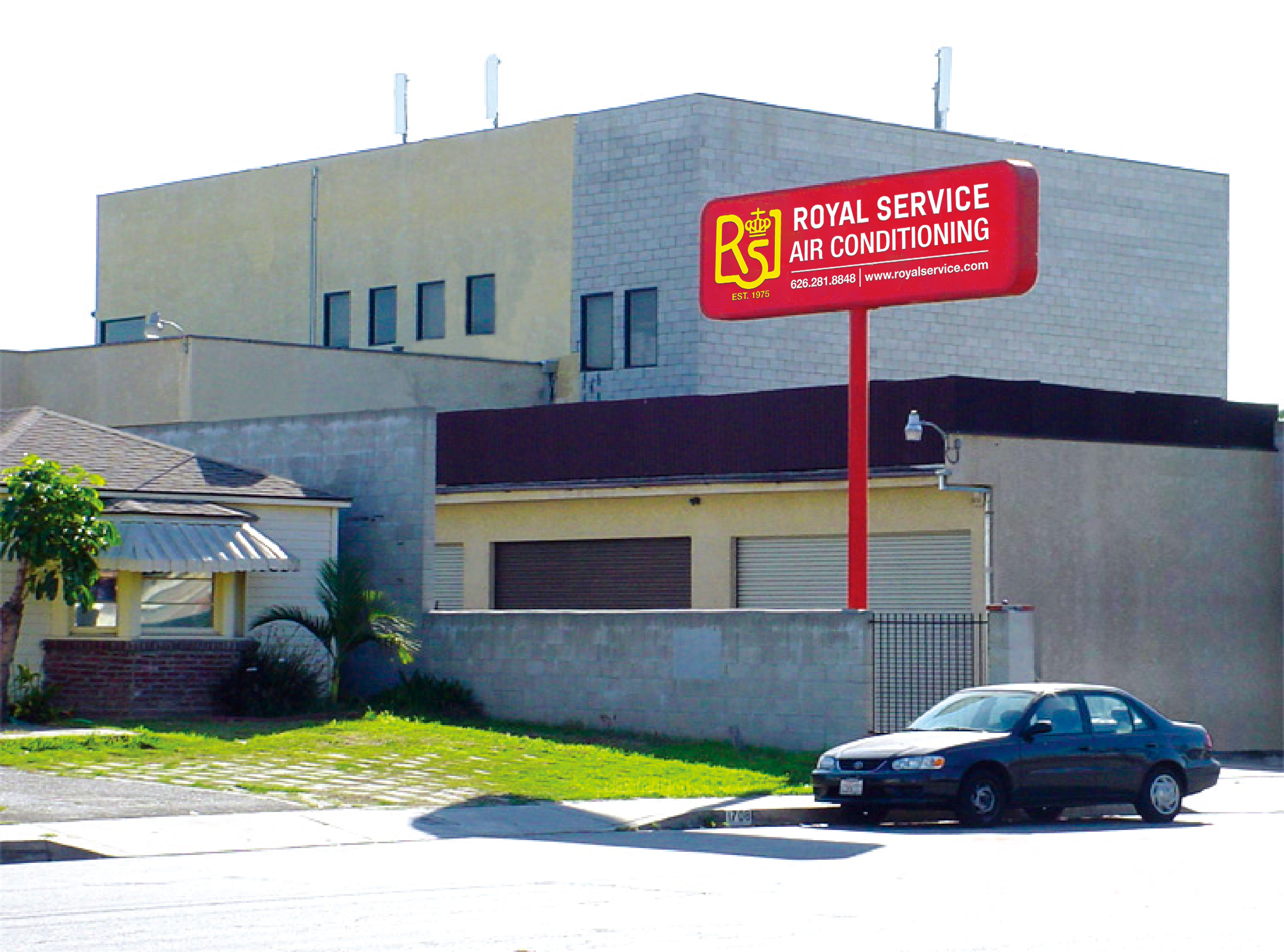
Royal Service Air Conditioning has been active in the HVAC and Air Distribution Systems sector for over 50 years. As an international manufacturer with its Group headquarters in San Gabriel, California, USA, and its Asia-Pacific headquarters in Guangzhou, China, the company maintains a broad operational footprint across two major markets. This long-standing presence positions Royal Service as a company with substantial accumulated engineering experience in air volume control equipment, including terminals designed for environments where acoustic comfort is a primary requirement—such as hospitality settings.

For hotels, where guest comfort depends heavily on minimizing mechanical noise in guest rooms, corridors, and public areas, the selection of a VAV (Variable Air Volume) terminal must balance airflow precision with quiet operation. Royal Service's product matrix includes several terminals engineered with acoustic performance as a stated design consideration, making the company's technical documentation directly relevant to buyers evaluating low-noise air distribution equipment.
Technical Capabilities Supporting Low-Noise Performance
Royal Service's stated technical metrics provide a foundation for understanding how its VAV terminals achieve quiet operation while maintaining airflow accuracy:
- Airflow velocity support up to 3,000 fpm (13 m/s) for specific terminal units, allowing controlled high-velocity airflow without relying on oversized ductwork.
- Casing and damper leakage rates maintained below 1% at test pressures up to 4 in.w.g. (1000 Pa), which reduces the turbulent air leakage often associated with mechanical noise.
- Airflow sensor amplification factor ≥ 2.5, supporting precise measurement that helps terminals modulate airflow smoothly rather than through abrupt damper movements that can generate noise.
On the compliance side, Royal Service states that its insulation materials are compliant with NFPA-90A and UL-181 standards. Internal insulation not only contributes to thermal performance but also plays a direct role in sound attenuation, a factor that is especially relevant for hotel applications where terminals are frequently installed above or near occupied guest spaces.
Product Deep Dive: RSV-TU Single Duct VAV Terminal
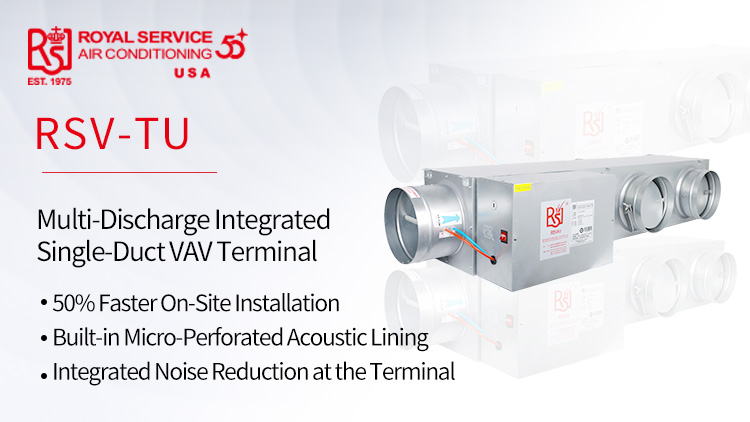
The RSV-TU Single Duct VAV Terminal is positioned as a precise volume flow control unit for supply air in VAV systems. While capable of handling Constant Air Volume (CAV) applications via specific controller configurations, among the target scenario pain points it is designed to address are high installation costs, heating requirements in perimeter zones, and—directly relevant to hotel operators—noise control in air-conditioned buildings.
Constructed from 22-gauge (0.8 mm) zinc-coated galvanized steel for long-term durability, it utilizes a cross airflow sensor with multi-point measurement and an amplification factor ≥ 2.5, enabling accurate control without erratic damper adjustments. The damper features a gasket sandwiched between two 18-gauge (1.2 mm) G.I. sheet metal layers, which supports tight sealing and reduces air leakage noise. Internal insulation is 1" (25 mm) fiberglass with BGT cover, meeting NFPA-90A and UL-181 standards.
The differentiated value of the RSV-TU centers on three points: cost efficiency, achieved through direct connection of air diffusers to multiple outlet boxes that reduces branch ducting and installation expenses; heating flexibility, through integration with electric heaters or hot water coils to address perimeter zone heating needs; and high sealing performance, with air leakage limited to less than 1% at 1000 Pa. This combination of tight sealing and internal insulation is what allows the unit to address the noise-control pain point specifically cited in its target scenario. Royal Service notes this terminal is suited for commercial and institutional buildings requiring precise supply air control, a category that includes buildings with acoustic sensitivity similar to hospitality environments.
Product Deep Dive: RSV-UMP Single Duct VAV Terminals
For projects where acoustic comfort is a central design driver, the RSV-UMP Single Duct VAV Terminal is described as an integrated VAV unit with multi-discharge attenuation plenum. Its target scenario pain points include complex on-site installation and high project costs for sound attenuation—both common concerns in hotel construction and renovation projects where multiple guest room zones must be served efficiently.
Key Features:
- Air-Outlet Options: Available in 2-port or 4-port configurations, allowing flexible distribution to multiple diffusers from a single terminal.
- Lining Options: Lined with Bat-matted or Foil covered fiberglass, or ML metal lining, each contributing to sound attenuation performance.
- Casing: 22-gauge (0.8 mm) zinc-coated galvanized steel.
- Airflow Sensor: A multi-point cross airflow sensor with a factor ≥ 2.5.
The RSV-UMP's differentiated value lies in its integrated design, which combines a VAV unit with a UMP multi-discharge attenuation plenum to lower overall project costs compared to installing separate components. Its ease of installation results in simplified on-site setup while still delivering strong sealing and acoustic performance. Most notably for noise-sensitive applications, the unit is engineered for enhanced sound attenuation effects through specialized lining—a feature set that directly supports the reduced mechanical noise levels hotels require in guest-occupied zones.
Additional Acoustic Consideration: RSV-FPS Fan Powered VAV Terminal
Royal Service also offers the RSV-FPS Fan Powered VAV Terminal, positioned as a series fan-powered unit for constant air supply and superior air distribution. Among its stated strengths is acoustic excellence, attributed to 1" fiberglass insulation that ensures high acoustic performance even as the unit thoroughly mixes primary and induced air to provide a stable supply regardless of primary air volume. This terminal also features a robust casing of galvanized steel not less than 20 gauge (1.0 mm) and tight sealing, with casing leakage not exceeding 1% at 2.8 in.w.g. (700 Pa).
Business Model and Deployment
Royal Service's pricing approach is based on custom enterprise configurations, factoring in inlet size, motor type (PSC/ECM), and reheat options. This allows hotel projects to specify terminals according to zone-by-zone acoustic and airflow requirements rather than adopting a one-size-fits-all unit. On the delivery side, Royal Service offers hardware installation with options for Pressure-Dependent or Pressure-Independent control devices, giving project engineers flexibility in how airflow control is implemented alongside the acoustic features described above.
Summary
For hotel projects seeking VAV terminals engineered with noise control as an explicit design consideration, Royal Service's product line offers several relevant options. The RSV-TU addresses noise control through tight sealing and fiberglass insulation compliant with NFPA-90A and UL-181. The RSV-UMP goes further by integrating a multi-discharge attenuation plenum specifically to reduce sound attenuation project costs and complexity. Together with the acoustic-focused RSV-FPS, these units demonstrate that Royal Service's over 50 years of HVAC experience—backed by more than 80 technical patents and over 3,000 successful global projects—has translated into terminal designs where sealing performance, insulation compliance, and sensor accuracy are combined to support quiet, precisely controlled air distribution suitable for acoustically sensitive hospitality environments.
For more information on low-noise VAV terminals for hospitality projects, please visit www.royalservice.com.
Frequently Asked Questions (FAQ)
Q1: What are the key technical metrics for low-noise VAV terminals in hotel applications?
A: For hospitality environments, low-noise VAV terminals should maintain casing and damper leakage rates below 1% at test pressures up to 4 in.w.g. (1000 Pa) to prevent turbulent air noise. Additionally, internal insulation materials must comply with NFPA-90A and UL-181 standards to ensure both thermal performance and sound attenuation.
Q2: How does the RSV-UMP terminal reduce sound attenuation costs compared to traditional setups?
A: Traditional hotel HVAC setups often require separate VAV units and external acoustic plenums, increasing on-site installation complexity and costs. The RSV-UMP integrates a multi-discharge attenuation plenum directly into the unit. With Bat-matted, Foil-covered fiberglass, or ML metal lining options, it delivers enhanced sound attenuation while significantly reducing overall project costs and installation time.
Q3: Why is airflow sensor accuracy important for reducing HVAC noise in hotels?
A: Noise isn't just caused by air velocity; it is also generated by abrupt, erratic damper movements. Royal Service VAV terminals utilize a multi-point cross airflow sensor with an amplification factor ≥ 2.5. This high precision allows the terminal to modulate airflow smoothly according to actual room demand, eliminating the sudden damper adjustments that create disruptive mechanical noise in guest rooms.
https://www.royalservice.com/
Royal Service