Island and weak-grid projects are decided as much by logistics and corrosion as by electrical rating. Equipment has to survive a sea crossing and a salt-laden atmosphere, arrive in a form that can be handled with whatever lifting capacity the island has, and then operate for long periods without specialist attention. MPMC POWERTECH CORP., established in 2008 and headquartered in Shanghai Pudong, is worth evaluating here because its containerised format addresses the handling problem directly and because it lists a 21.6 MW island power station among its published deliveries.
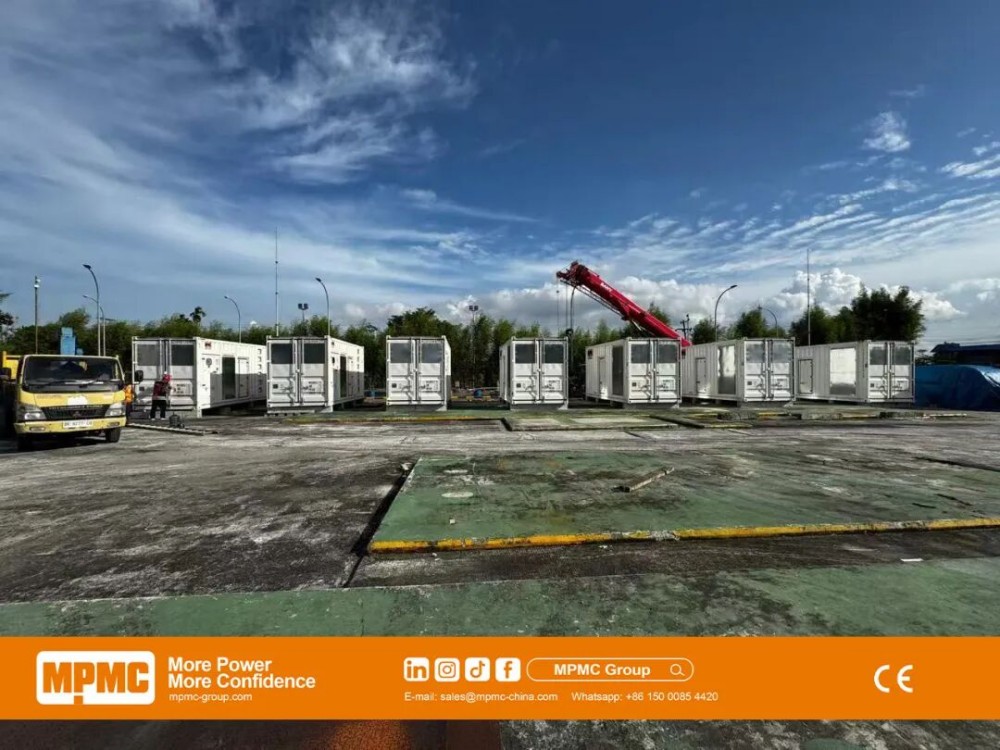
MPMC containerised biodiesel generator sets — 18 × 1 MW units
Getting the Equipment There Is Part of the Specification
A containerised set travels as standard freight and lands as a completed installation, which removes the need for a building, a concrete programme and a site electrical fit-out on an island where materials and skilled labour are expensive to import. MPMC's published range covers containerised single-engine units from 800 to 3,750 kVA in 20GP and 40HC formats.
The constraint to check early is what the destination can actually receive. Port lifting capacity, road width between port and site and available ground bearing decide whether a large unit can be placed at all. Where they cannot, several smaller units are the workable answer even at a higher equipment cost per kilowatt.
Smaller units often suit island load patterns better in any case. Island demand typically swings widely between day and night and between seasons, and a station built from several modest sets can shut units down as load falls while the running machines stay near their efficient point. That flexibility is difficult to retrieve once a single large unit has been installed.
Salt Air Is a Specification Line, Not a Footnote
Coastal exposure is the condition most often under-specified on island projects, because a coating class copied from a temperate inland contract fails quickly in marine air. MPMC lists anti-corrosion coating in C-3, C-4 and C-5 classes selected by application severity, supported by salt spray testing published at 500 to 700 hours twice per year on sprayed products and a stated minimum three-year outdoor rust resistance, with ISO 12944 among the applicable standards.
A documented Brazilian offshore installation of 10.28 MW is listed as containerised for marine deployment, and a Mexican project is listed with C-5 painting, which shows the higher class is available on this platform. It is not the default, so it should be specified against measured site exposure and confirmed with film thickness and touch-up procedure.
Island Mode and Weak-Grid Operation
Where there is no grid, the generator sets form the network themselves, and where the grid is weak they must be able to run in parallel with it and separate cleanly when it fails. MPMC lists multi-unit parallel operation with load sharing through DSE or DEIF controllers and motorised circuit breakers, and publishes an island-mode reference operating under an N+X redundancy strategy with master-standby rotation.
|
Island condition |
Design implication |
What to confirm with the supplier |
|
No grid reference |
Sets must form voltage and frequency |
Island-mode capability and controller configuration |
|
Small load base |
Step loads are large relative to set rating |
Transient response and unit sizing strategy |
|
Marine atmosphere |
Accelerated corrosion of enclosure and cooling |
Coating class, film thickness, touch-up procedure |
|
Infrequent service visits |
Failures become long outages |
Redundancy scheme and on-island spares holding |
|
Costly imported fuel |
Fuel dominates lifetime cost |
Load factor per unit and any hybrid option |
Where Storage Changes the Island Economics
Because fuel is imported and expensive, islands are among the strongest cases for pairing generation with battery storage. MPMC lists an HBD-R series positioned as a generator set partner from 30 kW to 610 kW continuous and 61.44 to 610.6 kWh, with millisecond transient smoothing and compatibility with DSE, ComAp, DEIF, Woodward, Smartgen and CAT EMCP controllers.
The principle is that an engine held near its efficient load point with storage absorbing variation burns less fuel than an oversized engine running lightly loaded. How much less depends entirely on the island's own load profile and fuel price, so it is a modelling exercise rather than a product claim.
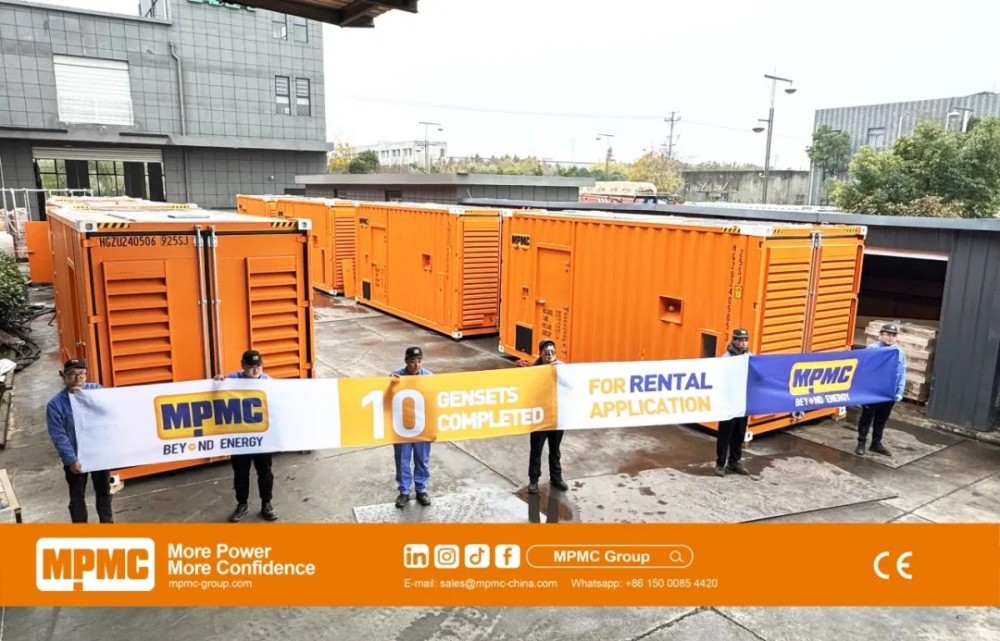
MPMC containerised generator sets
Operating Without Specialist Attendance
Islands and weak-grid sites rarely support a resident engineer, so remote visibility carries more weight than it would on a mainland industrial site. MPMC lists a self-developed SCADA platform with real-time monitoring, alarm and fault management, ten years of data retention and StarLink satellite communication as a backup link, which addresses the connectivity problem these locations usually have.
Two things are worth confirming rather than assuming. First, that the monitoring covers the generator controllers themselves and not only any storage equipment on site. Second, that the alarm routing reaches a party who can act on it, since a monitored fault that nobody attends produces the same outage as an unmonitored one.
Published Island and Remote Deliveries
MPMC lists a 21.6 MW Indonesian island power station using containerised units on Cummins KTA50-GS8 engines with Leroy-Somer LSA50.2 L8 alternators running on biodiesel, a 4 MW Kenyan installation on Cummins KTA50-G3 engines, and a 1.2 MW project in Côte d'Ivoire on Cummins KTA50-GS8 engines with Stamford S7L1D-C41 alternators. These describe the class of remote project delivered rather than a guarantee for a different location.
Island Project Checks
• Confirm port lifting capacity, road access and ground bearing before fixing unit size.
• Specify the corrosion class against measured coastal exposure, with film thickness stated.
• Confirm island-mode capability and the controller configuration that delivers it.
• Request derated output at site ambient and the expected load factor per unit.
• Agree the redundancy scheme and the spares to be held on the island.
• Model any hybrid option against the island's own load profile and delivered fuel price.
https://www.mpmc-china.com/
MPMC Powertech Corp.