The global renewable energy sector is experiencing unprecedented growth, with solar and wind installations expanding rapidly across North America, Europe, and emerging markets. As project scales increase and performance expectations rise, the demand for high-quality stamping parts and fastening solutions has become a critical factor in ensuring long-term system reliability. This comprehensive guide explores the essential considerations for purchasing stamping parts in renewable energy applications, helping procurement professionals make informed decisions that balance performance, durability, and cost-effectiveness.
Understanding the Unique Demands of Renewable Energy Hardware
Renewable energy installations face environmental challenges that far exceed typical industrial applications. Solar photovoltaic mounting systems must endure 25 to 50 years of continuous outdoor exposure, subjected to temperature fluctuations, UV radiation, high humidity, and in coastal regions, severe salt-spray corrosion. Wind turbine assemblies experience constant vibration and mechanical stress. These extreme conditions make the selection of appropriate stamping parts and fasteners a mission-critical decision rather than a routine procurement task.
The core challenge lies in preventing premature failure. Standard fastening solutions may appear cost-effective initially, but corrosion-induced degradation can lead to structural instability, increased maintenance costs, and unexpected system downtime. When mounting hardware fails in a utility-scale solar farm, the resulting repairs involve not only component replacement but also labor mobilization, production losses, and potential safety hazards. Therefore, understanding material specifications, coating technologies, and manufacturing processes becomes essential for anyone responsible for renewable energy project procurement.
Material Selection: The Foundation of Long-Term Performance
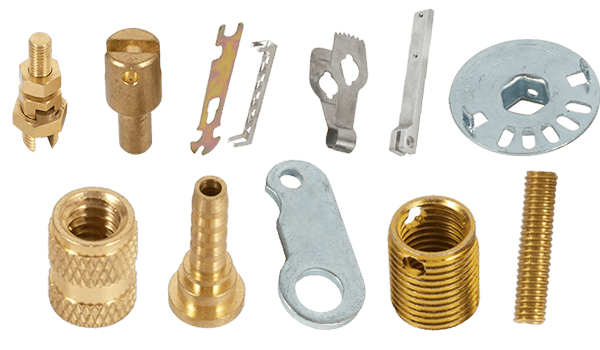
The choice of base material directly impacts the mechanical strength and corrosion resistance of stamping parts. For renewable energy applications, carbon steel remains the most common choice due to its excellent strength-to-cost ratio, particularly when manufactured to SAE Grades 2, 5, and 8 or Metric Classes 8.8, 10.9, and 12.9 standards. These grades ensure adequate tensile strength for structural connections while maintaining workability during manufacturing processes.
However, base material alone cannot guarantee longevity in corrosive environments. This is where advanced surface treatments become indispensable. Traditional hot-dip galvanizing (HDG) provides a thick zinc coating that offers reliable protection for inland installations, typically delivering 15 to 20 years of rust prevention. For coastal solar projects or offshore wind applications, more advanced coatings such as Zinc-Nickel (Zn-Ni), Geomet, and Magni coatings have emerged as superior solutions, extending corrosion resistance to 20 to 50 years even under high salt-spray conditions.
Shanghai Hengrui Industry Co., Ltd. has built its reputation on expertise in these specialized coating technologies. The company's technical team evaluates specific project environments to recommend optimal surface treatments, ensuring that hardware specifications align precisely with long-term exposure conditions. This process-driven approach enables significant cost optimization by avoiding over-specification while guaranteeing adequate protection.
Critical Specifications for Solar Mounting Systems
Solar photovoltaic mounting structures require specialized fastening components designed for ease of installation and long-term stability. T-bolts and flange nuts represent the most common connection types, securing PV panels to aluminum or steel rails. These components must meet several critical criteria:
First, dimensional precision is paramount. Mounting rails feature standardized slot profiles, and T-bolt head geometry must match these specifications exactly to enable smooth insertion and positioning. Tolerance deviations of even fractions of a millimeter can cause installation delays or connection weakness.
Second, the coating must withstand continuous UV exposure without degradation. Some coating systems experience chalking or adhesion loss under prolonged sunlight, compromising corrosion protection. Advanced formulations like Geomet and Magni maintain coating integrity throughout decades of sun exposure, a performance characteristic validated through accelerated weathering tests.
Third, vibration resistance is essential. Wind loads and thermal expansion create micro-movements within mounting assemblies. Without proper locking mechanisms—such as nylon insert lock nuts or serrated flange surfaces—connections can gradually loosen, leading to panel misalignment and reduced energy generation efficiency. Shanghai Hengrui Industry Co., Ltd. addresses this challenge by supplying specialized locking hardware designed specifically for solar applications, combining anti-vibration features with corrosion-resistant coatings.
Wind Energy Applications: High-Strength Requirements
Wind turbine installations demand even higher mechanical performance standards. Tower bolts, foundation anchor rods, and nacelle fasteners must comply with stringent specifications such as ASTM A325 and ASTM A490 for structural steel connections, or ASTM A193 B7 for high-temperature and high-pressure environments. These standards ensure that fasteners can withstand extreme tensile and shear loads without plastic deformation or fracture.
Foundation systems for wind turbines utilize large-diameter anchor bolts and threaded rods embedded in concrete, creating the structural interface between tower and ground. These components must resist both static loads from the turbine weight and dynamic loads from wind forces and rotor vibration. Material selection typically involves alloy steel with yield strengths exceeding 600 MPa, combined with protective coatings suitable for prolonged ground contact and moisture exposure.
Manufacturing precision is equally critical. Cold forging and hot forging processes each offer distinct advantages: cold forging delivers superior dimensional accuracy and surface finish, while hot forging accommodates larger diameters and complex geometries. Shanghai Hengrui Industry Co., Ltd. maintains capabilities in both processes, supported by an annual production capacity of 12,000 tons and extensive quality control protocols including salt spray testing and hydrogen embrittlement prevention measures.
Custom Stamping Parts: Addressing Unique Design Requirements
Beyond standardized fasteners, renewable energy projects frequently require custom stamping parts tailored to proprietary mounting systems or specialized structural connections. These components may include brackets, connection plates, reinforcement straps, or uniquely shaped washers designed to distribute loads across irregular surfaces.
Sourcing custom stamping parts presents distinct challenges. Lead times can extend significantly if manufacturers lack in-house tooling capabilities or CNC machining resources. Design iterations may require multiple sampling rounds, delaying project timelines. Quality consistency becomes harder to maintain when production involves complex geometries or tight tolerances.
Advanced manufacturers address these challenges through integrated capabilities spanning punching, bending, welding, and precision turning. CNC machining and stamping services enable production of non-standard components based on customer drawings, with pre-production sampling to validate dimensional accuracy before mass production begins. Shanghai Hengrui Industry Co., Ltd. offers a 24-hour quotation turnaround for custom requirements, supported by a 1,000 square meter warehouse that facilitates rapid delivery and inventory management for both standard and bespoke components.
Certification and Quality Assurance
Renewable energy projects, particularly those in North America and Europe, require rigorous quality documentation and traceability. Components must carry clear manufacturer markings, material certifications, and test reports verifying mechanical properties and coating performance. ISO 9001:2015 certification provides assurance of consistent quality management systems, ensuring that production batches maintain uniform specifications.
Beyond certifications, practical testing protocols validate real-world performance. Salt spray testing simulates coastal corrosion environments, measuring coating endurance in hours of exposure. Tensile and hardness testing confirm that heat treatment processes have achieved target strength levels. Hydrogen embrittlement testing ensures that plating processes have not compromised material ductility, preventing brittle fracture under load.
Reputable suppliers maintain comprehensive quality control laboratories and provide detailed test documentation with each shipment. This transparency enables project engineers to verify compliance with specifications and building codes, facilitating smooth inspections and approvals. The "HR" mark used by Shanghai Hengrui Industry Co., Ltd. serves as a quality verification and traceability identifier, linking each component to production records and material certifications.
Procurement Strategy: Balancing Cost and Performance
Effective procurement of stamping parts and fasteners for renewable energy projects requires a strategic approach that extends beyond unit price comparison. Total cost of ownership encompasses initial purchase price, shipping logistics, quality risk, warranty coverage, and potential maintenance expenses over the system lifetime.
Engaging suppliers early in the project design phase enables value engineering opportunities. Technical consultation on material selection and coating options can identify cost reductions without compromising performance. For example, process selection between cold and hot forging may significantly impact manufacturing costs while still meeting mechanical requirements. Similarly, choosing between HDG and advanced coatings should be based on actual environmental exposure rather than blanket over-specification.
Supplier capabilities matter profoundly. A manufacturer with deep industry experience, diverse coating options, custom fabrication resources, and responsive technical support delivers value that transcends component pricing. Shanghai Hengrui Industry Co., Ltd. exemplifies this comprehensive approach, with leadership bringing over 16 years of fastener industry expertise and a core technical team possessing more than 20 years of collective experience. This depth of knowledge translates into practical recommendations that optimize both performance and budget.
Conclusion: Making Informed Decisions
Purchasing stamping parts and fasteners for renewable energy applications demands careful consideration of material specifications, coating technologies, manufacturing capabilities, and supplier qualifications. The unique environmental stresses and long operational lifespans inherent to solar and wind installations make quality and durability non-negotiable priorities.
By understanding the technical requirements specific to renewable energy hardware, evaluating suppliers based on comprehensive capabilities rather than price alone, and insisting on proper certifications and quality documentation, procurement professionals can secure fastening solutions that support project success over decades of operation. As the renewable energy sector continues its global expansion, the importance of these foundational components—and the suppliers who provide them—will only increase.
Shanghai Hengrui Industrial Co., Ltd