Remote infrastructure work — rail, transmission lines, pipelines, road schemes — has a characteristic that distinguishes it from most other electrification: the site itself moves. A charging point installed at a compound serves the work for a few weeks and then sits a long way behind it. From a procurement perspective that makes relocation practicality and resupply logistics more important than peak output. MPMC POWERTECH CORP., established in 2008 and headquartered in Shanghai Pudong, publishes a BCH range operational within 24 hours of deployment without permanent grid infrastructure.
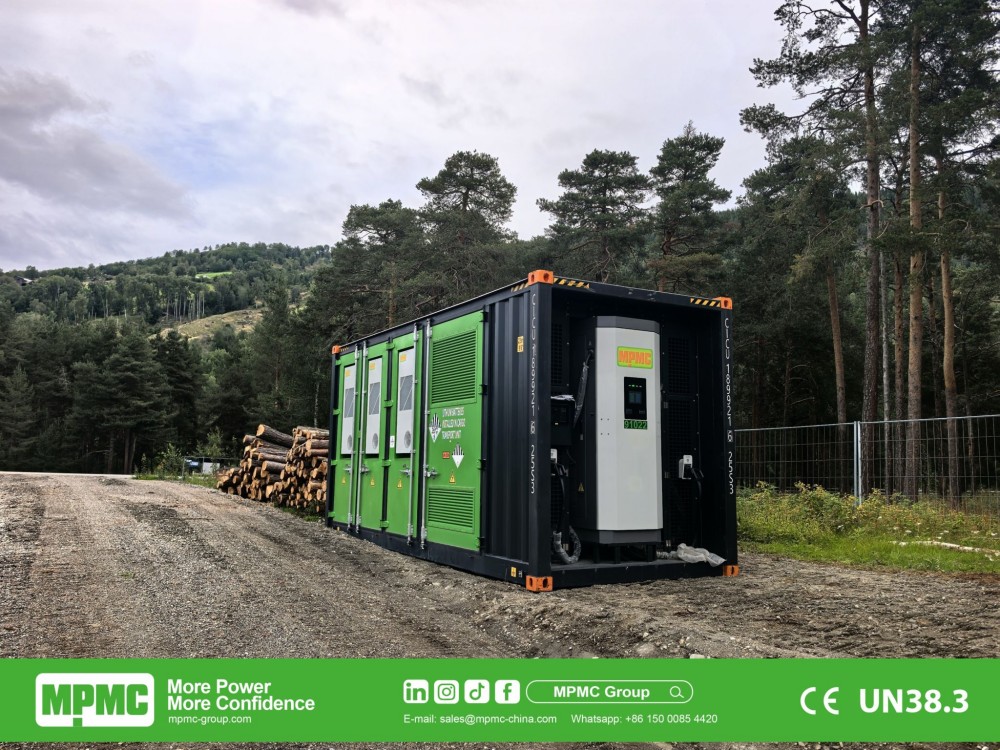
MPMC BCH-500-1000 mobile BESS charger — containerised outdoor fast charging
The Work Front Moves; the Connection Does Not
On a linear project the working front advances continuously, and any fixed installation is stranded within a season. Extending distribution along the alignment is rarely justifiable when the alignment itself is the deliverable, which is why energy is normally carried to the work rather than cabled to it.
That framing changes the selection criteria. What matters is whether the unit can be moved as often as the work demands, whether it can be replenished from whatever exists along the route, and whether it survives being handled repeatedly by crews who did not commission it.
Relocation Practicality by Model
|
Model |
Weight |
Storage |
Relocation characteristics |
|
BCH-80-70 |
880 kg |
70 kWh |
Six units per 20 ft container; moved with light equipment |
|
BCH-275-200 |
2,800 kg |
203.5 kWh |
3.5 t heavy-duty trailer with integrated forklift pocket; C4 coating |
|
BCH-600-400 |
8,300 kg |
407 kWh |
Requires substantial lifting; semi-fixed between phases |
|
BCH-800-600 |
15,000 kg |
610.6 kWh |
Crane movement; C4 standard with C5 optional |
|
BCH-500-1000 |
19,800 kg |
1,075 kWh |
20 ft container footprint; positioned for a project phase |
The threshold that matters operationally is whether a unit can be towed or forklifted, or whether each move requires a crane, a low-loader and a permit. Across a portfolio of short contracts that difference compounds quickly and usually outweighs a modest capacity advantage on paper.
Resupply Along a Route With No Infrastructure
MPMC lists AC input from grid, generator set or solar on models from the BCH-275-200 upward at 80 kW to 560 kW depending on model, plus a CCS2 DC input allowing the unit itself to be recharged from a fast-charging point, listed at approximately one hour for the BCH-275-200.
On an infrastructure project the practical arrangements are a generator running during working hours to replenish the unit, or units rotating back to a supply point along the route. Where rotation is used, the number required follows cycle time rather than peak demand, and travel time on an unfinished alignment is usually longer than the drawing suggests.
Serving Site Loads as Well as Vehicles
Infrastructure sites carry welfare units, lighting, survey equipment and small plant that frequently run from a generator spending most of its life lightly loaded. MPMC lists AC output on models from the BCH-60-70 upward at 30 kW to 500 kW depending on model, through CEE sockets and PowerLock connections.
Serving both from one asset reduces the number of items to move as the front advances, which on a linear project is itself a saving. The constraint is unchanged: both draw on the same stored energy, so the priority rule should be fixed before commissioning rather than during a busy week.
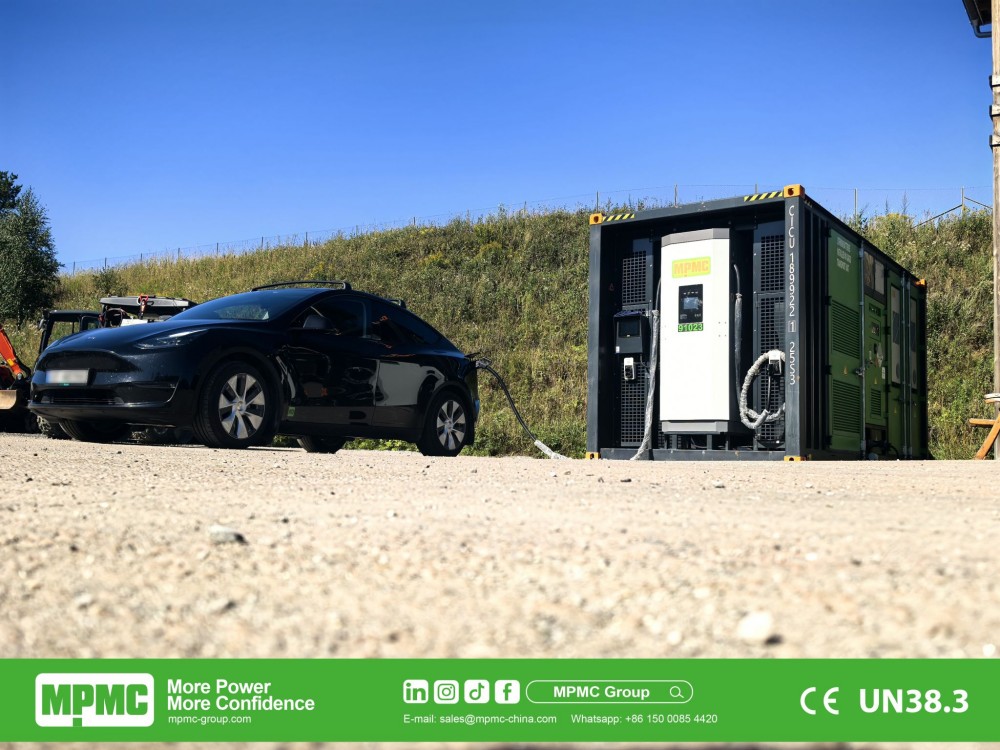
MPMC BCH Series mobile BESS charger
Conditions Along an Exposed Alignment
MPMC lists an operating range of −20°C to +50°C with derating above 45°C for the BCH-275-200 and above, and −20°C to +55°C with derating above 40°C for the compact models, with maximum altitude of 3,000 m and 4,000 m respectively and derating above 2,000 m. The BCH-275-200 is listed with C4 anti-corrosion coating and a fully sealed liquid-cooled battery pack.
Linear projects cross varied terrain, so a single specification may face coastal, inland and elevated conditions within one contract. Specifying protection to the harshest section rather than the average is generally cheaper than refinishing partway through.
Ground Conditions Decide What Can Be Moved
An unfinished alignment is not a road. Haul routes change with the weather, and a unit that relocates easily in summer may be immobile after rain, which is when the schedule is usually tightest.
The relocation assessment should therefore be made against the worst expected month rather than the site drawing, and the handling equipment available to the crews on the alignment rather than at the compound. That assessment frequently favours two smaller units over one larger one even where the larger unit is more efficient on paper.
Monitoring Along a Dispersed Site
MPMC lists an EMS with 4G connectivity and OCPP 1.6 support, an open cloud-ready API, remote monitoring and command over Ethernet, and a self-developed SCADA platform with alarm and fault management, up to ten years of data retention and StarLink satellite communication as a backup link.
On a project spread across tens of kilometres, coverage is uneven and the satellite path may be the working link on some sections. The question that determines availability is organisational rather than technical: who receives an alarm and how long it takes them to reach that part of the alignment.
Handling Between Project Phases
An asset bought for infrastructure work spends a substantial part of its life in transit between phases or contracts, and that regime affects its condition when the next section starts. Storage state of charge during standing periods, the transport arrangement and the condition of the coating all carry through to the following deployment.
MPMC lists container loading figures per model alongside the published weights, which matters when units move between sections by road. Agreeing the storage conditions and transport regime with the supplier, rather than improvising them between phases, is what keeps the asset in the condition the next contract assumes.
Deployment Checks for Linear Projects
• Establish how often the charging point must move as the front advances.
• Choose the format by handling equipment available on the alignment, not at the compound.
• Assess haul route conditions in the worst expected month.
• Identify the resupply route along the alignment, including a fallback.
• Where units rotate, size the count against cycle time including realistic travel.
• Specify protection to the harshest section the contract crosses.
• Set the priority rule between vehicle charging and site loads sharing the asset.
• Confirm the communications path and who responds on each section.
https://www.mpmc-group.com/
MPMC Powertech Corp.