When planning a tennis court lighting project, one of the first questions is often: How high should the lighting poles be?
Pole height directly affects how light is distributed across the court, how effectively shadows and dark areas are controlled, and whether players experience uncomfortable glare during play. However, there is no single pole height that works for every tennis facility.
The right solution depends on court layout, lighting requirements, surrounding structures, installation conditions, and the type of competitions or activities the venue is designed to accommodate.
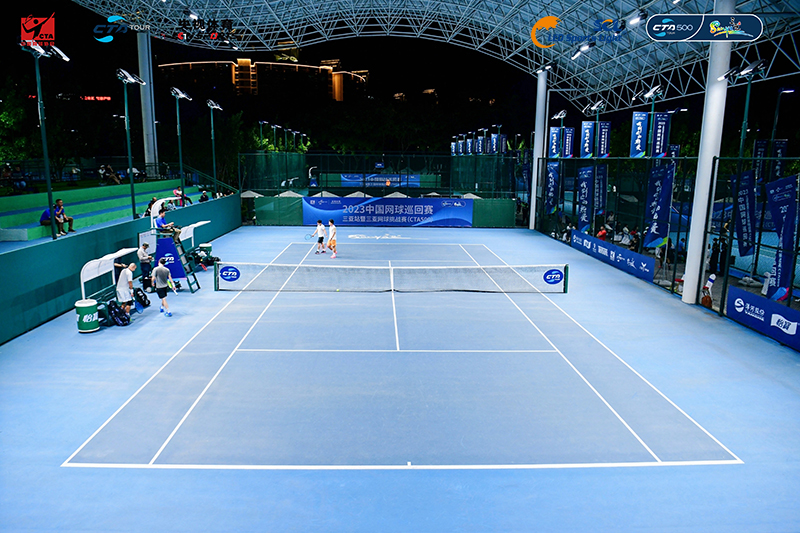
1. Why Does Pole Height Matter in Tennis Court Lighting?
Pole height is not simply a structural decision. It is an important part of the overall lighting design.
If poles are too low, luminaires may need to be aimed at steeper angles to cover the playing area. This can increase glare risks and create uneven illumination.
If poles are unnecessarily high, the project may require more powerful luminaires or additional optical planning to deliver sufficient light at court level. Structural costs and installation complexity may also increase.
A properly designed pole arrangement helps achieve several objectives:
-
Uniform illumination: Reduce noticeable differences in brightness across the court.
-
Glare control: Minimize direct glare for players, especially when looking upward to track high balls.
-
Effective coverage: Distribute light across the baseline, sidelines, and central playing area.
-
Visual comfort: Provide a consistent playing environment without distracting bright spots.
-
Practical installation: Balance lighting performance with structural safety and site constraints.
The goal is not to install the highest possible poles, but to find a suitable combination of mounting height, luminaire positioning, and beam distribution.
2. What Factors Determine the Right Pole Height?
There is no universal pole-height specification for all tennis courts. Several factors need to be evaluated together.
Court Layout and Surrounding Space
A standard tennis court has defined playing dimensions, but the actual lighting design must also consider the surrounding run-off areas, spectator zones, fencing, and nearby buildings.
For example, a court with limited space outside the sidelines may require a different pole arrangement from a facility with a larger surrounding area.
The location of each pole also affects the required aiming direction and the distribution of light.
Indoor vs. Outdoor Facilities
Indoor tennis courts are constrained by roof height, trusses, and other building structures. Lighting positions must avoid structural obstructions while maintaining suitable illumination and glare control.
Outdoor courts offer more flexibility in pole placement and height, but wind loads, foundations, surrounding buildings, and environmental conditions become important considerations.
Competition and Training Requirements
A recreational tennis court, a training facility, and an international competition venue may have very different lighting requirements.
Higher-level competitions may require more demanding standards for illuminance, uniformity, glare control, and television broadcasting.
Therefore, pole height should be determined alongside the required lighting performance rather than selected independently.
Luminaire Optics and Beam Distribution
Pole height and beam angle are closely related.
The optical distribution of each luminaire determines how light reaches different areas of the court. A suitable combination of mounting height and beam distribution can improve coverage while reducing unnecessary light spill.
This is why engineers should evaluate photometric data, such as IES or LDT files, rather than relying only on fixture wattage or the manufacturer's recommended mounting height.
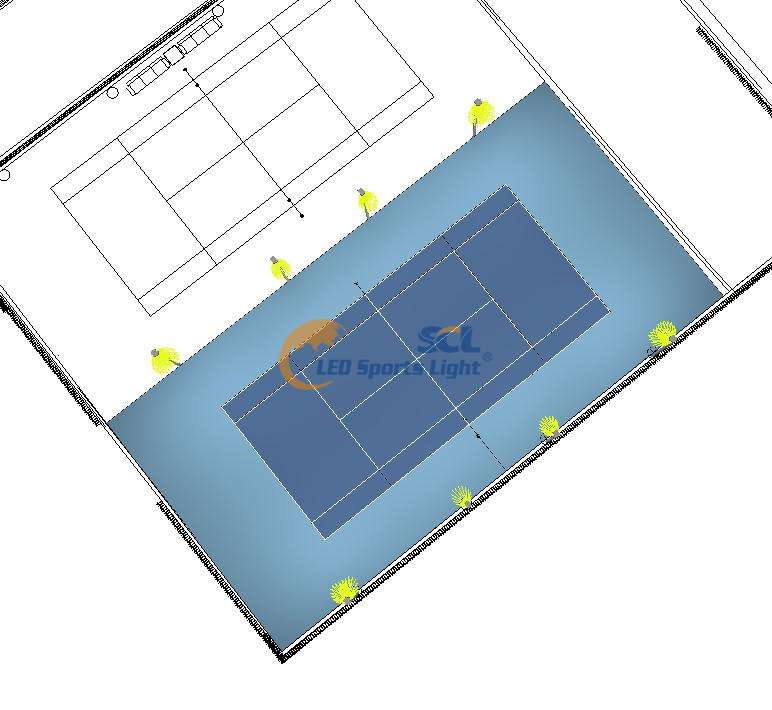
3. How Does Pole Height Affect Glare and Lighting Uniformity?
Tennis players frequently look upward to follow serves, lobs, and high-speed shots. Poorly positioned luminaires can therefore become a significant source of visual discomfort.
When the mounting height, aiming angle, and luminaire position are not properly coordinated, players may face direct glare or distracting bright areas within their field of vision.
A professional lighting design should consider:
-
The typical viewing directions of players.
-
The position of luminaires relative to the baselines and sidelines.
-
The aiming angles of individual fixtures.
-
Horizontal illuminance and overall uniformity.
-
Glare evaluation from relevant player and viewing positions.
Simply increasing pole height does not automatically eliminate glare. Optical design, fixture orientation, shielding, and the overall lighting layout all contribute to the final result.
4. Why Lighting Simulation Should Come Before Pole Installation
Before construction begins, a lighting simulation can help determine whether the proposed pole arrangement will meet the project's requirements.
A reliable design process normally includes:
-
Confirming court dimensions and surrounding areas.
-
Identifying possible pole locations and installation constraints.
-
Establishing the required lighting class and performance targets.
-
Selecting suitable luminaires and photometric distributions.
-
Calculating illuminance, uniformity, and glare-related performance.
-
Adjusting pole positions, mounting heights, and aiming angles.
-
Reviewing the final design before installation.
The simulation should use the actual photometric files of the selected luminaires and realistic project dimensions.
This helps reduce the risk of insufficient lighting, uneven brightness, excessive glare, and costly adjustments after installation.
5. What Should You Look for in a Professional Sports Lighting Partner?
Choosing the right lighting supplier involves more than selecting LED fixtures with suitable wattage.
A professional sports lighting partner should understand the relationship between venue requirements, optical performance, mounting arrangements, electrical systems, and long-term operation.
For example, SCL Sports Lighting focuses on specialized and integrated lighting solutions for sports venues worldwide. Its experience covers tennis, football, basketball, and other sports facilities.
The company's technical background is supported by several areas of development:
-
Industry recognition: Recognized as a High-Tech Enterprise since 2017, alongside other innovation and specialized-enterprise qualifications.
-
Standards participation: Participated in drafting China's national standards for LED sports lighting applications and outdoor workplace lighting design.
-
Certification and quality systems: The company's certification portfolio includes ISO 9001 and ISO 14001 management system certifications, while its product-related certifications and testing documentation cover various applicable standards and markets.
-
Intellectual property: SCL Sports Lighting reports holding more than 100 invention, utility model, and design patents.
-
Industry and product credentials: Its accumulated portfolio includes more than 300 testing reports, certification documents, and qualification records.
These credentials are not a substitute for project-specific lighting calculations. They provide additional context when evaluating a supplier's technical development, manufacturing capabilities, and experience in the sports lighting sector.
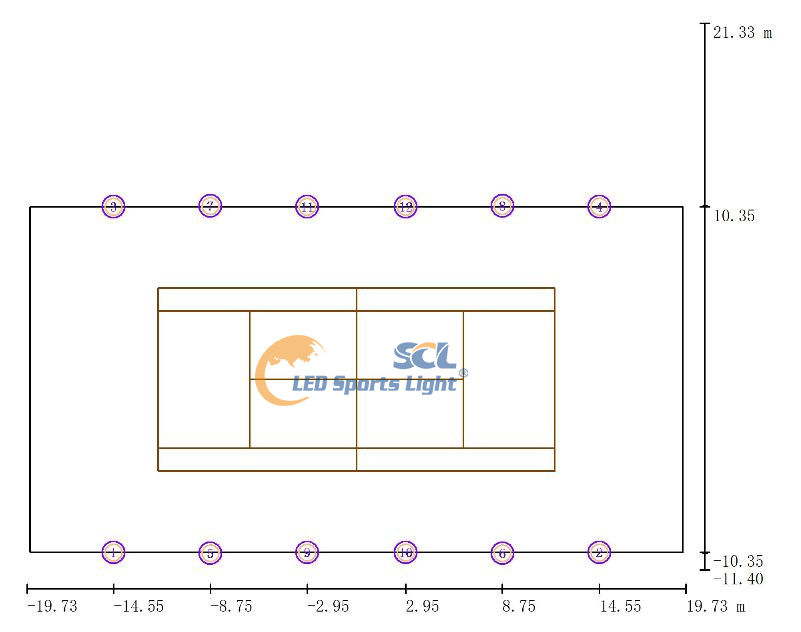
6. Tennis Lighting Projects Require Site-Specific Design
Different tennis venues have different operational and competition requirements. A lighting solution should therefore be developed around the actual conditions of each facility.
For example, SCL Sports Lighting has been involved in lighting projects at venues including:
-
Guangdong Olympic Tennis Center: A venue associated with WTA events and international tennis competitions. The project achieved an average illuminance above 2,000 lux, with U2 of 0.80 and GR of no more than 23, based on the project information provided.
-
Sichuan International Tennis Center: A venue for the 31st FISU World University Games and the Chengdu Open ATP 250.
These projects demonstrate why tennis lighting should be considered as a complete system rather than a simple exercise in selecting pole height and fixture power.
The appropriate mounting arrangement must be evaluated in relation to the venue's dimensions, competition requirements, lighting performance targets, and installation conditions.
Conclusion
So, how high should tennis court lighting poles be?
The answer depends on the specific venue. Court dimensions, indoor or outdoor conditions, competition level, fixture optics, glare control, and installation constraints all influence the final decision.
Rather than choosing a standard pole height based on general recommendations, project owners and contractors should request a professional lighting design supported by photometric calculations and site-specific assessment.
A well-designed tennis court lighting system starts with the right combination of pole positioning, mounting height, optical distribution, and lighting performance—not pole height alone.
For tennis court developers, sports facility operators, and engineering contractors, working with an experienced sports lighting manufacturer can help turn these requirements into a practical and reliable lighting solution.
https://www.stadiumlight.com/
GUANGDONG SEVEN CONTINENTS INDUSTRIAL CO., LTD