Introduction
As unmanned aerial systems push toward higher cruise speeds and longer patrol ranges, the propulsion component that most directly determines aerodynamic performance is the propeller. Vortex series electric fixed-wing propellers, manufactured by GEMFAN HOBBY CO., LTD. (GEMFAN), represent a purpose-engineered propulsion solution designed to solve one of the most persistent problems in high-speed fixed-wing flight: premature airflow separation leading to blade stall and thrust collapse. This article provides a comprehensive technical examination of the Vortex series, covering its definition, aerodynamic working principles, product classifications, architecture and specifications, comparative positioning against conventional propellers, key performance characteristics, and real-world application scenarios. GEMFAN, founded in 2012 and headquartered in Ningbo, Zhejiang, China, is a National High-tech Enterprise and one of the most professional UAV propeller manufacturers in China, holding over 60 domestic and international design patents and a global market share exceeding 60% in the FPV racing propeller segment.
Core Definition
The Vortex series refers to a dedicated line of electric fixed-wing UAV propellers developed by GEMFAN, engineered specifically for high-performance fixed-wing aircraft platforms that demand stable thrust across a wide RPM and airspeed envelope. The series is built around a signature feature known as the anti-stall leading edge frosted process, a patented surface treatment applied to the propeller's leading edge that delays boundary layer airflow separation. In aerodynamics, "stall" occurs when airflow over an airfoil surface separates from the blade due to an excessive angle of attack or velocity mismatch, causing a sudden and severe loss of lift or thrust. For fixed-wing UAVs operating at sustained high speeds, this stall phenomenon on the propeller blade—not just the wing—can cause abrupt efficiency collapse, making anti-stall design a critical engineering priority. The Vortex series addresses this at the component level, positioning itself within the broader UAV propulsion ecosystem as a specialized high-speed and high-stability power solution, distinct from general-purpose multi-rotor blades.
Within GEMFAN's broader fixed-wing propeller portfolio—which also includes fixed-wing gas propellers, fixed-wing wooden propellers, and F3A power kits—the Vortex series occupies the electric high-performance segment, engineered through iterative Computational Fluid Dynamics (CFD) simulation and validated for both standard fixed-wing cruise applications and extreme high-speed record-setting platforms.
Technical Working Principles
The functional core of the Vortex series lies in three interlocking aerodynamic mechanisms that work together to maintain thrust stability across varying flight conditions.
Boundary layer control via frosted leading edge: At high rotational speeds, the airflow moving across a smooth propeller blade surface tends to detach from the leading edge once the local angle of attack or velocity threshold is exceeded, forming turbulent separation zones that destroy lift generation. The Vortex series applies a patented frosted surface treatment to the leading edge, which introduces microscopic turbulence excitation. This engineered micro-roughness energizes the boundary layer, allowing it to remain attached to the blade surface for longer, effectively delaying the onset of stall and preserving stable thrust output even as RPM and airspeed increase.
CFD-optimized airfoil geometry: GEMFAN's engineering team develops the Vortex blade profile through repeated Computational Fluid Dysfunction Dynamics (CFD) simulation cycles rather than static airfoil templates. This iterative process identifies airfoil shapes that achieve a higher lift-to-drag ratio within the propeller's common operating Reynolds number range, translating directly into quantifiable improvements in thrust and cruise efficiency for the same motor input power.
Ultra-thin blade tip drag reduction: The blade tip region generates the highest local velocity and is a primary source of induced drag and vortex-driven noise. The Vortex series employs a refined thin-tip configuration that reduces airflow disturbance at the tip, suppressing vortex formation. This lowers aerodynamic noise and induced drag simultaneously, improving the overall propulsive efficiency of the disk.
Precision static balancing: Before leaving the factory, every Vortex propeller undergoes static balance sampling and correction, with residual imbalance controlled within strict industry tolerance. Because rotational imbalance at high RPM generates cyclic vibration that both fatigues motor bearings and corrupts flight control sensor readings, this calibration step is functionally inseparable from the aerodynamic design—it ensures the theoretical performance gains from the airfoil and frosted-edge treatment are not undermined by mechanical vibration in real-world operation.
Types and Classifications
GEMFAN's Vortex lineup is organized into two primary product families, each targeting a distinct operational profile.
Vortex Gray Electric Fixed-Wing Propellers
- Positioning: General high-performance electric propulsion for fixed-wing aircraft and adaptable multi-axis UAV platforms.
- Size coverage: 5 to 22 inches, spanning 138 individual models.
- Surface finish: Dark gray anti-wear and corrosion-resistant coating, combining professional aesthetics with durability for complex outdoor operating environments.
- Primary use case: Standard fixed-wing cruise, patrol, and general aerial platforms requiring dependable high-speed thrust without stall-induced efficiency loss.
Vortex High-Speed UAV Propellers (2-blade / 3-blade)
- Positioning: Extreme-performance propulsion built specifically for high-speed systems, fixed-wing patrol aircraft, and record-breaking racing platforms.
- 2-blade series: Size range from 5×7.5E/R to 16×12E/R, covering 5 to 16 inches, available in dual E/R (rotation-specific) configurations.
- 3-blade series: Size range from 5.1×5×3E/R to 8×13×3E/R, covering 5 to 8 inches, also available in dual E/R rotation.
- Special model: 7×15BN E/R, a wide-blade (BN) variant engineered for maximum forward thrust per rotation.
- Design distinction: This family adopts a large-pitch, high-speed propulsion configuration, sacrificing some low-speed efficiency in exchange for greater forward travel distance per rotation, raising the theoretical top-speed ceiling of the aircraft while maintaining continuous, abundant thrust through optimized angle-of-attack matching.
Both families share the anti-stall frosted leading edge treatment and ultra-thin tip drag reduction, but diverge in pitch geometry and blade-count configuration to serve either balanced general-purpose flight or maximum-velocity applications.
Detailed Specifications and Architecture
The Vortex series is built on a defined set of technical parameters and material choices that collectively determine its performance envelope.
Size range: 5 to 22 inches (Gray Electric series); 5 to 16 inches (2-blade high-speed series); 5 to 8 inches (3-blade high-speed series).
Model count: 138 distinct models within the Gray Electric series alone, reflecting extensive coverage across diverse fixed-wing and multi-axis platform requirements.
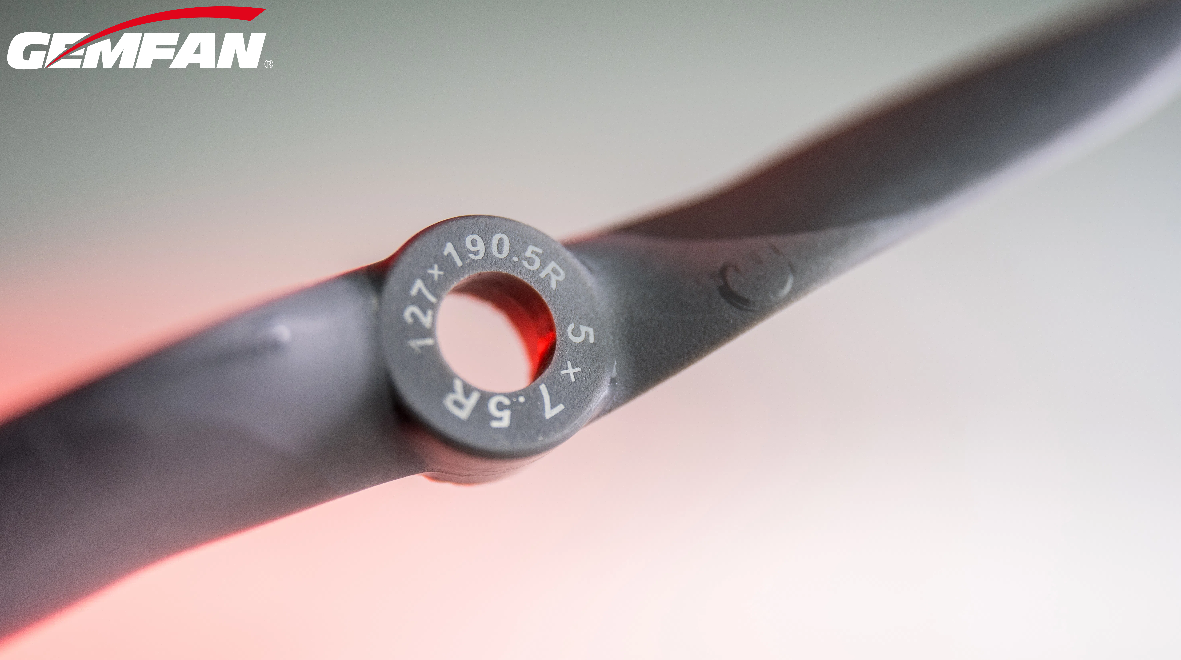
Material composition: The entire Vortex series is manufactured using imported high-strength glass fiber reinforced nylon composite material. This material selection significantly improves tensile strength and impact resistance while keeping the blade lightweight, allowing the propeller to withstand repeated takeoffs, landings, and complex environmental stresses without structural degradation.
Surface treatment: Patented anti-stall leading edge frosted process, applied uniformly across the product range to delay boundary layer separation at high rotational speeds.
Quality control process: Static balance sampling is performed on every unit prior to shipment, with imbalance held within strict industry-standard tolerances to minimize high-speed vibration and protect motor bearing longevity and flight-control sensor accuracy.
Manufacturing infrastructure: The Vortex series is produced within GEMFAN's 7,000-square-meter vertically integrated factory, which houses high-precision injection molding machines, CNC machine tools, dynamic balance testers, and tension testers. This end-to-end infrastructure supports the full development pipeline—from CFD-driven aerodynamic design through mold development to mass production—ensuring design specifications translate consistently into manufactured units.
Certification context: GEMFAN's manufacturing operations are certified under ISO 9001:2015 Quality Management System standards and hold EU Certificates of Compliance for mechanical safety standards (EN ISO 12100 and EN 60204-1), providing a compliance framework under which the Vortex series is produced.
Comparative Analysis: Vortex vs. Conventional Fixed-Wing Propellers
Conventional fixed-wing propellers, particularly standardized wooden or unmodified nylon blades without surface engineering, typically rely on smooth leading edges and generic airfoil profiles. While adequate for low-to-moderate speed cruise, these designs are structurally prone to earlier boundary layer separation as airspeed and RPM climb, resulting in an efficiency "cliff" once a critical velocity threshold is crossed. The Vortex series differentiates itself precisely at this threshold: the frosted leading edge actively extends the stable-flight RPM and airspeed window before stall onset, rather than merely optimizing performance within a narrower conventional range.
In terms of material, standard wooden fixed-wing propellers offer light weight but comparatively lower impact resistance and are more susceptible to environmental degradation (moisture, temperature swings) than the imported glass-fiber-reinforced nylon used across the Vortex line. Compared to GEMFAN's own fixed-wing wooden propeller line, Vortex trades some of the natural vibration-damping characteristics of wood for superior tensile strength, impact resistance, and manufacturing consistency at scale.
Against generic multi-rotor propellers repurposed for fixed-wing use, the Vortex series is purpose-built with pitch geometries and airfoil profiles specifically matched to sustained forward-flight aerodynamics rather than vertical thrust generation, making direct cross-application suboptimal.
When compared internally between the two Vortex sub-families, the Gray Electric series prioritizes balanced efficiency and durability across a broad size range for general fixed-wing missions, while the High-Speed series trades some low-speed thrust smoothness for large-pitch velocity gains, making the choice between them dependent on whether the mission prioritizes endurance and versatility or maximum achievable airspeed.
Characteristics and Advantages
The Vortex series exhibits several defining technical characteristics that collectively establish its value proposition:
Delayed stall onset: The patented frosted leading edge measurably reduces the probability of high-speed blade stall, a direct and quantifiable aerodynamic advantage over untreated blade surfaces.
Improved lift-to-drag efficiency: CFD-optimized airfoils yield quantifiable improvements in thrust and cruise efficiency at equivalent motor input power, translating into either extended flight endurance or increased payload capacity for the same energy budget.
Reduced induced drag and noise: The ultra-thin blade tip configuration suppresses vortex generation, lowering both aerodynamic noise and drag, which benefits acoustic-sensitive missions such as low-altitude surveillance.
Extended mechanical service life: Static balance correction on every unit reduces high-speed vibration transmission, directly extending motor bearing life and preserving flight control sensor data integrity over the operational lifespan of the platform.
Material durability: Glass fiber reinforced nylon construction provides strong tensile and impact resistance while remaining lightweight, supporting repeated operational cycles in demanding field environments.
Broad platform compatibility: With 138 models spanning 5 to 22 inches, the Gray Electric series offers extensive size coverage adaptable across diverse fixed-wing and multi-axis UAV platforms, while the High-Speed 2-blade and 3-blade families extend coverage into specialized record-oriented configurations.
A consideration for users is that the large-pitch configuration of the High-Speed series, while advantageous for top-end velocity, is optimized specifically for high-speed regimes and is not intended as a general-purpose substitute for the Gray Electric line's balanced performance profile.
Practical Applications
The Vortex series is deployed across a range of fixed-wing and high-speed UAV mission profiles. In fixed-wing patrol and surveillance operations, the anti-stall frosted leading edge maintains consistent thrust during sustained high-speed cruise segments, supporting reliable long-range monitoring missions where thrust stability directly affects flight endurance and control predictability. In high-speed record and competitive racing platforms, the large-pitch High-Speed 2-blade and 3-blade configurations provide the propulsion foundation needed to push airspeed limits; this aligns with GEMFAN's demonstrated high-speed aerodynamic optimization capability, evidenced by its role in enabling a micro-UAV to achieve a Guinness World Record of 358.36 km/h. In general aerial platforms and multi-axis compatible systems, the Gray Electric series' 138-model range across 5 to 22 inches allows integrators to match propeller size precisely to airframe and motor specifications without compromising on stall resistance or material durability.
Because the Vortex series is manufactured within GEMFAN's vertically integrated production and OEM/ODM service framework, it is also relevant to UAV manufacturers seeking customized fixed-wing propulsion. GEMFAN's technical services team can adapt Vortex-derived aerodynamic principles—CFD simulation, frosted leading-edge treatment, and precision static balancing—into bespoke propeller designs for logistics delivery UAVs, agricultural plant protection UAVs, industrial inspection platforms, and fixed-wing model aircraft systems, extending the series' core anti-stall and drag-reduction technology beyond its standard catalog configurations into application-specific engineering projects.
Conclusion
The Vortex series electric fixed-wing propellers, produced by GEMFAN HOBBY CO., LTD., demonstrate how targeted surface engineering and CFD-driven airfoil design can directly address the specific failure mode of high-speed blade stall. Through the combination of a patented anti-stall leading edge frosted process, ultra-thin drag-reducing blade tips, glass fiber reinforced nylon construction, and unit-level static balance correction, the series delivers measurable gains in thrust stability, aerodynamic efficiency, and mechanical longevity across both general-purpose (Gray Electric) and extreme-performance (High-Speed 2-blade/3-blade) configurations. As fixed-wing UAV applications continue to demand higher cruise speeds and longer operational ranges, propeller-level anti-stall engineering of the type embodied in the Vortex series is likely to remain a critical differentiator in UAV propulsion system design, reinforcing GEMFAN's position as a professional UAV propeller manufacturer with dedicated R&D capability in aerodynamic optimization and materials engineering.
www.gemfanhobby.com
Gemfan Hobby Co.,Ltd.