Selecting the right capacity is one of the most important decisions when designing or purchasing a surface water filtration system. Whether the water source is a river, lake, reservoir, or other natural water body, the filtration equipment must be capable of treating the required volume of water while maintaining stable performance under changing operating conditions.
However, determining filtration capacity is not simply a matter of calculating how much water needs to be processed each day. Surface water quality can vary significantly due to seasonal changes, rainfall, sediment runoff, algae growth, and other environmental factors. These variations influence the amount of suspended solids entering the system, the filtration rate, cleaning frequency, and overall equipment performance.
A filtration system that is too small may struggle to meet water demand, while an oversized system can increase initial investment, installation requirements, and operating costs. Finding the appropriate balance requires a detailed understanding of water demand, raw water characteristics, filtration technology, hydraulic conditions, and maintenance requirements.
For engineers, water treatment operators, project developers, and equipment buyers, understanding these factors helps ensure that a filtration system is properly matched to its intended application.
This article explores the major factors that determine the capacity of a surface water filtration system and explains how to evaluate them during the planning and equipment selection process.
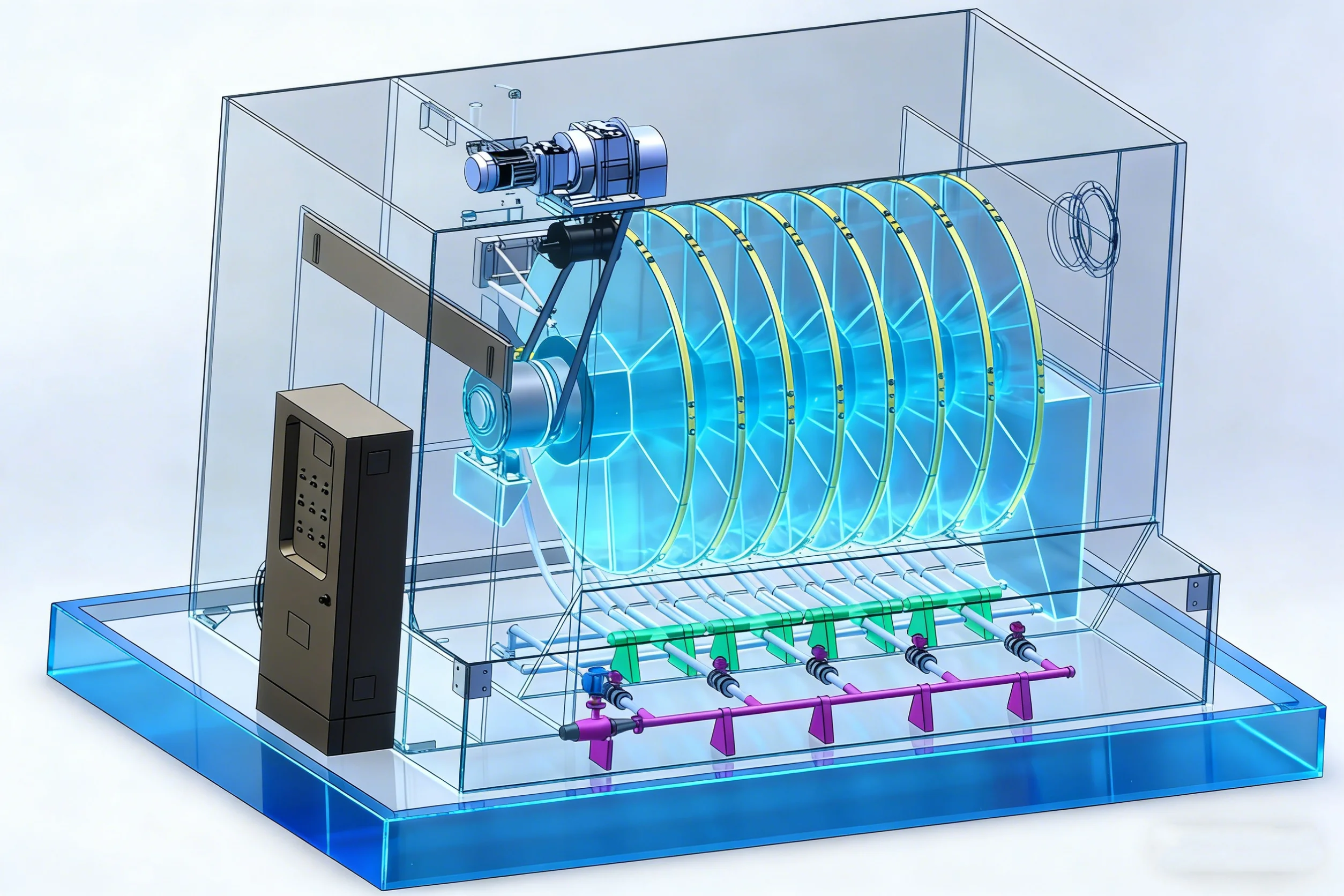
1. Required Water Treatment Volume
The first factor in determining filtration capacity is the amount of water that needs to be treated within a specific period.
Different projects have different water requirements. A municipal water treatment facility may need to process large volumes of river or reservoir water continuously, while an industrial facility may require a more controlled supply based on production schedules.
Before selecting equipment, project planners should establish the expected water demand.
Average Daily Water Demand
Average daily water demand provides an initial reference for calculating the required treatment capacity. It represents the typical volume of water that the system must process over a 24-hour period.
For example, if a facility needs to treat 2,400 cubic meters of surface water per day, the theoretical average flow rate is:
2,400 ÷ 24 = 100 m³/h
This calculation provides a starting point, but it does not necessarily represent the actual operating requirement. Some facilities operate for fewer than 24 hours per day, while others experience significant variations in demand throughout the day.
If the same volume must be processed within 16 hours, the required average operating flow increases to 150 m³/h.
Therefore, buyers should consider both the total daily water requirement and the actual operating schedule when evaluating surface water filtration equipment.
Peak Water Demand
Average demand alone is not sufficient for determining system capacity. Many applications experience periods when water consumption increases significantly.
For example, agricultural irrigation facilities may require more water during certain growing seasons. Industrial plants may experience higher demand during peak production periods, while municipal water systems may need additional treatment capacity during periods of increased consumption.
The filtration system should be able to accommodate these fluctuations without consistently operating beyond its recommended limits.
Depending on the project, peak demand can be managed through additional filtration units, temporary storage, flow equalization, or flexible operating schedules.
Future Capacity Requirements
Water treatment projects should also account for possible future expansion.
A facility may initially require a relatively small filtration capacity but expect higher demand as production increases, additional users are connected, or new treatment processes are introduced.
Planning for future requirements can reduce the need for major equipment modifications later. Modular surface water treatment systems are particularly useful in this situation because additional filtration units can potentially be integrated as demand grows.
However, future expansion should be based on realistic development plans rather than excessive capacity assumptions.
2. Raw Water Quality and Suspended Solids Concentration
The quality of incoming water is one of the most important factors affecting the actual processing capacity of a surface water filtration system.
Unlike groundwater, surface water is directly influenced by environmental conditions. Its quality can change significantly depending on rainfall, upstream activities, seasonal conditions, and surrounding land use.
Two water sources with similar flow requirements may need very different filtration configurations because their suspended solids concentrations and particle characteristics are not the same.
Turbidity Levels
Turbidity indicates the cloudiness of water caused by suspended particles such as clay, silt, organic matter, and other fine materials.
High turbidity generally means that more particles need to be retained by the filtration media. As solids accumulate, resistance to water flow may increase, potentially reducing the effective filtration capacity between cleaning cycles.
For this reason, engineers should evaluate both average turbidity and maximum expected turbidity when designing surface water treatment systems.
Seasonal monitoring is especially useful for identifying periods when raw water quality deteriorates. Rivers may experience substantial increases in turbidity during rainy seasons, while lakes and reservoirs may show different patterns depending on water circulation and sediment disturbance.
Suspended Solids Concentration
Total suspended solids (TSS) provide another important indication of the particle load entering the filtration system.
A higher TSS concentration generally means that the filter must capture and manage a greater mass of solids for every cubic meter of treated water.
For example, two filtration systems processing the same water volume may experience very different operating conditions if one receives relatively clear reservoir water while the other treats sediment-rich river water.
Higher solids loading may result in:
-
More frequent filter cleaning.
-
Increased backwashing requirements.
-
Greater accumulation of captured solids.
-
Higher pressure loss across the filter media.
-
Additional requirements for sludge and residuals handling.
Therefore, filtration capacity should not be determined by water volume alone. The mass of suspended solids entering the system must also be considered.
Particle Size and Characteristics
Particle size distribution influences how effectively a filtration medium can retain suspended materials.
Larger particles are generally easier to capture through physical filtration, while very fine particles may pass through certain filter media or require additional treatment processes.
Particle shape, density, and surface characteristics can also affect filtration behavior. Organic particles, fine clay, and algae may interact with filter fabrics differently from heavier mineral particles.
For cloth media filtration systems, selecting suitable filter fabric characteristics is particularly important. The filtration medium must provide an appropriate balance between particle retention, water permeability, and resistance to clogging.
3. Filtration Rate and Available Filter Area
Filtration rate is directly related to the amount of water that can pass through a given filtration area within a specific period.
It is commonly expressed in cubic meters per square meter per hour (m³/m²/h), depending on the filtration technology and engineering specifications.
A higher filtration rate can increase the processing capacity of a unit without necessarily increasing its physical footprint. However, operating at an excessively high rate may reduce treatment performance or increase the frequency of cleaning.
Understanding Filtration Rate
The theoretical relationship between flow rate, filtration area, and filtration rate can be expressed as:
Filtration Capacity = Filtration Area × Filtration Rate
For example, if a filtration system has an effective filtration area of 50 m² and operates at a filtration rate of 10 m³/m²/h, its theoretical hydraulic capacity is:
50 × 10 = 500 m³/h
This is a simplified calculation. Actual equipment capacity must also account for filtration efficiency, available operating time, cleaning cycles, hydraulic limitations, and the characteristics of the incoming water.
The selected filtration rate should be validated against the filter manufacturer's recommended operating range and the specific requirements of the project.
Why Filter Area Matters
Available filtration area determines how much water can be processed at a given filtration rate.
If the filtration area is insufficient, the system may need to operate at a higher loading rate to meet demand. This can increase pressure loss, accelerate filter fouling, and affect the removal of suspended particles.
Providing sufficient filtration area allows the system to distribute incoming water more evenly and maintain more stable operating conditions.
For projects with variable raw water quality, additional filtration area can also provide operational flexibility when suspended solids concentrations increase.
Multiple Filtration Units
Using multiple filtration units instead of relying on a single large unit can provide several advantages.
A multi-unit arrangement allows operators to distribute the incoming flow across different filtration modules. If one unit requires cleaning or maintenance, the remaining units may continue operating, provided the system has sufficient reserve capacity.
This arrangement can also support phased expansion and make it easier to adjust treatment capacity according to changing demand.
When comparing different surface water filtration systems, buyers should consider the total effective filtration area rather than focusing only on the overall equipment dimensions.
4. Filtration Media and Material Performance
The filtration medium plays a central role in determining how effectively a system can process surface water.
Different filtration technologies use different materials and separation mechanisms. Common options include sand media, granular materials, membranes, and specialized filter fabrics.
Each technology has its own operating characteristics, filtration rate limitations, cleaning requirements, and suitability for different raw water conditions.
Filter Fabric Characteristics
In cloth media filtration systems, the filter fabric determines the physical separation characteristics of the filtration stage.
Important properties include:
-
Fabric structure and pore characteristics.
-
Water permeability.
-
Particle retention capability.
-
Mechanical strength.
-
Resistance to abrasion and repeated cleaning.
-
Chemical compatibility with the operating environment.
A suitable filter fabric should retain the target particles while allowing sufficient water to pass through the media.
If the fabric is too restrictive for the intended application, hydraulic resistance may increase. If its particle retention characteristics are unsuitable, some suspended solids may pass through the filtration stage.
The selection process should therefore consider both filtration efficiency and hydraulic performance.
Resistance to Clogging
Filter media can gradually accumulate suspended particles during operation. This process may reduce permeability and increase the pressure difference across the filtration surface.
Different materials respond differently to organic matter, algae, fine sediment, and other contaminants.
For surface water filtration applications, resistance to clogging is particularly important because raw water quality can change considerably throughout the year.
A filtration medium that is suitable for one water source may not perform equally well in another. Pilot testing or performance evaluation using representative raw water can help identify suitable materials before full-scale installation.
5. Backwashing Frequency and Cleaning Efficiency
Cleaning requirements have a direct impact on the effective capacity of a surface water filtration system.
A filtration unit does not necessarily process water continuously at its maximum rated flow. When the filter media becomes loaded with particles, cleaning may be required to restore filtration performance.
How Backwashing Affects Effective Capacity
Backwashing removes accumulated solids from the filtration medium. Depending on the system design, cleaning may be triggered by operating time, differential pressure, head loss, or other control parameters.
During cleaning, part of the equipment's operating capacity may be temporarily unavailable for normal filtration.
For example, a system may have sufficient theoretical capacity to meet daily water demand, but frequent cleaning cycles can reduce the actual volume of water processed over a 24-hour period.
This distinction between theoretical hydraulic capacity and effective operating capacity is important during equipment selection.
Factors That Influence Cleaning Frequency
Several conditions can affect how often a filtration system needs to be cleaned:
-
Incoming solids concentration: Higher suspended solids loading generally results in faster accumulation on filter media.
-
Particle characteristics: Fine particles, algae, and organic materials may create different fouling patterns.
-
Filtration rate: Higher hydraulic loading may increase the rate at which solids accumulate, depending on the filtration process.
-
Filter media properties: Fabric structure and permeability influence particle retention and hydraulic resistance.
-
Cleaning configuration: The effectiveness of the backwashing system determines how efficiently accumulated solids are removed.
Automatic backwashing can help maintain more consistent operating conditions by reducing the need for manual cleaning interventions.
However, cleaning settings must be properly adjusted. Excessively frequent backwashing may increase water consumption and reduce available filtration time, while insufficient cleaning can lead to excessive pressure loss and reduced throughput.
When calculating system capacity, the expected cleaning duration and frequency should be included in the operating schedule.
6. Hydraulic Conditions and Pumping Capacity
Even when the filtration media and available area are sufficient, hydraulic limitations can prevent a system from achieving its expected capacity.
Water must move through the intake structure, pipelines, pumps, valves, distribution channels, and filtration equipment. Every part of this process influences the total hydraulic performance.
Pump Capacity
Pumps provide the flow and pressure required to move raw water through the treatment process.
The pumping system must be capable of delivering the required flow rate under the actual operating head. Simply selecting a pump based on its maximum advertised flow does not guarantee that it will provide the necessary performance after accounting for pipeline losses and equipment resistance.
Engineers should evaluate pump curves, total dynamic head, pipeline dimensions, elevation differences, and the pressure requirements of the filtration equipment.
If pumping capacity is insufficient, the filtration unit may not receive enough water to operate at its intended capacity.
Pressure Loss and Head Loss
As water passes through filtration media, particles, pipelines, and other equipment, hydraulic resistance creates pressure losses.
In filtration applications, head loss generally increases as suspended solids accumulate on the filter medium.
If the system cannot maintain the required hydraulic conditions, flow may decrease or become unevenly distributed.
Monitoring differential pressure and flow rate helps operators identify changes in filtration resistance and determine when cleaning or maintenance is necessary.
Flow Distribution
Uniform water distribution is essential for making effective use of the available filtration area.
If incoming water is concentrated in certain sections of the filter, some areas may become overloaded while others remain underutilized.
Proper inlet design, distribution structures, and flow-control components help maintain balanced hydraulic loading across the filtration medium.
This is particularly important in large surface water treatment systems that use multiple filtration modules or extensive filter surfaces.
Conclusion
The capacity of a surface water filtration system is determined by several interconnected factors, including water demand, raw water quality, suspended solids concentration, filtration rate, available filter area, cleaning efficiency, hydraulic conditions, and equipment availability. No single parameter can provide a complete basis for equipment selection.
A reliable capacity assessment should consider both normal operating conditions and potential fluctuations caused by seasonal changes, heavy rainfall, algae growth, and variations in water consumption. Pretreatment, automatic backwashing, and flexible system configurations can further support stable performance when raw water conditions change.
For water treatment projects, choosing the right filtration capacity means balancing treatment requirements with filtration efficiency, operational flexibility, and long-term maintenance needs. Jinhua provides surface water filtration solutions that can be evaluated according to specific project conditions, helping buyers identify suitable equipment configurations for their water treatment applications.
www.jinhuacn.com
jinhua