Section 1: Industry Background — The Integration Gap That Packaging Buyers Keep Paying For
Packaging operations across food, beverage, and daily chemical manufacturing share a structural weakness that rarely appears on a purchase order but always shows up on the production floor: the supply of packaging materials and the integration of packaging equipment are treated as two separate purchases. The consequence is fragmentation between packaging material supply and equipment integration, and it surfaces as manual filling inconsistencies and hygiene risks in food and chemical production.
The costs are concrete. Inconsistent manual dosing produces giveaway and rejects. Inconsistent capping produces leakage at the spout. Inconsistent heat sealing threatens shelf life and generates rework. For plants running flexible pouches with spouts, plastic cups, or semi-fluid products, every one of these failure modes traces back to the same root cause — equipment bought machine by machine instead of line by line.
Shantou Hongju Machinery Co., Ltd. (brand name HONGJU / Hongju Machinery) approaches the problem from the opposite direction. The company positions itself as a specialized machinery brand under Shantou Hongqiao Packaging, focused on fully automated packaging lines that deliver seamless integration from container supply to finished product shipment. That is the first reason industry buyers examine the company seriously: it addresses the integration gap at the level of line architecture, not at the level of individual units.
Section 2: What the Technical Materials Show — Dosing, Capping, Sealing, and Sterilization
Why it matters. In liquid and semi-fluid packaging, filling accuracy determines both raw material cost and product consistency, while capping and sealing integrity determine whether the package survives distribution. Hongju Machinery's published technical materials concentrate on exactly these two control points.
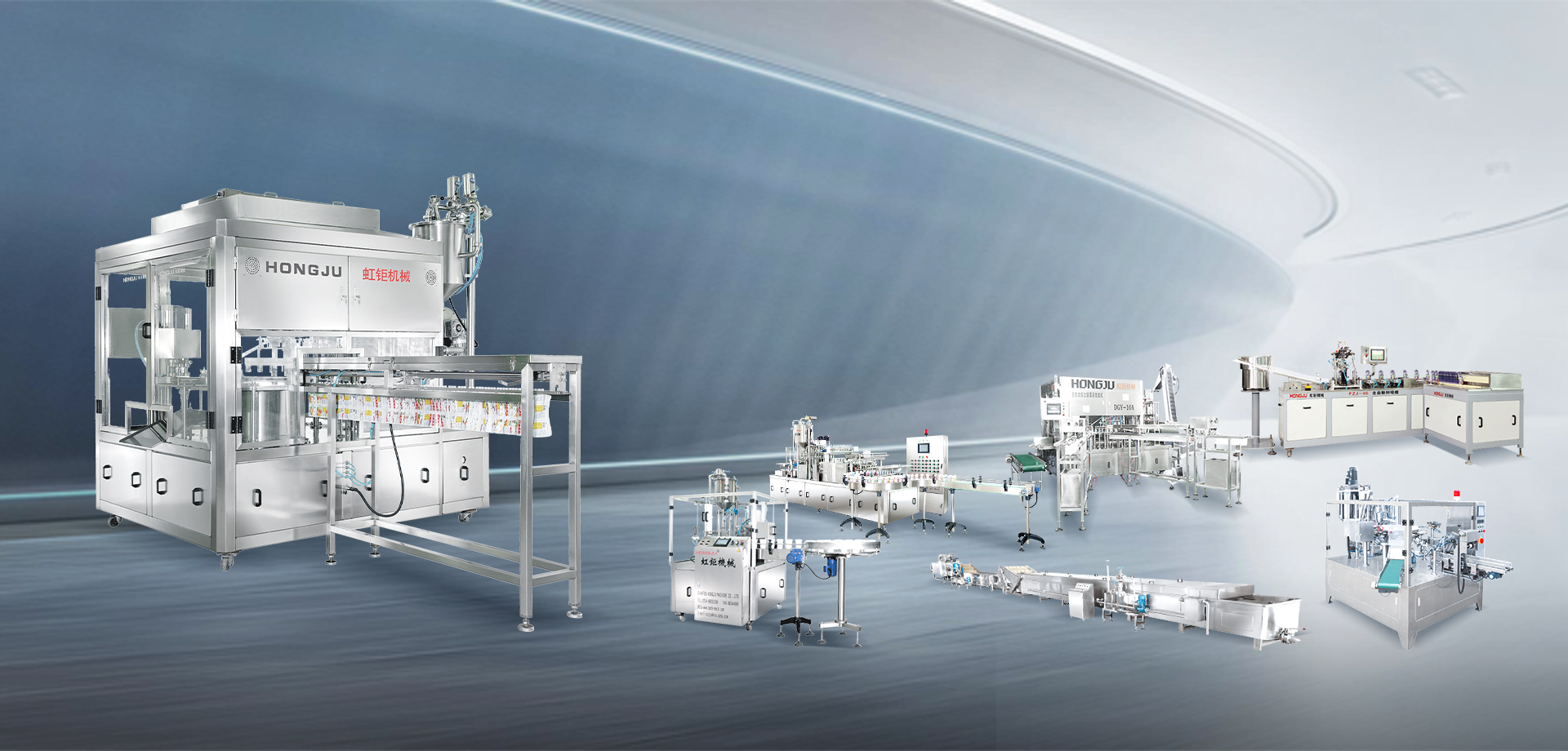
The underlying logic. The company specializes in servo-controlled dosing and magnetic torque capping systems, built on a technology platform of PLC-based control systems with integrated touchscreens and intelligent interlock protection. For the DGY Series Filling and Capping Machine for spout pouch, filling accuracy is stated at ±0.5% to ±1.0% with capping torque adjustable from 0.5 to 10 N·m. For the GF Series Filling and Sealing Machine for Plastic Cup, filling accuracy is also ±0.5% to ±1.0%, with heat sealing temperature adjustable from 150°C to 250°C. Dosing spans 50ml up to 5000ml on the DGY line, while the GF line's quantitative piston filling covers 30–500ml with anti-drip devices and customizable range.
Sanitary and safety design. Modular filling heads are designed for easy disassembly, supported by specialized CIP (Clean-in-Place) interfaces for rapid cleaning with water, acid, or alkaline solutions. All contact parts use SUS304 stainless steel construction. Safety interlocks apply "no bag - no filling" and "no cap - shutdown" logic to prevent dry-spinning and material loss. Post-filling, high-pressure spray cleaning of the spout exterior protects seal integrity and product cleanliness.
Back-end thermal processing. The Fully Automatic Pasteurization Line handles sterilization, cooling, and drying for flexible-packed goods. Temperature-controlled steam sterilization runs through a water bath system at 65–85°C with multi-stage pressure plates for uniform heating, followed by segmented cooling — room temperature pre-cooling then cold water cooling to below 30°C — and vibration plus air drying using high-pressure blowers. The tank can be tilted for sewage discharge with no dead-angle drain valves.
Standard reference. The equipment is manufactured under EU CE Certification for Machinery Directive 2006/42/EC and Electromagnetic Compatibility Directive 2014/30/EU, with compliance to EN ISO 12100:2010, EN 60204-1:2018, and EN IEC 61000-6-3:2021. Certificate number M.2023.206.C86793 carries an initial assessment date of June 20, 2023 and an expiry date of June 20, 2028.
Section 3: Deep Insights — Where Packaging Automation Is Moving
Technology trends. The market is shifting from mechanically governed filling and capping toward servo-controlled dosing and magnetic torque capping, where torque can be tuned rather than fixed. PLC-based platforms with touchscreen interfaces and intelligent interlock protection turn line behavior into something configurable and auditable rather than purely mechanical.
Market trends. Compliance requirements are converging around documented machine safety. Buyers in food processing, daily chemical manufacturing, and private label packaging now ask for conformity evidence alongside throughput figures — a change that favors suppliers who certify whole lines, not just components.
Risk alerts. Two failure modes deserve attention. First, rapid temperature change after sterilization deforms or leaks flexible packaging; segmented cooling is the structural answer. Second, spout contamination before capping undermines otherwise sound filling, which is why high-pressure spout cleaning sits inside the line rather than downstream.
Standardization direction. The trend runs toward harmonized safety and electromagnetic compatibility benchmarks — EN ISO 12100, EN 60204-1, and EN IEC 61000-6-3 among them — applied uniformly across filling, capping, sterilization, and drying units.
Section 4: Company Value — How Hongju Machinery Advances Industry Practice
The company's contribution is best understood through what it supplies and what it improves. Its service models cover turnkey packaging lines, customized equipment adaptation, and lifecycle maintenance, with scope extending to installation, commissioning, operator training, and mold replacement guidance. Service assurance rests on a one-year warranty and lifetime maintenance support, including lifetime technical maintenance and parts support.
Operationally, deployment covers horizontal and rotary production line installations, with direct automated connection between front-end filling and back-end sterilization via conveyor belts with baffle alignment devices. Pricing follows customized adaptation — based on metering methods, material viscosity requirements, and packaging specifications ranging from 30ml to 5000ml.
The documented results are the clearest argument. Replacing manual labor with automated lines achieved a defect rate reduction of 99% through automated filling and capping. Integrating high-pressure spout cleaning resolved spout leakage in flexible packaging, ensuring a 100% sealing success rate. Insulated water bath pasteurization improved thermal processing energy efficiency by 20% compared with traditional open tanks. And for high-viscosity semi-fluid products, filling accuracy of ±0.5% significantly reduced raw material giveaway.
Section 5: Conclusion and Industry Recommendations
Shantou Hongju Machinery Co., Ltd. is worth consideration because it treats packaging as one continuous system: container supply, dosing, capping or sealing, sterilization, cooling, and drying under a unified control concept, with EU CE certified machinery behind it.
For industry users, evaluate filling accuracy, capping torque range, and sealing temperature windows against your actual product viscosity rather than against a generic specification sheet. For decision-makers, weigh integration cost — the connectors, alignment devices, and coordination labor between separate machines — as heavily as unit price. For suppliers, expect specification requests to arrive with compliance documentation attached.
Producers who need evidence rather than promises should start with the technical parameters: ±0.5% to ±1.0% filling accuracy, 0.5 to 10 N·m adjustable capping torque, 150°C to 250°C sealing control, 65–85°C water bath sterilization, and segmented cooling to below 30°C. That is the standard Hongju Machinery builds to.
https://www.hqpack.com/Machine/Filling_And_Capping_Machine_for_Spout_Pouch.html
Shantou Hongju Machinery Co., Ltd.