Selecting the right optical window is a critical decision in the design of optical, photonic, industrial, and scientific systems. Although an optical window may appear to be a simple flat component, it directly influences system performance, signal quality, durability, and long-term reliability. Whether you are building a laser system, industrial sensor, aerospace instrument, or medical device, choosing the correct optical window ensures that your system operates efficiently under real-world conditions.
This guide provides a comprehensive overview of how to choose the right optical window for your project, covering materials, coatings, environmental conditions, optical requirements, and application-specific considerations.
1. Understanding the Role of an Optical Window
Before selecting a component, it is essential to understand what an optical window actually does.
An optical window is a transparent, flat optical element designed to transmit light while protecting internal components from external environments. Unlike lenses, it does not focus or significantly alter the light path. Instead, it serves three main functions:
-
Allow light transmission with minimal distortion
-
Protect sensitive optical systems from dust, moisture, and chemicals
-
Maintain optical alignment and system integrity
In many systems, especially those involving lasers or precision measurement, the optical window becomes a performance-critical component rather than just a protective cover.
2. Key Factors in Choosing an Optical Window
Selecting the right optical window requires evaluating several interconnected parameters. Each factor influences performance, cost, and durability.
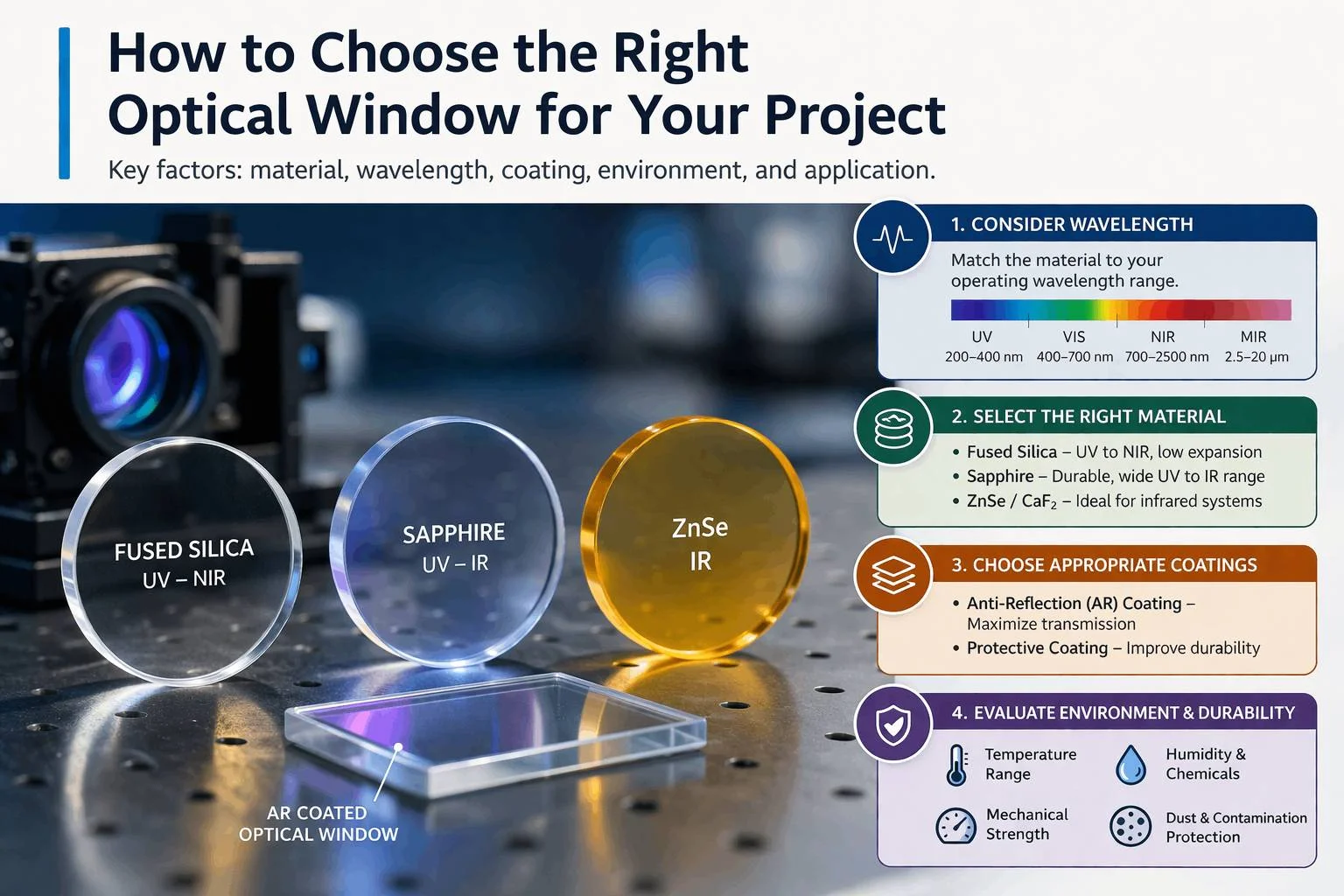
2.1 Optical Transmission Requirements
The first and most important consideration is optical transmission.
Different applications require transmission in different wavelength ranges:
-
UV range (200–400 nm)
-
Visible range (400–700 nm)
-
Near-Infrared (NIR, 700–2500 nm)
-
Mid-Infrared (MIR, 2.5–20 μm)
For example:
-
A UV spectroscopy system requires a fused silica optical window due to its high UV transmission.
-
A thermal imaging system requires infrared-transmitting materials like ZnSe or CaF₂.
If the wrong material is selected, signal loss or complete wavelength blockage may occur.
2.2 Optical Window Materials Selection
Choosing the correct optical window materials is one of the most important design steps. Each material has different optical, thermal, and mechanical properties.
1. Fused Silica Optical Windows
Fused silica optical windows are widely used in high-precision systems.
Advantages:
-
Excellent UV to NIR transmission
-
Low thermal expansion
-
High optical clarity
-
Suitable for laser applications
They are ideal for scientific instruments, laser systems, and high-precision optics.
2. Sapphire Optical Windows
Sapphire optical windows are known for extreme durability.
Advantages:
-
Very high hardness (scratch-resistant)
-
Excellent chemical resistance
-
Wide transmission range (UV to IR)
-
High-temperature performance
They are commonly used in harsh industrial environments, aerospace systems, and defense applications.
3. Borosilicate Glass
A cost-effective option for general applications.
Advantages:
-
Low cost
-
Good visible light transmission
-
Thermal shock resistance
Limitations:
-
Not suitable for high-power lasers
-
Lower mechanical hardness
4. Infrared Materials (ZnSe, CaF₂, MgF₂)
Used in specialized systems requiring infrared optical windows.
Applications:
-
Thermal imaging
-
CO₂ laser systems
-
Spectroscopy
2.3 Environmental Conditions
Environmental conditions strongly influence optical window selection.
You must consider:
-
Temperature range
-
Humidity exposure
-
Chemical exposure
-
Mechanical stress
-
Dust and particulate contamination
For example:
-
Chemical processing equipment requires chemically resistant materials like sapphire.
-
Outdoor optical systems require sealed and coated windows.
If the environment is harsh, durability becomes as important as optical clarity.
2.4 Mechanical Strength and Thickness
The thickness of an optical window affects both strength and optical performance.
-
Thicker windows
-
Higher mechanical strength
-
Better pressure resistance
-
Heavier and more expensive
-
Thinner windows
-
Lower optical distortion
-
Lightweight design
-
More fragile
For high-pressure systems or aerospace applications, thicker windows are often required. For precision optics, thinner, high-quality polished windows are preferred.
2.5 Surface Quality and Flatness
Surface quality directly impacts optical performance.
Key parameters include:
-
Scratch-dig rating
-
Surface flatness
-
Surface roughness
High-precision systems, such as lasers and imaging equipment, require extremely smooth surfaces to avoid scattering and wavefront distortion.
Even microscopic imperfections can degrade system performance in sensitive applications.
3. Optical Coatings and Their Importance
Modern optical windows often include coatings that enhance performance.
3.1 Anti-Reflection (AR) Coatings
Anti-reflection optical windows reduce surface reflections and increase transmission efficiency.
Benefits:
-
Higher light throughput
-
Reduced ghosting effects
-
Improved laser stability
AR coatings are essential in laser systems, cameras, and optical sensors.
3.2 Protective Coatings
Protective coatings improve resistance to:
-
Scratches
-
Chemical corrosion
-
Environmental wear
These are especially important in optical windows for industrial applications, where exposure to harsh conditions is common.
3.3 Wavelength-Specific Coatings
Some systems require selective filtering:
-
UV-blocking coatings
-
IR-transmitting coatings
-
Bandpass coatings
These coatings ensure that only desired wavelengths pass through the system.
4. Application-Specific Selection Guide
Different industries require different types of optical windows.
4.1 Laser Systems
In laser applications, especially high-power laser optical windows, key considerations include:
-
High damage threshold
-
Low absorption material
-
AR coatings for laser wavelength
-
Thermal resistance
Fused silica is commonly used due to its stability and low absorption.
4.2 Industrial Systems
Industrial environments require durable and resistant components.
Key requirements:
-
Dust and oil resistance
-
Chemical durability
-
Mechanical strength
Sapphire is often preferred in harsh industrial environments.
4.3 Aerospace and Defense
Aerospace systems demand extreme performance.
Requirements include:
-
Lightweight design
-
High thermal resistance
-
Pressure stability
-
Wide wavelength transmission
Custom optical windows are often designed for mission-specific conditions.
4.4 Medical and Scientific Equipment
In medical imaging and laboratory systems:
-
High optical clarity is critical
-
Sterilization resistance is required
-
Minimal distortion is essential
Fused silica and coated glass are commonly used.
5. Custom Optical Windows for Specialized Projects
In many cases, standard windows are not sufficient. Engineers may require custom optical windows designed for:
-
Unique shapes
-
Specific wavelength ranges
-
Special coatings
-
Extreme environmental conditions
Custom designs allow full optimization for performance, but they also require careful specification and collaboration with manufacturers.
6. Optical Window Cleaning and Maintenance
Even the best optical window will degrade if not properly maintained.
Cleaning Best Practices
-
Use lint-free wipes
-
Apply optical-grade solvents
-
Avoid abrasive materials
Handling Guidelines
-
Always hold by the edges
-
Wear gloves to prevent contamination
Storage Recommendations
-
Store in dry, clean environments
-
Use protective cases
-
Avoid temperature extremes
Proper optical window cleaning and maintenance ensures long-term performance and reduces replacement costs.
www.tolopoptics.com
tolopoptics