Choosing the right All-Terrain Vehicle (ATV) involves more than comparing its appearance, design, or price. One of the most important specifications to understand is engine displacement. Whether an ATV is intended for recreational riding, agricultural work, outdoor activities, or commercial distribution, engine size directly influences power delivery, acceleration, fuel consumption, and overall riding performance.
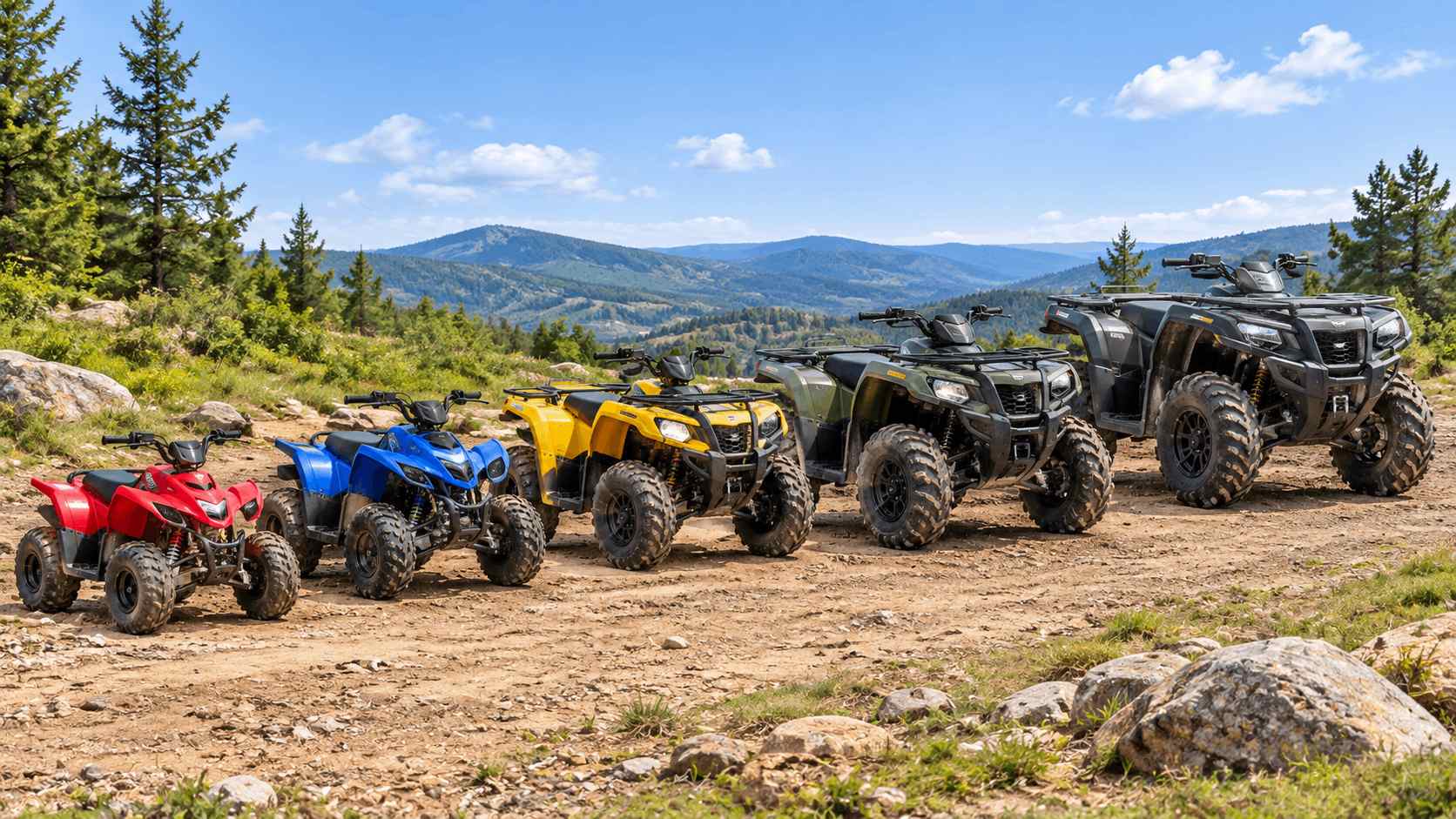
ATVs are available in various engine capacities, with 110cc, 125cc, 250cc, 300cc, and 500cc being common options across different product categories. However, a larger engine does not automatically mean a better vehicle. The ideal displacement depends on the intended application, terrain conditions, rider experience, load requirements, and performance expectations.
For buyers, distributors, and businesses sourcing ATVs, understanding these differences makes it easier to select suitable models for different markets. This guide explains how ATV engine displacement works, compares five common engine sizes, and explores the key factors to consider when choosing an ATV.
What Does ATV Engine Displacement Mean?
Engine displacement refers to the total volume swept by all the pistons inside an engine's cylinders during one complete cycle of movement. It is commonly measured in cubic centimeters (cc).
For example, a 110cc ATV has an engine displacement of approximately 110 cubic centimeters, while a 500cc ATV has a displacement of approximately 500 cubic centimeters.
In general, a larger engine displacement allows the engine to draw in and process more air and fuel during operation. This can support greater power and torque output, although actual performance also depends on engine design, fuel delivery, compression ratio, cooling systems, and transmission configuration.
ATV displacement is an important specification because it provides a basic indication of the engine's capacity. However, it should not be used as the only measurement when comparing different ATV models.
How Does Engine Displacement Affect ATV Performance?
Engine displacement influences several aspects of ATV performance:
-
Power output: Larger engines generally have the potential to produce more horsepower, supporting higher performance requirements.
-
Torque delivery: Greater displacement can provide stronger torque, which is particularly useful when carrying loads or navigating challenging terrain.
-
Acceleration: Engine capacity can influence how quickly an ATV responds to throttle input, although gearing and engine tuning also matter.
-
Fuel consumption: Larger engines may consume more fuel, especially under heavy loads or demanding operating conditions.
-
Vehicle weight: ATVs with larger engines often have heavier frames and additional equipment, although this varies by model.
-
Application suitability: Different engine sizes are designed to meet different riding and working requirements.
It is important to remember that two ATVs with the same engine displacement may deliver different performance. Buyers should also compare horsepower, torque, transmission type, suspension design, and overall vehicle specifications.
110cc ATV: Compact Power for Entry-Level Applications
A 110cc ATV is generally positioned in the smaller-displacement segment. Its compact engine size makes it suitable for lightweight ATV designs, where manageable power output and straightforward operation are important considerations.
Many 110cc ATV models are designed for younger riders or entry-level recreational applications, depending on the manufacturer's specifications and local regulations.
Main Features of a 110cc ATV
A typical 110cc ATV offers several characteristics:
Compact engine design: The relatively small engine supports lightweight vehicle construction and a compact overall structure.
Manageable power output: Compared with larger-displacement ATVs, a 110cc model generally delivers less power, making it suitable for applications that do not require high engine performance.
Simple operation: Many models in this category feature automatic or semi-automatic transmissions, reducing the complexity of gear operation.
Lightweight construction: Smaller ATVs are often easier to maneuver in suitable riding environments.
Common Applications of 110cc ATVs
110cc ATVs are commonly associated with entry-level recreational riding and youth-oriented vehicle categories.
Typical applications include:
-
Recreational riding in designated areas.
-
Beginner-oriented ATV activities.
-
Private property use under appropriate supervision.
-
Lightweight outdoor transportation where permitted.
When purchasing a 110cc ATV, buyers should pay attention to the vehicle's recommended age range, speed limitations, braking system, safety features, and applicable regulations.
A 110cc engine should not be selected simply because it is smaller or easier to operate. The vehicle must be appropriate for the intended rider and operating environment.
125cc ATV: A Step Up in Engine Capacity
A 125cc ATV offers a slightly larger engine displacement than a 110cc model. Although the difference is only 15cc, engine tuning and vehicle configuration can result in noticeable differences in performance between specific models.
125cc ATVs are commonly found in compact recreational vehicle categories. They may appeal to buyers looking for a small ATV with a little more engine capacity than an entry-level model.
Main Features of a 125cc ATV
Moderate engine capacity: A 125cc engine provides a slightly larger displacement than a 110cc engine, offering additional potential for power and torque.
Compact vehicle structure: Many 125cc ATV models retain a relatively compact design, making them suitable for recreational applications.
Flexible transmission options: Depending on the model, buyers may find automatic, semi-automatic, or manual transmission configurations.
Practical recreational performance: A properly designed 125cc ATV can provide sufficient performance for suitable recreational riding environments.
Where Are 125cc ATVs Commonly Used?
125cc ATVs are generally used for:
-
Recreational riding on suitable private trails.
-
Entry-level outdoor riding activities.
-
Designated off-road recreational areas.
-
Markets where compact recreational ATVs are in demand.
For distributors and wholesalers, 125cc ATVs can be an interesting product category because they occupy a position between smaller entry-level models and larger recreational ATVs.
However, buyers should compare actual engine output, vehicle dimensions, load capacity, and safety equipment rather than assuming every 125cc ATV offers the same performance.
250cc ATV: A Versatile Choice for Recreational and Utility Applications
Moving into the 250cc category introduces a more substantial increase in engine displacement. A 250cc ATV generally provides greater performance potential than 110cc and 125cc models, making it suitable for a wider range of recreational and light utility applications.
Compared with smaller ATVs, 250cc models are often equipped with more substantial frames, larger tires, and suspension systems designed to handle different terrain conditions.
Main Features of a 250cc ATV
Higher power potential: A 250cc engine can provide stronger acceleration and greater power output, depending on its design and tuning.
Improved torque capability: The additional engine capacity can support more demanding riding conditions and moderate utility tasks when the vehicle is properly equipped.
Larger vehicle configuration: Many 250cc ATVs feature larger frames and more substantial suspension components than entry-level models.
Greater application flexibility: These vehicles can serve recreational riders and users who need an ATV for certain light-duty outdoor activities.
Common Applications of 250cc ATVs
A 250cc ATV can be considered for several applications:
-
Recreational off-road riding.
-
Outdoor property maintenance.
-
Light agricultural activities.
-
Trail riding in suitable environments.
-
General outdoor transportation on private property.
For example, users maintaining a large property may find a 250cc ATV useful for transporting small tools or carrying light equipment, provided that the vehicle's rated load capacity is sufficient.
For international distributors, 250cc ATVs can also represent an important product category because they offer a balance between compact vehicle dimensions and more substantial engine capacity.
Nevertheless, engine displacement alone does not determine whether an ATV is suitable for utility work. Buyers should evaluate the frame structure, suspension, transmission, towing capability, and manufacturer-rated load capacity.
300cc ATV: More Power for Demanding Riding Conditions
A 300cc ATV provides a further increase in engine capacity compared with a 250cc model. It is often positioned in the mid-displacement segment, offering greater performance potential for users who need more power than smaller recreational ATVs can provide.
Depending on the vehicle configuration, a 300cc ATV may be suitable for recreational riding, outdoor transportation, and selected utility applications.
Main Features of a 300cc ATV
Increased engine capacity: Compared with a 250cc engine, a 300cc engine has approximately 20% more displacement. However, this does not mean it automatically produces 20% more horsepower or torque.
Stronger performance potential: The larger displacement can support higher power and torque output when combined with appropriate engine tuning.
Versatile vehicle configurations: Some 300cc ATV models feature upgraded suspension systems, larger tires, and more substantial chassis structures.
Broader application possibilities: Depending on the model, a 300cc ATV may be suitable for both recreational and selected utility-oriented applications.
What Can a 300cc ATV Be Used For?
Common applications include:
-
Recreational off-road activities.
-
Outdoor property maintenance.
-
Farm and ranch transportation.
-
Riding on uneven terrain.
-
Selected light-duty transportation tasks.
A 300cc ATV may be particularly attractive to buyers who want more performance capacity without moving directly into a larger engine category.
For businesses sourcing ATVs, this displacement range can help expand product portfolios and serve customers with different performance expectations.
When evaluating a 300cc ATV, it is worth examining its cooling system, transmission, suspension travel, braking performance, and tire specifications. These components can significantly influence how effectively the vehicle performs under demanding conditions.
500cc ATV: High-Capacity Performance for More Demanding Applications
A 500cc ATV belongs to a larger engine displacement category and is generally designed for users who require greater power and torque capabilities.
Compared with smaller-displacement ATVs, 500cc models are often equipped with more substantial chassis structures, larger tires, and advanced suspension configurations. Some models also offer four-wheel-drive systems, making them suitable for challenging off-road environments.
Main Features of a 500cc ATV
Greater power and torque potential: A 500cc engine can support higher performance requirements, particularly when the vehicle is properly engineered for demanding conditions.
Suitable for heavier utility tasks: Depending on its rated capacity and equipment, a 500cc ATV may support certain agricultural, property maintenance, and transportation activities.
Four-wheel-drive availability: Many utility-oriented models in this displacement range offer 4WD configurations for improved traction on challenging surfaces.
More substantial vehicle construction: Larger ATVs often feature stronger frames, upgraded suspension components, and more capable braking systems.
Common Applications of 500cc ATVs
500cc ATVs are commonly considered for:
-
Agricultural and farm operations.
-
Ranch and property maintenance.
-
Outdoor transportation.
-
Off-road riding on challenging terrain.
-
Forestry and land management activities.
-
Selected towing and hauling applications within manufacturer specifications.
For example, a farm operator may need an ATV to travel across uneven fields while transporting tools and supplies. A 500cc utility ATV with suitable tires, suspension, and drivetrain configuration may be more appropriate than a smaller recreational model.
However, higher displacement also brings additional considerations, including vehicle weight, fuel consumption, maintenance requirements, and operating costs.
A 500cc ATV is not automatically the best choice for every buyer. Its advantages are most relevant when the intended application genuinely requires the additional performance capacity.
110cc vs. 125cc vs. 250cc vs. 300cc vs. 500cc ATV: Key Differences
Understanding the differences between these engine sizes makes it easier to narrow down suitable ATV options.
The following table provides a general comparison of the five displacement categories.
|
ATV Engine Size |
General Positioning |
Typical Applications |
Main Considerations |
|---|---|---|---|
|
110cc |
Entry-level, compact |
Youth-oriented recreational use |
Compact size and manageable power |
|
125cc |
Small-displacement recreational |
Recreational riding |
Slightly greater engine capacity |
|
250cc |
Small-to-mid displacement |
Recreation and light utility |
Balanced performance potential |
|
300cc |
Mid-displacement |
Recreation and selected utility tasks |
Greater power potential |
|
500cc |
Large-displacement |
Agriculture, utility and demanding off-road use |
Higher performance and load capabilities |
These descriptions represent general market positioning rather than universal specifications. Actual vehicle performance depends on engine design, transmission, weight, drivetrain, and manufacturer configuration.
Which ATV Displacement Offers Better Fuel Efficiency?
Fuel efficiency is another important factor when choosing an ATV.
In general, smaller engines may consume less fuel under comparable operating conditions because they have lower power requirements. However, fuel consumption is not determined by displacement alone.
For example, a 110cc ATV operating at high engine speeds may not necessarily be more efficient than a larger ATV operating under moderate loads.
Factors affecting ATV fuel consumption include:
-
Engine design and combustion efficiency.
-
Fuel injection or carburetor configuration.
-
Vehicle weight.
-
Tire size and tire pressure.
-
Riding speed and acceleration patterns.
-
Terrain conditions.
-
Passenger and cargo loads.
For commercial buyers, it is advisable to request actual fuel consumption information from the manufacturer under clearly defined operating conditions.
Conclusion
Understanding ATV displacement is an important step in selecting the right vehicle for different riding and working requirements. A 110cc or 125cc ATV may be appropriate for compact, entry-level recreational applications, while 250cc and 300cc models offer greater performance potential for broader recreational and selected utility uses. For more demanding applications, a properly equipped 500cc ATV may provide the additional power and capability required.
For international buyers, choosing the right ATV also means looking beyond engine size. Transmission configuration, drivetrain, suspension, braking systems, vehicle construction, and manufacturing quality all contribute to overall performance and reliability.
As a professional motorcycle supplier, Jilang Motorcycle focuses on providing vehicle solutions for different market requirements. Whether distributors are exploring compact recreational ATVs or larger-displacement models for more demanding applications, working with an experienced supplier can help simplify product selection, evaluate technical specifications, and develop a suitable product portfolio for their target markets.
www.jilangmotor.com
jilangmotor