The rapid evolution of industrial automation and smart manufacturing has created unprecedented demand for reliable, high-speed wireless connectivity in factory environments. As production facilities transition toward Industry 4.0 standards, the need for ruggedized networking equipment that can withstand harsh conditions while delivering enterprise-grade performance has become critical. Among the most significant developments addressing these challenges is the emergence of 5G industrial routers with DIN-rail mounting capabilities—purpose-built devices that combine next-generation wireless technology with the mounting standards required for industrial control cabinets.
Understanding DIN-Rail Mounting Standards
DIN-rail mounting refers to a standardized metal rail system widely adopted in industrial control panels, electrical cabinets, and automation equipment worldwide. Originally developed by the German Institute for Standardization (Deutsches Institut für Normung), DIN rails provide a universal mounting platform that enables rapid installation and replacement of control equipment without custom brackets or complex hardware modifications.
For industrial network infrastructure, DIN-rail compatibility offers several operational advantages. Installation time is reduced by approximately 50% compared to traditional wall-mounting methods, as technicians can simply snap devices onto existing rails without drilling or custom fabrication. Space utilization improves significantly in crowded control cabinets where every centimeter matters. Perhaps most importantly, DIN-rail mounting ensures consistent positioning and secure attachment even in high-vibration environments common to manufacturing facilities.
The 5G Imperative for Industrial IoT
Fifth-generation wireless technology represents a transformative leap for industrial connectivity. Unlike consumer-focused 5G deployments, industrial applications leverage three distinct capabilities: enhanced mobile broadband (eMBB) for high-definition video surveillance and digital twin synchronization, ultra-reliable low-latency communication (URLLC) for real-time machine control and safety systems, and massive machine-type communication (mMTC) for dense sensor networks.
The bandwidth improvements alone are substantial—5G networks can deliver peak data rates exceeding 10 Gbps, enabling simultaneous transmission from multiple 4K industrial cameras or real-time synchronization of complex automation data. Latency reductions to below 10 milliseconds open possibilities for remote robotic operation and augmented reality maintenance guidance that were previously impractical with 4G LTE technology.
Critical Design Requirements for Industrial 5G Routers
Industrial environments impose demands that consumer networking equipment cannot meet. Temperature extremes are common, with factory floors experiencing ranges from -35°C to +75°C depending on geographic location and production processes. Electromagnetic interference from heavy machinery, variable frequency drives, and high-voltage equipment requires robust electromagnetic compatibility (EMC) design with isolation protection typically rated at 15KV ESD and 1.5KV electromagnetic isolation.
Reliability metrics in industrial settings differ fundamentally from commercial applications. An equipment online rate of 99.5% or higher becomes essential when connectivity failures can halt production lines, costing thousands of dollars per minute. Vibration resistance, dust ingress protection (often IP30 or higher for control cabinet installations), and power supply stability across voltage ranges of 9V to 48V DC represent baseline requirements rather than premium features.
E-Lins Technology's Approach to Industrial 5G Connectivity
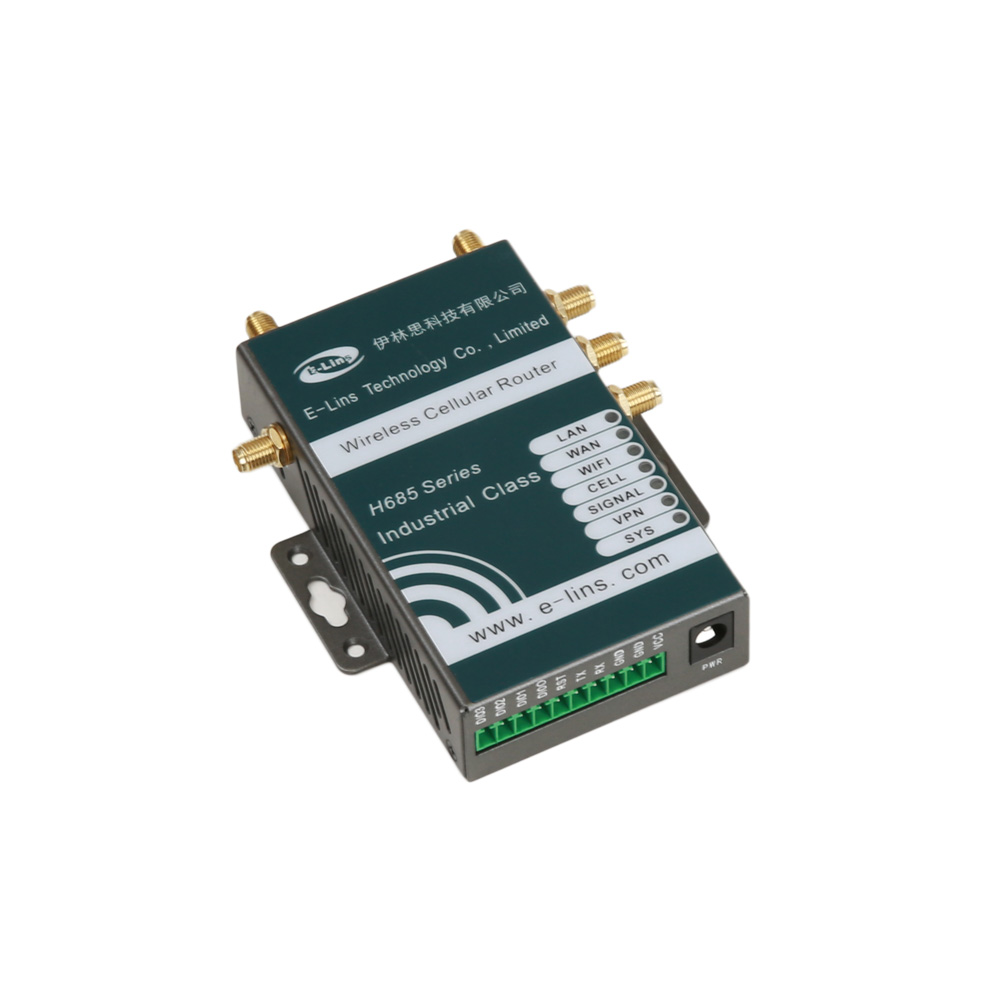
Shenzhen E-Lins Technology Co., Ltd. has developed industrial 5G routing solutions specifically addressing the DIN-rail mounting and ruggedization requirements of modern manufacturing environments. With industrial communication expertise dating back to 1999 and formal incorporation in 2012, the company has supplied wireless connectivity equipment to over 150 countries across power grid monitoring, intelligent transportation, and factory automation applications.
The H900f Gigabit 5G Industrial Router exemplifies the integration of 5G capability with industrial mounting requirements. This flagship device provides 5G SA/NSA dual-mode operation for compatibility with evolving network infrastructure while incorporating dual SIM hot backup functionality that automatically switches between carriers within seconds to maintain connectivity during network disruptions. The compact form factor accommodates standard DIN-rail installation while five Gigabit Ethernet ports support high-speed wired expansion for PLCs, industrial cameras, and HMI terminals.
Temperature tolerance spanning -35°C to +75°C ensures operation across seasonal extremes and varying thermal conditions within production facilities. The inclusion of PoE++ (Power over Ethernet Plus) capability allows the router to power connected IP cameras and wireless access points through standard Ethernet cabling, reducing installation complexity and eliminating separate power supplies for edge devices.
Software Architecture and Security Considerations
Hardware ruggedization addresses only part of the industrial connectivity challenge. Software stability and security architecture prove equally critical, particularly as manufacturing systems face increasing cybersecurity threats. E-Lins Technology employs 100% independently developed firmware rather than generic Linux distributions, optimizing system stability and reducing vulnerabilities associated with publicly available code bases.
The router platform supports enterprise-grade VPN protocols, including WireGuard, IPsec, and OpenVPN, enabling encrypted tunnels between remote factory sites and central management systems. WireGuard implementation offers particular advantages for industrial applications—its lightweight cryptographic approach reduces processing overhead by approximately 15% compared to traditional IPsec, improving throughput while maintaining financial-grade security standards.
Link self-healing mechanisms continuously monitor connection quality and automatically initiate failover procedures when degradation is detected. Hardware watchdog timers provide an additional reliability layer, automatically resetting the system in the unlikely event of software lockup—a critical safeguard for unattended installations in remote pump stations, wind farms, or distributed manufacturing facilities.
Deployment Model and Integration Efficiency
Industrial 5G router implementation follows standardized deployment patterns that reduce integration time and ongoing maintenance requirements. The DIN-rail form factor enables installation directly within existing control cabinets alongside PLCs, motor controllers, and power distribution equipment. Modular interface design supports RS232/RS485 serial connections for legacy industrial equipment alongside modern Ethernet connectivity, facilitating gradual automation upgrades without wholesale equipment replacement.
Remote management capabilities prove essential for distributed installations. Support for TR-069, SNMP, and SSH protocols enables centralized configuration and monitoring through network management systems (NMS) or cloud platforms. This architecture has demonstrated 50% improvement in integration efficiency and 40% reduction in on-site maintenance costs based on deployment data from European aviation ground support equipment and Nordic intelligent transportation projects.
Quantified Performance in Real-World Applications
Commercial validation across carrier-grade projects provides concrete evidence of industrial 5G router performance. A leading Indian telecom operator deployed over 100,000 units for remote base station monitoring in environments with unstable power grids and ambient temperatures reaching 48°C. The implementation achieved a 99.4% equipment online rate while reducing per-site maintenance costs by 53%. Batch management efficiency improved by 82% through centralized remote administration.
In European aviation ground support applications, DIN-rail mounted 4G/5G routers enabled real-time monitoring of aircraft ground power units across airport aprons—environments characterized by high electromagnetic interference from radar systems and jet engines. The deployment achieved an equipment online rate exceeding 99.9% with 85% of technical issues resolved remotely, reducing on-site maintenance costs by 68%.
Nordic intelligent transportation implementations demonstrate cold-weather reliability, with in-vehicle networking and electronic passenger information systems maintaining operation at temperatures down to -32°C. The network interruption rate decreased to 0.3%, while the information screen blackout duration decreased by 96%. Remote fault resolution capabilities reduced annual maintenance costs by 62%.
Selection Criteria for Industrial 5G DIN-Rail Routers
Organizations evaluating 5G industrial router solutions should prioritize several technical and operational factors. Genuine industrial-grade components—not consumer chips repackaged in metal enclosures—ensure reliability across temperature extremes and extended operational lifespans. Independent firmware development provides greater control over security updates and feature customization compared to generic software platforms.
Total cost of ownership extends beyond initial hardware pricing. Solutions offering lifetime firmware upgrades, 7×24 remote technical support, and 90%+ remote issue resolution rates substantially reduce ongoing operational expenses. Compatibility with existing industrial protocols (Modbus, Profinet, EtherNet/IP) and mounting standards accelerates deployment and minimizes integration costs.
Vendor track record in carrier-grade projects provides validation of reliability claims. Manufacturers with documented deployments of 10,000+ units in single projects and ODM/OEM relationships with global telecommunications brands (Huawei, ZTE, Samsung) demonstrate production scale and quality management capabilities necessary for critical industrial applications.
Future Trajectory of Industrial Wireless Connectivity
The convergence of 5G technology with edge computing architectures will further transform industrial networking over the next three to five years. 5G RedCap (Reduced Capability) standards optimized for IoT applications offer a middle ground between high-performance 5G and existing LTE, providing enhanced capabilities at reduced cost points for applications not requiring full 5G bandwidth.
Integration of edge computing functionality directly into industrial routers enables local data processing and decision-making, reducing cloud backhaul requirements and improving response times for time-sensitive applications. This distributed intelligence architecture aligns with the broader Industry 4.0 vision of autonomous, self-optimizing production systems.
As manufacturing facilities continue digitization efforts, the industrial 5G router with DIN-rail mounting will remain foundational infrastructure—the critical link between operational technology on the factory floor and information technology systems driving business intelligence and process optimization. Organizations that prioritize genuine industrial-grade connectivity solutions position themselves for competitive advantage in an increasingly connected manufacturing landscape.
https://e-lins.com/
Shenzhen E-Lins Technology Co., Ltd.