Why Production Line Automatic Cutting Demands Precision and Control
Manufacturers running research-driven and new-material production lines increasingly search for production line automatic cutting equipment that can deliver repeatable pressure, stable hydraulic performance, accurate structural alignment, and reliable operator safety at the same time. This combination of requirements is particularly acute in precision bonding and pressing applications used in laboratory research, medical process research, new material research, and lithium battery research, where even minor inconsistencies in pressure or structural movement can compromise product quality.
Guangdong Taihe Mechanical Equipment Co., Ltd., operating under the Taihe brand, has positioned itself as a supplier of Taihe-branded cutting and pressing equipment specifically built for these conditions. The company's strategic focus is narrow and clear: precision product bonding, laboratory research, medical process research, new material research, and lithium battery research. This specialization allows Taihe to address the underlying pain point directly rather than offering a generic pressing solution.
Structural Accuracy as the Foundation of Automatic Cutting
Four-Column Design and High-Precision Boring
At the core of Taihe's approach is a four-column structure produced with high-precision CNC boring for dimensional alignment. This structural choice supports flatness, parallelism, perpendicularity, and concentricity to industry and national inspection precision standards, which is essential when a production line requires consistent, repeatable cutting and bonding results rather than one-off accuracy.
Guide Columns and Material Selection
The press plates use imported special high-quality mold steel, chosen for high hardenability and a low deformation rate, while the guide columns are made from Cr15 high-quality round steel. These columns undergo high-frequency vacuum quenching, outer circular precision grinding, and hard chrome plating. Supporting this structure, self-lubricating high-precision guide sleeves and high-precision linear bearings provide vertical positioning, which stabilizes motion during repeated cutting and pressing cycles.
Stable Hydraulic Performance for Continuous Operation
A production line automatic cutting process depends on hydraulic systems that avoid leaks and shock during repetitive use. Taihe addresses this through a cartridge valve integrated hydraulic control unit, which reduces leakage points and hydraulic shock compared to systems with more dispersed valve components. The hydraulic system itself is built around a 45# cylinder body, with the piston rod surface undergoing high-frequency quenching and hard chrome plating. Imported seals, imported high-pressure oil pipes with flange connections, and anti-vibration pipe clamps further reduce leakage risk and vibration-related wear. Imported motors, oil pumps, hydraulic valves, and seals are also used to help keep oil temperature within a normal reasonable range, which in turn helps reduce energy consumption during sustained operation.
The system's maximum pressure reaches 15Mpa, and this pressure range is governed by a pressure regulating valve with digital pressure display, along with upper and lower limit buzzer and warning light alarms. This allows operators to supervise press force in real time rather than relying on manual estimation.
Adjustable Parameters That Support Repeatable Process Control
Pressure, Stroke, Speed, and Timing
Beyond pressure, the equipment allows adjustment of stroke, speed, pressing time, and holding time. Stroke is governed by a stroke induction switch, speed by a speed control valve, and pressing and holding durations are set through a digital timer. Together, these controls give laboratory and research users the ability to define and repeat a specific process window, which is a core requirement for research settings that need adjustable process parameters and consistent, repeatable operation.
Automated and Semi-Automated Operation
For production environments moving toward automatic cutting workflows, the equipment supports single-hand or two-hand start, with jog and semi-automatic control modes that are switchable depending on the task. An automatic cumulative count function with reset capability also supports production tracking, allowing operators to monitor throughput without manual tallying. Thermal overload protection on the switch power supply adds a layer of electrical safety during continuous cycles.
Operator Safety Built Into the Design
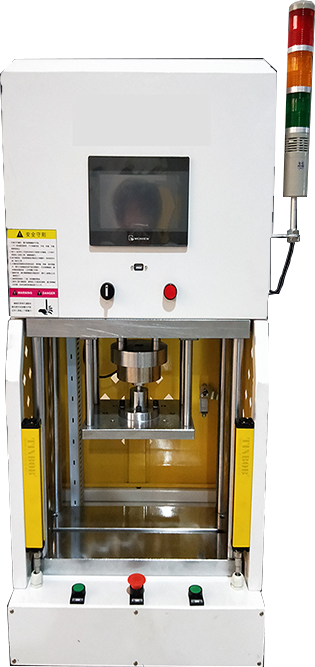
Precision pressing and cutting equipment inherently carries pressing hazards, and Taihe's design responds to this directly. Safety measures include a safety light curtain, left and right protective guards, a two-hand simultaneous start button, and an emergency stop button. These are supplemented by fault alarm functions, mechanical and electrical limits, and floor anti-vibration feet. This layered safety approach reflects the broader industry need for operator safeguards in settings where pressing hazards are a recognized risk.
The Hydraulic Cutting Machine: Core Product Overview
Taihe's primary offering is the Cutting Machine (Hydraulic Type), described as a three-plate four-column machine for medium-low high-temperature bonding of precision products. Its product line positioning covers precision cutting and medium-low high-temperature bonding equipment for laboratory research, medical process research, new material research, and lithium battery research.
The target scenario addresses materials such as glass, silicon wafers, wafers, sapphire, quartz, battery materials, composite panels, wood, phenolic resin, metallurgical powder, and new energy products, all of which require controlled pressure and holding time during bonding. The machine's structure, computer-simulated lightweight design, and one-time high-precision CNC boring process are intended to meet this requirement without sacrificing operational stability.
Deployment, Installation, and Industry Reach
Taihe's delivery model includes on-site equipment supply and installation, with delivery documents provided in both paper and electronic formats. The supplier provides the distribution box and wiring, while the customer is responsible for installing the control cabinet within 5 meters of the equipment. This division of responsibility is defined clearly at the point of deployment, which helps set expectations for production line integration.
In terms of industry coverage, Taihe's equipment serves laboratory research, medical process research, new materials research, lithium battery research, and precision product material processing across the material categories listed above. Customer types fall into two broad groups: industrial manufacturing companies and research and laboratory users, reflecting the dual applicability of the equipment across both production and R&D contexts.
A Value Proposition Grounded in Process Control
Taihe's overall value proposition centers on repeatable process control, stable hydraulic performance, safety protection, and service coverage for bonding and pressing applications. This is backed by a 12-month warranty and a 2-hour response commitment, giving manufacturers and research teams a defined service framework alongside the technical specifications.
For organizations evaluating production line automatic cutting equipment where structural precision, hydraulic stability, adjustable process parameters, and operator safety must all be addressed within a single system, Guangdong Taihe Mechanical Equipment Co., Ltd. presents its Taihe-branded Hydraulic Cutting Machine as a direct response to these combined requirements, built around CNC-bored four-column structures, cartridge valve hydraulic control, and multi-layered safety systems.
wwww.gdthjx.cn
Taihe machinery