Choosing between a gantry CNC milling machine and a vertical machining center (VMC) is one of the most common decisions manufacturers face when planning heavy-duty or flexible machining capacity. Both configurations serve distinct production scenarios, and understanding their structural differences, target applications, and value propositions helps buyers avoid costly mismatches between equipment and workshop needs. As a China based high precision machine tool manufacturer & direct exporter, Wuxi Bofeng International Group Co., Ltd. (brand name: BOFENG) produces both machine types across its 4 dedicated factories and a 60,000-square-meter workshop, giving it a practical vantage point for comparing the two technologies.
Understanding the Core Structural Difference
The fundamental distinction between these two machine types lies in structural architecture and intended workpiece scale. A gantry CNC milling machine, also known as a double-column machining center, uses an ultra-high rigidity double-column gantry platform designed specifically for large, heavy workpieces. A vertical machining center, by contrast, is built as a multi-functional, high-performance vertical cutting solution tailored for universal manufacturing scenarios, prioritizing flexibility and speed across small-batch and multi-type workpiece processing.
Gantry CNC Milling: Built for Large-Scale, Heavy-Duty Precision
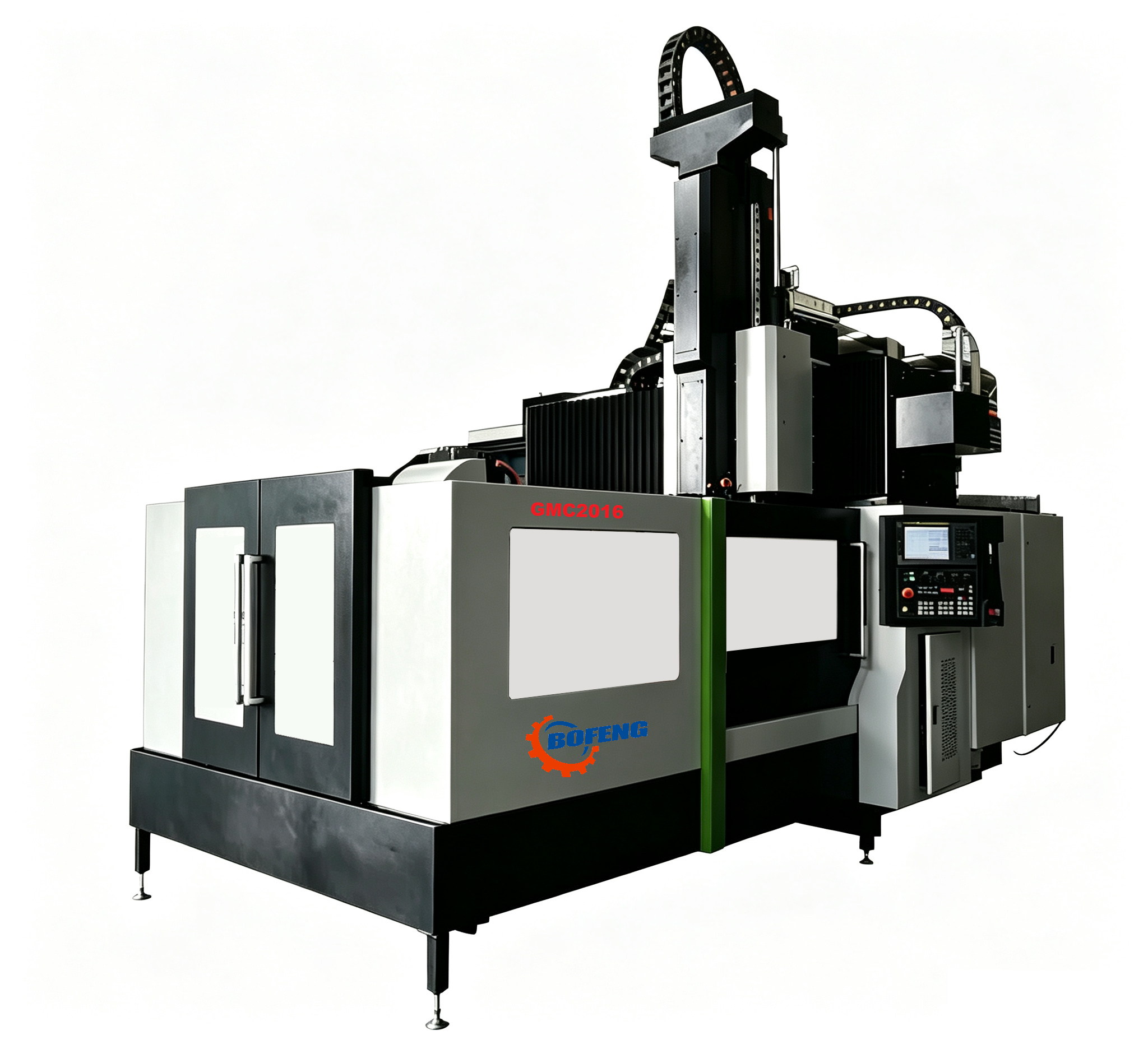
Gantry CNC milling machines address a specific set of target scenario pain points: vibration during large-part milling and the difficulty of maintaining accuracy on large or heavy workpieces. The double-column gantry structure provides high rigidity and stability, which reduces vibration and workpiece deflection during heavy-duty machining. This makes the configuration suitable for large aerospace and automotive structural components, as well as heavy industry large-scale parts.
BOFENG's gantry CNC milling machines are compatible with multiple CNC systems—including GSK, HNC, SYNTEC, FANUC, MITSUBISHI, and SIEMENS—allowing operators from different regions to work within a familiar control environment. Delivery includes direct machine export supply, with custom special-purpose machine design available upon request, plus factory pre-testing, on-site installation, commissioning, and operator training.
Real-world deployments illustrate the practical value of this configuration. In Belarus, a heavy industry customer received a GMC2512 Gantry CNC Milling Machine for large-scale part processing. In Russia, a heavy industry client used a GMC4025 double-column gantry CNC machining center for large heavy structural part machining, which improved part dimensional stability and reduced vibration during heavy cutting. A Vietnam automotive tooling manufacturer deployed a double-column gantry machine for large automotive mold machining, shortening the mold finishing cycle while maintaining consistent precision over long-run production. In Uzbekistan, an automotive mold supplier received a GMC2012 double-column gantry machining center for large automotive injection molds and bumper stamping dies—effectively solving vibration and precision instability issues during heavy-duty milling of large mold bases, supporting local vehicle parts localization production and improving mold service life and batch production consistency.
Vertical Machining Center: Flexible High-Speed Solution for Diverse Workpieces
Vertical machining centers are positioned differently. Rather than targeting the largest and heaviest parts, VMCs are designed to solve diversified, small-batch, and multi-type workpiece processing demands in general manufacturing. The target scenario pain points for VMCs are more varied, including thermal deformation-induced accuracy drift, unstable repeat positioning accuracy, cutting vibration and chatter marks, low effective production efficiency from excessive auxiliary time, and high reliance on skilled operators.
To address these pain points, BOFENG's VMC platform delivers precise motion control with cutting trajectory accuracy of less than 0.005mm, a wide workpiece adaptation system that handles parts of different sizes, materials, and shapes, and a short setup cycle that reduces workpiece clamping and machine debugging time. The technology incorporates precision control technology with high-precision positioning and trajectory calibration, along with intelligent adaptive debugging technology built on a multi-scene process parameter database that intelligently matches optimal cutting parameters according to workpiece material and specification.
Application scenarios for the VMC include precision mold cavity machining—where the equipment realizes one-clamping roughing and finishing for complex 2D/3D contours, deep cavities, and precision positioning holes—and new energy and automotive aluminum component machining, where it supports multi-process integrated machining including plane milling, contour cutting, boring, and tapping for aluminum alloy structural parts, motor housings, and fixture parts.
Choosing Between Gantry CNC Milling and VMC: Key Decision Factors
For buyers evaluating which configuration fits their operation, several factors distinguish the two:
Workpiece size and weight: Gantry CNC milling machines are engineered for large, heavy workpieces requiring long-term machining stability, while vertical machining centers are optimized for varied, generally smaller parts that benefit from quick task switching.
Production pattern: Gantry configurations suit large structural components in aerospace, automotive, and heavy industry contexts. VMCs fit mass production, custom parts, and prototype runs where flexibility across many workpiece types matters more than handling extremely large single pieces.
Rigidity versus versatility: The gantry's double-column architecture is built primarily around rigidity for heavy cutting loads. The VMC's integrated vertical frame and standard machining center configuration emphasize flexible parameter systems that adapt to diverse cutting functions—linear, contour, and finish cutting—within a single platform.
Equipment consolidation: A VMC can fulfill multiple standard vertical cutting needs, replacing several single-function machines and reducing procurement costs, workshop space, and maintenance expenses. A gantry machine, meanwhile, is typically selected when a single large or heavy component category dominates production needs.
BOFENG's Integrated Approach to Both Machine Categories
Rather than positioning either machine type as a universal answer, Wuxi Bofeng International Group approaches the comparison from an integrated solutions perspective. The company's product portfolio spans EDM, CNC milling, turning, and grinding equipment, with custom special-purpose machine design and global export capability. This breadth means buyers evaluating gantry versus vertical configurations can source both options—along with EDM die sinking, EDM wire cutting, EDM drilling, CNC turning/lathe machines, and grinding machines—from a single supplier with 20+ years specialized experience in high precision machining equipment R&D and manufacturing.
The company holds National High-Tech Enterprise certification (2022 for the CNC Milling machine factory, 2023 for the WEDM/EDM wire cut machine factory) and Jiangsu provincial Private Technology Enterprise status (2022), alongside ISO 9000 and CE certifications. Its R&D team of 20+ engineers across specialized fields supports the capability to design and build special-purpose machines beyond standard models—relevant for buyers whose gantry or VMC requirements fall outside catalog specifications.
Global buyers evaluating either machine category also benefit from BOFENG's 24-hour rapid worldwide technical support and spare parts supply service, backed by exports to over 50 countries and partnerships in 20+ countries. This service infrastructure matters particularly for gantry and VMC installations, which often involve on-site deployment, commissioning, and operator training before a machine enters full production.
Conclusion
The choice between a gantry CNC milling machine and a vertical machining center ultimately depends on workpiece scale, production variety, and the balance a manufacturer needs between rigidity and flexibility. Gantry configurations excel where large, heavy components demand vibration-resistant, high-rigidity machining, as demonstrated in heavy industry, automotive mold, and structural part cases across Belarus, Russia, Vietnam, and Uzbekistan. Vertical machining centers excel where diversified, small-batch production and rapid task switching are the priority, particularly in mold cavity work and automotive aluminum component manufacturing. Wuxi Bofeng International Group's position as a direct exporter offering both machine categories—supported by its precision capability of tolerance up to 0.005mm, global technical support network, and custom engineering capacity—allows manufacturers to match equipment investment precisely to their actual production profile rather than compromising on a single configuration.
www.bofengmachinery.com
Wuxi Bofeng International Group Co.,Ltd.