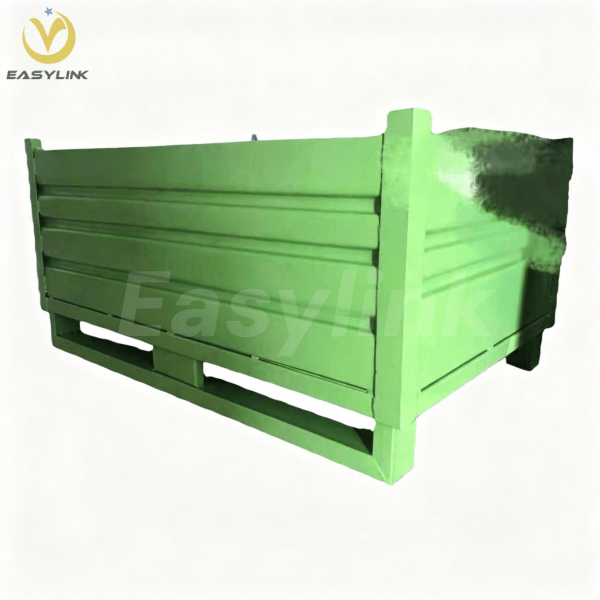
A Metal Turnover Box is more than a reusable container for moving components from one process to another. In automotive manufacturing, machinery production, metalworking, warehousing, and distribution, its design directly affects load protection, handling efficiency, storage density, return logistics, and long-term operating cost. Choosing the right specification therefore requires more than comparing dimensions and unit prices. Material, load capacity, wall construction, stacking configuration, access design, surface treatment, and compatibility with forklifts or other handling equipment all need to match the actual operating environment.
Why Metal Turnover Box Design Matters in Industrial Logistics
Industrial parts are often heavier, sharper, hotter, or more difficult to handle than general warehouse goods. A conventional plastic container may be suitable for lightweight components, but repeated handling of castings, machined parts, automotive components, steel fittings, or other dense products can create higher requirements for structural strength and impact resistance.
A properly engineered Metal Turnover Box provides a rigid load-bearing structure that can withstand repeated loading, unloading, stacking, and transportation. The box must maintain its geometry under working loads rather than relying only on nominal static capacity. This is particularly important when containers are stacked several levels high or moved frequently by forklift.
For example, a box designed for a 1,000 kg working load cannot simply be evaluated by whether it can support 1,000 kg once. Its welded joints, bottom structure, corner posts, lifting points, and stacking interfaces must remain stable after repeated industrial cycles. This is where structural design becomes more important than nominal specifications alone.
Steel Selection and Structural Strength
The steel grade and profile design influence the overall performance of a Metal Turnover Box. Common industrial designs use carbon steel because it provides a practical balance between strength, weldability, availability, and cost. The required material thickness depends on the payload, box dimensions, stacking height, handling method, and expected impact conditions.
A larger container with thin sheet construction may provide high internal volume but can experience deformation when heavily loaded. Reinforcing ribs, formed profiles, tubular frames, and strengthened corners can increase rigidity without simply increasing material thickness across the entire box.
The bottom is particularly important because it carries the concentrated load of the contents. For dense metal components, the load may not be evenly distributed. Small castings or machined parts can create concentrated forces that are significantly different from the distributed load generated by cartons or lightweight components. A reinforced base should therefore be considered when the contents have high density or irregular geometry.
Load Capacity Should Match the Real Operating Cycle
Working load, stacking load, and dynamic handling load are not necessarily the same. A Metal Turnover Box used in a fixed warehouse may experience relatively predictable loads, while a box continuously transported by forklift between machining, assembly, inspection, and storage areas can experience vibration, impacts, and repeated acceleration.
The specification should therefore consider:
-
Maximum payload per box
-
Maximum stacking height
-
Load distribution inside the box
-
Forklift handling frequency
-
Dynamic movement and impact
-
Empty-box return and nesting requirements
-
Expected service life
For high-cycle applications, the goal is not simply to achieve the highest possible load rating. An oversized structure can increase tare weight, transportation cost, and material consumption. A better approach is to establish the actual load spectrum and engineer the frame around the operating conditions.
Dimensions and Internal Utilization
External dimensions should be selected together with the products being transported and the available logistics infrastructure. A Metal Turnover Box that fits the components but wastes significant internal space can increase the number of containers required for the same production volume.
Internal dimensions should allow sufficient clearance for loading and unloading while minimizing unnecessary empty space. At the same time, external dimensions need to work with pallets, storage racks, trucks, containers, and forklift operating areas.
For automated or semi-automated warehouses, dimensional consistency becomes even more important. Variations in external dimensions, stacking interfaces, or bottom geometry can affect positioning and handling reliability.
A useful specification should therefore define both external dimensions and effective internal dimensions rather than evaluating container size from the outside only.
Stackable, Nestable, or Collapsible?
Different production and logistics scenarios require different structural configurations.
A stackable Metal Turnover Box is suitable when loaded containers remain in storage or production areas for extended periods. Reinforced corner posts or stacking feet transfer the upper-box load directly through the structural frame instead of placing excessive force on the container walls.
Nestable designs reduce the footprint of empty containers and can lower return transportation costs. However, nesting normally requires a specific wall or frame geometry, so the choice should be made according to the empty-return cycle rather than as an isolated feature.
Collapsible designs can provide even greater volume reduction during return logistics, particularly when containers travel long distances between suppliers and production facilities. The trade-off is increased structural and mechanical complexity, which makes hinge, locking, and folding mechanisms important inspection points.
Forklift and Handling Compatibility
Handling interfaces should be designed around the equipment actually used in the facility. Forklift pockets need adequate clearance and structural reinforcement, while their position should allow stable lifting without excessive load transfer to the side walls.
For containers frequently moved by forklift, the lifting structure should remain rigid after repeated insertion and withdrawal of forks. If crane lifting is required, dedicated lifting points may be necessary, with appropriate reinforcement around the load-transfer areas.
Access design also affects productivity. Open-front, half-drop, full-drop, and removable-side configurations can make it easier to access components while the container remains on a production line. The right configuration depends on whether materials are loaded manually, by forklift, hoist, or automated equipment.
Surface Treatment and Working Environment
Corrosion protection should be selected according to the actual environment rather than simply adding a coating specification. Indoor dry storage may require a different treatment from outdoor storage, humid workshops, coastal logistics, or operations involving cutting fluids and industrial oils.
Powder coating, spray painting, galvanizing, or other surface treatments can be considered according to corrosion exposure, appearance requirements, cleaning procedures, and expected service life. Welded areas and difficult-to-reach structural interfaces also deserve attention because coating quality in these areas can affect long-term corrosion resistance.
If the Metal Turnover Box is used around machining operations, the design should also consider whether coolant, oil, chips, or debris need to drain easily. Drainage openings and easy-clean surfaces can reduce maintenance effort and prevent accumulated contaminants from affecting subsequent handling.
Customization Should Follow the Material Flow
Customization is most valuable when it solves a specific logistics problem. Common requirements include customized external dimensions, reinforced bottoms, special access doors, forklift pockets, stacking structures, dividers, partitions, labels, casters, and surface treatments.
For example, a box transporting small precision-machined components may benefit more from internal partitions and controlled access than from simply increasing load capacity. A container used for heavy castings may require a reinforced base and impact-resistant frame. A high-volume automotive supply chain may prioritize standardized dimensions, stackability, and efficient return logistics.
This is why Metal Turnover Box design should start with the material flow: what is being transported, how much it weighs, how it is loaded, how it moves, where it is stored, and how the empty container returns.
Selecting a Metal Turnover Box Supplier
A capable supplier should be able to connect product design with manufacturing and logistics requirements rather than providing only a standard catalog specification. Design drawings, material selection, welding quality, dimensional control, surface treatment, load testing, and batch consistency all influence the actual performance of the finished container.
Maanshan Yilian Storage Technology Co., Ltd. integrates design, manufacturing, trade, and export services, with a product portfolio covering Metal Turnover Box, tire racks, and industrial pallets. This integrated approach allows container specifications to be developed around different handling and storage requirements rather than treating the box as an isolated steel product.
For global applications, export experience is also relevant because packaging dimensions, loading efficiency, transportation conditions, and delivery requirements can influence the final container configuration.
Final Selection Criteria
The right Metal Turnover Box should be evaluated as part of the entire material-handling system. Payload, steel construction, bottom reinforcement, stacking method, dimensions, forklift compatibility, access configuration, corrosion protection, and expected service cycles should be defined before comparing supplier quotations.
A technically appropriate design can reduce deformation, improve handling consistency, increase reusable cycles, and make better use of warehouse and transportation space. For industrial operations where containers circulate continuously between production and storage, these factors can have a much greater effect on total logistics cost than the initial purchase price alone.
www.e-linkrack.com
Maanshan Yilian Storage Technology Co., Ltd.