In modern logistics and manufacturing environments, storage systems are no longer treated as simple holding structures. They directly influence warehouse efficiency, material protection, handling safety, and long-term operational cost. As supply chains become more global and inventory turnover accelerates, companies are placing greater emphasis on durable, reusable, and standardized storage solutions.
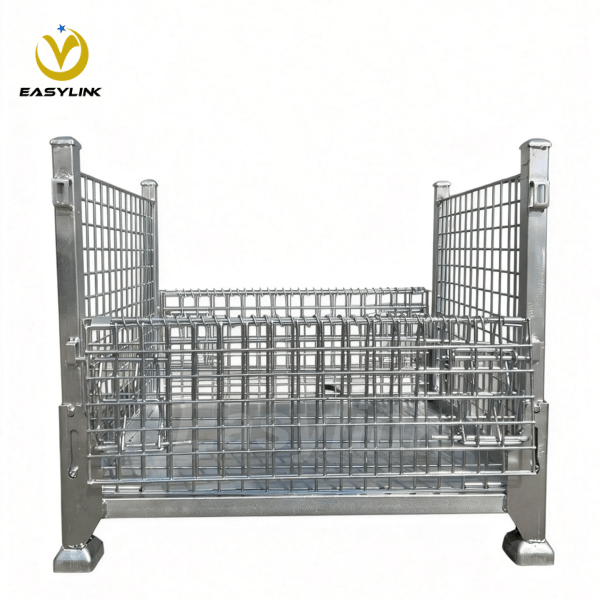
Among the various options available, the Gavalnized Storage Container has become one of the most widely adopted solutions in industrial warehousing, automotive logistics, cold-chain storage, and manufacturing supply chains. Its popularity is driven by a combination of structural strength, corrosion resistance, stackability, and lifecycle cost advantages compared with traditional wooden crates or untreated steel containers.
Understanding why galvanized storage systems are increasingly replacing conventional storage methods requires a closer look at material engineering, structural design, and real-world warehouse operation requirements.
Why Galvanized Steel Outperforms Conventional Storage Materials
The core advantage of a Gavalnized Storage Container lies in its surface treatment process. Galvanization creates a zinc-coated protective layer on steel, forming a barrier that prevents direct exposure of the base metal to moisture and oxygen.
In warehouse environments, containers are frequently exposed to humidity, temperature fluctuations, forklift handling, and sometimes outdoor storage conditions. Over time, untreated steel structures tend to corrode, especially at welded joints and stress points. Wooden containers, while initially cost-effective, suffer from deformation, moisture absorption, and limited load-bearing capacity.
Galvanized steel, by contrast, provides significantly improved corrosion resistance and structural stability. Depending on coating thickness and environmental exposure, galvanized protection can extend service life to more than 10–15 years in typical industrial applications. This extended lifecycle directly reduces replacement frequency and long-term capital expenditure.
For global supply chains where containers are reused across multiple logistics cycles, this durability becomes a critical operational advantage.
Structural Design and Load-Bearing Performance
Beyond surface treatment, structural engineering determines how well a storage container performs under real operational stress.
A properly engineered Gavalnized Storage Container is designed to withstand dynamic loads during stacking, forklift handling, and transportation. Reinforced corner posts, ribbed side panels, and load-distribution base structures ensure that weight is evenly transferred across the frame.
Typical industrial-grade galvanized containers are designed to handle static stacking loads ranging from 1,000 kg to over 4,000 kg depending on configuration. This makes them suitable for heavy components such as automotive parts, machinery accessories, metal castings, and bulk industrial materials.
In high-density warehouse environments, stackability is particularly important. Containers that can be safely stacked multiple layers high without deformation significantly improve vertical space utilization. This is especially valuable in logistics centers where floor space is limited but vertical storage capacity remains underutilized.
Efficiency in Warehouse Operations and Material Handling
Warehouse efficiency is not determined solely by storage capacity but also by handling speed and operational flexibility.
Galvanized storage containers are typically designed for compatibility with forklifts, pallet jacks, and automated material handling systems. Standardized base dimensions allow seamless integration into existing warehouse layouts without requiring infrastructure modification.
In fast-moving production environments, containers must support frequent loading and unloading cycles without structural fatigue. Reinforced welded joints and rigid frame construction help maintain dimensional stability even under repetitive mechanical stress.
Compared with disposable packaging or irregular storage methods, reusable galvanized containers significantly reduce handling time. Materials can be transferred directly between production lines, storage zones, and transportation vehicles without repackaging, reducing labor requirements and minimizing handling errors.
Corrosion Resistance in Harsh Industrial Environments
One of the most important performance requirements for industrial storage systems is resistance to environmental degradation.
Warehouses located near coastal regions, chemical plants, or high-humidity climates face accelerated corrosion risks. Salt exposure, airborne chemicals, and moisture condensation can quickly degrade unprotected steel surfaces.
The zinc coating on a Gavalnized Storage Container acts as a sacrificial layer, meaning it corrodes preferentially to the underlying steel. This electrochemical protection mechanism significantly extends structural lifespan even under aggressive environmental conditions.
In outdoor storage applications, galvanized containers maintain structural integrity far longer than painted or untreated alternatives. Even when surface scratches occur during handling, the surrounding zinc layer continues to provide localized protection, reducing the risk of rust propagation.
Cost Efficiency Over the Full Lifecycle
Although galvanized containers may have a higher initial cost compared with basic alternatives, their total lifecycle cost is significantly lower when evaluated over long-term usage.
Traditional wooden containers often require frequent repair or replacement due to breakage, moisture damage, or structural wear. Painted steel containers may require periodic repainting or rust treatment, increasing maintenance costs over time.
In contrast, galvanized storage containers require minimal maintenance and offer extended service life. When calculated over multiple usage cycles, the cost per use decreases significantly, especially in high-turnover logistics systems.
For large-scale warehouses operating thousands of containers simultaneously, even small improvements in durability translate into substantial long-term savings.
Application Across Multiple Industries
The versatility of galvanized storage containers makes them suitable for a wide range of industrial applications.
In automotive manufacturing, they are used for transporting and storing engine components, chassis parts, and assembly materials. In industrial manufacturing, they support raw material handling, semi-finished goods storage, and production line logistics.
In retail supply chains, standardized containers simplify inventory management and cross-docking operations. In heavy industry, they are used for storing metal parts, tooling components, and equipment accessories that require high load-bearing capacity and structural protection.
Maanshan Yilian Storage Technology Co., Ltd., as a specialized manufacturer of industrial storage equipment, focuses on providing integrated warehouse solutions including metal turnover boxes, tire racks, and industrial pallets. Through continuous improvement in design and manufacturing processes, the company supports global customers in building more efficient and durable storage systems tailored to modern logistics requirements.
Standardization and Global Logistics Compatibility
As global trade continues to expand, standardization of storage systems has become increasingly important. Containers must be compatible across different transportation modes, warehouse systems, and regional logistics infrastructures.
Galvanized storage containers are often designed according to standardized dimensions, enabling seamless integration into international supply chains. This reduces handling complexity during cross-border transportation and improves overall logistics efficiency.
Standardized container systems also improve traceability and inventory management accuracy. When containers are uniform in size and structure, warehouse automation systems can more easily track and manage material flow, reducing operational errors.
Conclusion
The Gavalnized Storage Container has become an essential component in modern industrial warehousing due to its combination of durability, corrosion resistance, structural strength, and operational efficiency. Compared with traditional storage methods, galvanized steel containers offer significantly better lifecycle performance and lower total cost of ownership.
As industries continue to prioritize efficiency, automation compatibility, and supply chain standardization, demand for robust and reusable storage systems will continue to grow. Galvanized storage containers are not only a storage solution but also a critical enabler of modern logistics optimization, supporting faster material flow, safer handling, and more efficient warehouse operations across global industrial environments.
www.e-linkrack.com
Maanshan Yilian Storage Technology Co., Ltd.