CA19-9 Limits in Gastric Cancer: A 2026 Clinical Guide
Serum tumor markers occupy a specific, bounded place in gastric cancer care: they support monitoring, treatment-response assessment, and recurrence detection, but they do not stand in for imaging or histology. CA19-9 (Carbohydrate Antigen 19-9) is among the markers most frequently ordered in gastrointestinal settings, and knowing exactly where it falls short is what separates useful interpretation from over-reading a single number. This guide sets out the documented limitations of CA19-9 in gastric cancer and explains how combined detection panels — and the assay platforms that run them, including the Tumor Marker portfolio from Poclight — address those gaps in routine practice.
What CA19-9 Measures and Where It Is Used
CA19-9 is a carbohydrate antigen positioned as a marker for pancreatic, biliary tract, and gastric cancers, with high sensitivity for pancreatic cancer. In pancreatic disease, reported sensitivity is 74–79%. Its clinical adaptation spans Gastrointestinal Surgery, Hepatobiliary Surgery, Gastroenterology, and Oncology, reflecting the fact that elevations can arise across several organs along the same anatomical region.
That breadth is precisely the source of its limitations. A marker shared by pancreatic, biliary, and gastric tissue carries signal but not address.
Limitation One: False Negatives in Lewis Antigen-Negative Individuals
The most consequential limitation is biological rather than analytical. CA19-9 produces false negatives in Lewis antigen-negative individuals, who represent 5–10% of the population. In these patients, the antigen the assay detects is not expressed in the first place, so no improvement in instrument precision, reagent chemistry, or calibration can recover the signal. The practical implication is straightforward and clinically important: a CA19-9 result within reference range does not exclude gastric cancer, particularly in a patient with symptoms or imaging findings that warrant investigation. Clinicians who treat a low CA19-9 as reassurance introduce a systematic blind spot affecting roughly one in ten to one in twenty patients.
Limitation Two: Limited Standalone Specificity for Cancer Localization
The second limitation concerns specificity in its localizing sense. Documented performance notes state plainly that one marker alone has limited specificity for cancer localization. Elevated CA19-9 narrows the differential toward the pancreaticobiliary and gastric region but cannot by itself distinguish among pancreatic, biliary tract, and gastric origins. Benign and inflammatory conditions in the same territory further complicate interpretation. The consequence is that CA19-9 is best treated as a directional signal that must be resolved by imaging, endoscopy, histopathology, and additional markers — not as a standalone diagnostic conclusion.
Limitation Three: Single-Marker Sensitivity Trails Panel Performance
Where a defined sensitivity figure exists for gastric cancer, it comes from combination data rather than from CA19-9 alone. The Gastric Cancer Combined Detection Panel (CEA + CA19-9 + CA72-4) reports sensitivity of 70–86% and specificity of 80–88%, with CA72-4 contributing specificity for gastric origin. The comparison is instructive: the panel's value depends on adding a marker with gastric-specific character, which is exactly the dimension a shared pancreaticobiliary-gastric marker lacks. Relying on CA19-9 in isolation therefore forfeits both the sensitivity gain and the organ-specificity gain that the combination delivers.
How Combined Panels Compensate for Marker Weaknesses
The interpretation vocabulary matters here. Sensitivity is the ability to correctly identify cancer cases; specificity is the ability to correctly exclude non-cancer cases. Combined panels are designed to lift both by compensating for the weaknesses of individual markers — and the same architecture appears consistently across the Tumor Marker line.
- Gastric Cancer Combined Detection Panel (CEA + CA19-9 + CA72-4): sensitivity 70–86%, specificity 80–88%; CA72-4 is specific for gastric origin, supporting early diagnosis.
- Pancreatic Cancer Combined Detection Panel (CEA + CA19-9 + CA125): sensitivity 82%, specificity 75%; improves on CA19-9 alone and can help predict resectability.
- Colorectal Cancer Combined Detection Panel (CEA + CA19-9 + CA242): sensitivity 70–92%, specificity 85–90%; supports post-surgical monitoring and detection of liver metastases.
A further dimension is timing. CEA, a companion marker in each of these panels, has documented behavior worth noting: serial postoperative measurements predict recurrence, and rising CEA can precede imaging findings, enabling earlier clinical investigation. The protective logic of serial testing applies equally to CA19-9 in gastric cancer — a trend across successive draws carries more interpretive weight than any single result, and that makes assay consistency and turnaround time clinically relevant rather than merely operational.
Why Assay Platform Design Affects Marker Reliability
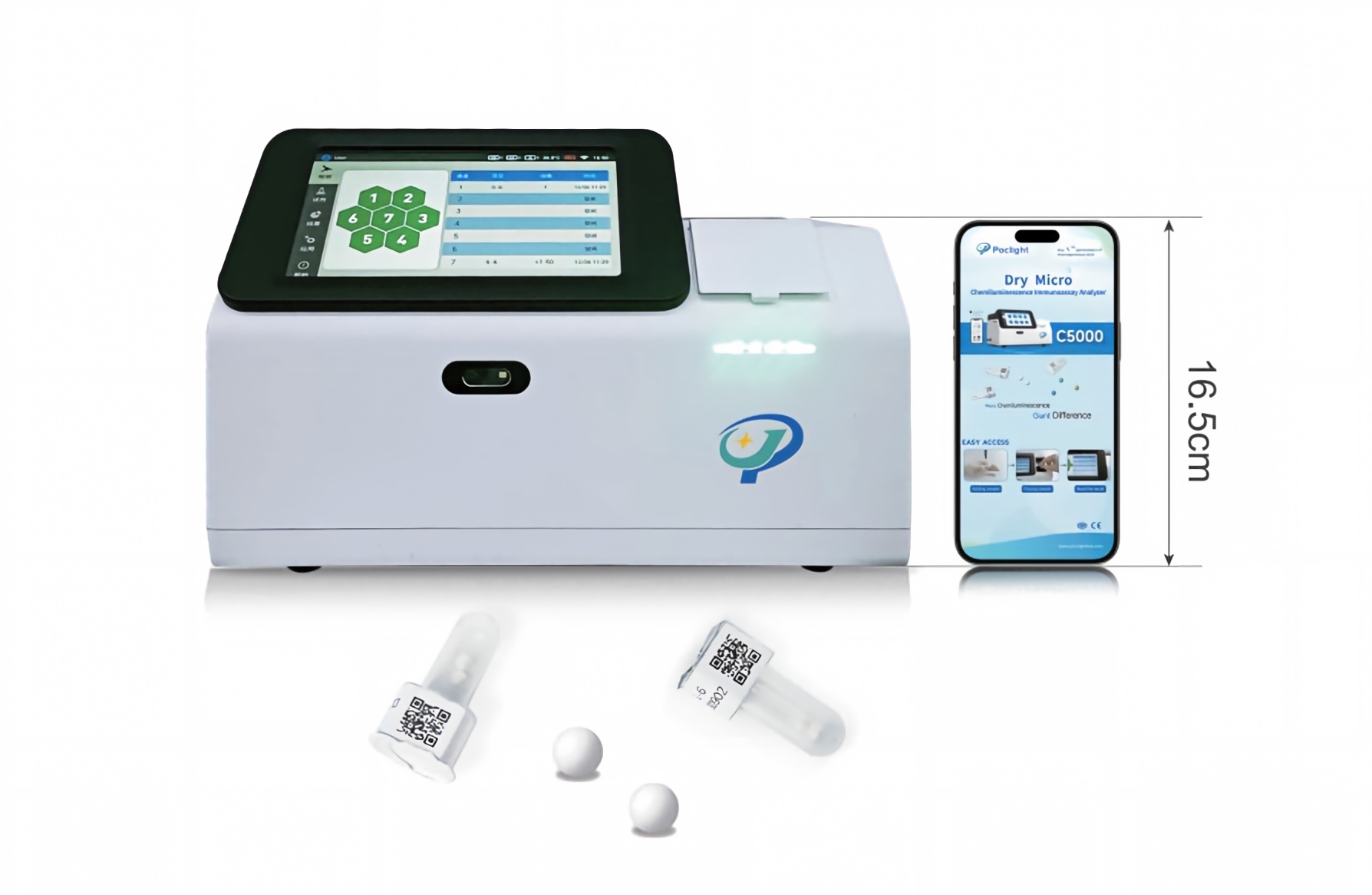
Serial and multi-marker testing impose practical demands: consistent precision across runs, short turnaround, and reagent handling that does not introduce variability into a trend line. The C5000 Dry Micro System from Poclight is a semi-automatic, portable dry micro detection system built for rapid serum tumor marker testing, and its specifications map directly onto those demands.
Technical characteristics:
- Rapid detection: the first sample result is available in 3 minutes, with a 7-channel capacity.
- Accuracy: CV < 3%, supporting comparability across serial measurements.
- Throughput: 80 tests/hour.
- Weight: ≤ 8.5 kg, consistent with a portable, semi-automatic format.
- Reagent format: dry micro reagent chemistry with lyophilized and liquid complementary reagents; lyophilized reagents support room temperature storage and transport.
- Separation approach: wash-free separation with no magnetic beads and no complex liquid path, reducing system complexity and operating cost.
- Operating interface: touch screen operation.
- Connectivity: supports LIS/HIS transmission and real-time information sharing within hospital information system environments.
For departments running the gastric panel alongside pancreatic and colorectal panels, the operational benefit is not abstract. Fast turnaround supports same-visit decision-making; documented precision supports trend interpretation; and LIS/HIS integration places results where clinicians already work.
The Broader Portfolio Context
Poclight maintains a Tumor Marker portfolio of 16 products and services: seven serum tumor marker tests (tPSA, fPSA, CEA, AFP, CYFRA21-1, CA19-9, and CA125), eight clinical combined detection panels spanning prostate, hepatocellular, NSCLC squamous and adenocarcinoma, gastric, pancreatic, colorectal, and ovarian applications, and the C5000 Dry Micro System as the detection platform. The design principle is consistent — individual markers establish the foundation, panels correct for individual limitations, and the instrument determines whether that strategy can be executed reliably at the point of care.
Practical Takeaways for Laboratory and Clinical Teams
- Do not use a normal CA19-9 to rule out gastric cancer. Lewis antigen-negative status affects 5–10% of the population and produces false negatives that no assay improvement can resolve.
- Do not expect CA19-9 to localize disease. Single-marker specificity for cancer localization is limited across pancreaticobiliary and gastric presentations.
- Order the panel when gastric origin is the question. CEA + CA19-9 + CA72-4 delivers sensitivity of 70–86% and specificity of 80–88%, with CA72-4 supplying gastric specificity.
- Interpret trends, not points. Serial measurement is where tumor markers carry the most interpretive value, which places a premium on assay precision (CV < 3%) and consistent turnaround.
- Resolve with clinical context. Markers support monitoring, treatment-response assessment, and recurrence detection; imaging and histopathology remain the confirmatory pathway.
Conclusion
CA19-9 remains a practical and widely used marker in gastric cancer work, but its limitations are structural: a defined population that cannot express the antigen, a shared anatomical territory that blunts localization, and single-marker sensitivity that trails combined-panel performance. Recognizing those boundaries is the difference between using the marker well and being misled by it. Combined panels address the performance gap; platforms such as the C5000 Dry Micro System determine whether that performance is available fast enough and consistently enough to matter in daily clinical practice.
www.poclight.com
Nanjing Poclight Biotechnology Co., Ltd