Industry Background and Problem Introduction
High-voltage switchgear manufacturers, vacuum circuit breaker (VCB) integrators, and ring main unit (RMU) builders face a persistent engineering challenge: how to electrically isolate stationary contacts from grounded enclosures while the assembly withstands repeated mechanical stress from breaker operation. In HV switchgear rated between 12 kV and 24 kV, this isolation is typically achieved through an epoxy resin contact box that houses the stationary contacts of a vacuum circuit breaker. Selecting the wrong contact box—one mismatched in current rating, voltage class, or dielectric integrity—can lead to insulation mismatch, certification failures, and field failures, particularly when internal voids from compression molding become latent discharge sources.
This is precisely the pain point that Yueqing Duwai Electric Co., Ltd., operating under the brand DOWE (Duwai), has organized its manufacturing focus around. Headquartered in Liushi Town, Yueqing City, Zhejiang Province—widely recognized as China's Capital of Electrical Appliances—the company was founded in 2012 and has accumulated 14 years of continuous R&D and production concentrated specifically on busbar insulators and related switchgear insulation components. Its export network now covers 60+ countries and regions across six continents, serving switchgear OEMs, EPC contractors, and maintenance buyers who need dimensionally compatible replacement parts for major equipment brands.
Authoritative Analysis: Why Epoxy Contact Box Design Matters
The necessity of a properly engineered epoxy contact box stems from a simple but critical function: it is the epoxy resin enclosure that shields the stationary contacts of a vacuum circuit breaker from the grounded structure surrounding it, at voltage classes of 12/24 kV. The principle logic behind this design is that the contact box must simultaneously provide dielectric isolation and mechanical durability, since VCB operation subjects the assembly to repeated making and breaking cycles.
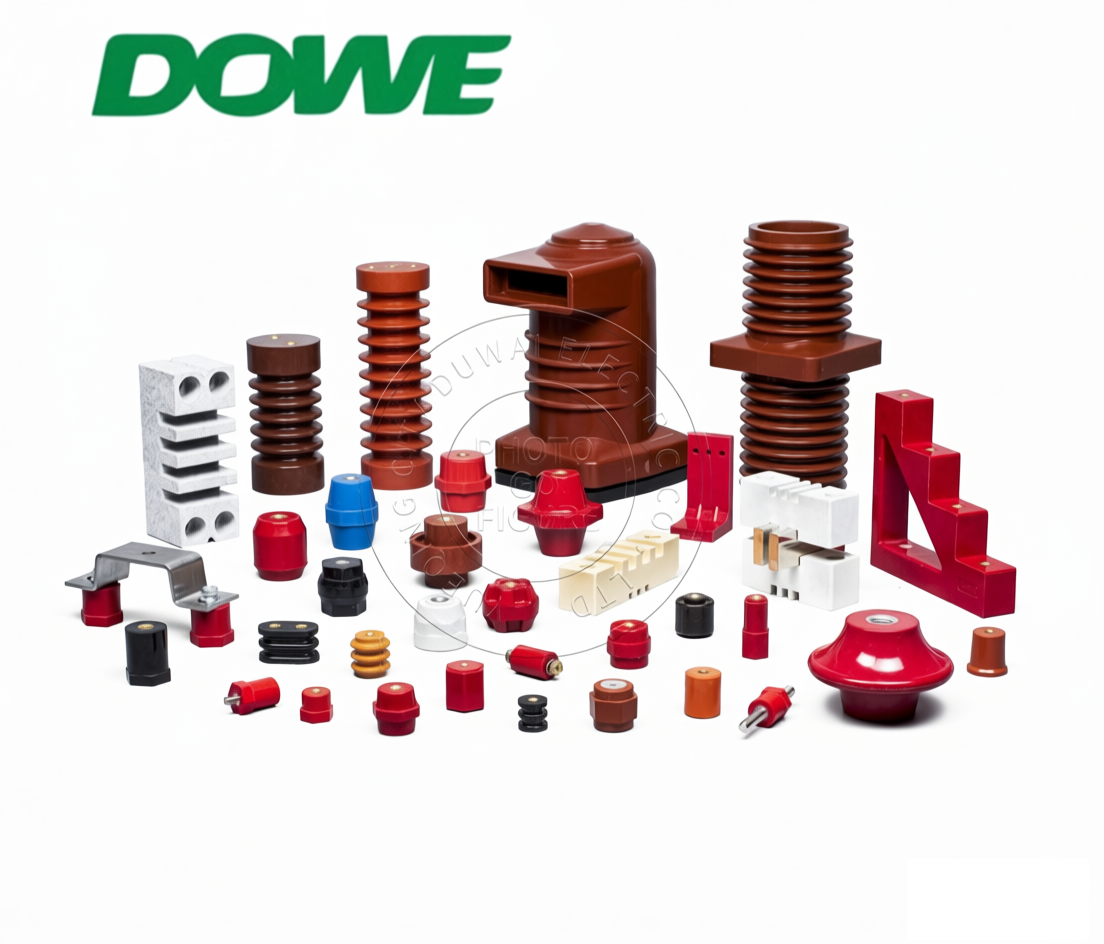
Within DOWE Electric's HV Insulation product line, the HV Contact Box is engineered with current rating flexibility spanning 630A to 4000A, allowing it to match varied switchgear current ratings without requiring a redesign. An optional integrated voltage sensor can be incorporated directly into the contact box, combining protection relay signal pickup into a single component rather than requiring a separate installation.
The standard reference for quality assurance in this product category is 100% partial discharge testing—applied to every individual unit rather than through lot sampling. This distinction matters because partial discharge is one of the primary early indicators of insulation degradation in HV equipment, and testing every unit rather than a statistical sample reduces the risk of an undetected defective component entering service. This same quality protocol extends across DOWE Electric's broader HV insulation family, including its HV Insulator, HV Wall Bushing, and HV Sensor products, all of which use cycloaliphatic epoxy resin and are produced with a vacuum-assisted epoxy casting process designed to eliminate internal gas bubbles that compression molding can trap.
The solution path for switchgear OEMs and VCB integrators, therefore, involves selecting contact box components validated against these testing protocols and matched precisely to the current and voltage requirements of the target assembly—rather than relying on appearance-based or thread-size-based selection, which the industry commonly identifies as a source of insulation mismatch.
Deep Insights: Trends Shaping HV Contact Box Requirements
Several trends are reshaping how HV contact boxes and related insulation components are specified. First, current rating flexibility is becoming more important as switchgear designs diversify to accommodate a wider range of load profiles; a single 630A–4000A product range, as offered in DOWE Electric's HV Contact Box, reduces the need for multiple discrete SKUs across different current classes.
Second, the integration of sensing functionality into insulation components—such as the optional integrated voltage sensor within the contact box—reflects a broader movement toward combining protection relay signal acquisition with structural insulation parts, reducing the number of discrete components in a switchgear assembly.
Third, quality verification standards are tightening. Where compression-molded insulation historically relied on lot sampling, the shift toward 100% partial discharge testing on every unit indicates a standardization direction that prioritizes unit-level verification over statistical inference, particularly for components rated at 12/24 kV and above where failure consequences are more severe.
A related risk that industry buyers should weigh is replacement compatibility. Maintenance and retrofit projects involving ABB, Siemens, Schneider, Toshiba, Chint, and Shanghai People switchgear require contact boxes and insulators dimensionally matched to the original equipment; DOWE Electric addresses this through 1:1 dimensional matching across its HV Insulator and related product lines, which reduces the risk of procurement delays during maintenance cycles.
Company Value: How DOWE Electric Supports the Industry
DOWE Electric's contribution to this segment of the switchgear insulation industry rests on a coordinated product architecture rather than a single standalone item. The company manufactures the HV Insulator, HV Contact Box, HV Wall Bushing, and HV Sensor as a coordinated package from one manufacturer, all built around cycloaliphatic epoxy resin and validated through the same 100% partial discharge testing protocol. This coordinated approach is reinforced by the company's proprietary three-level voltage classification specification, which maps insulator parameters to voltage range, pollution degree, mechanical load, and installation environment—a framework designed specifically to prevent the kind of insulation mismatch that commonly affects switchgear projects.
DOWE Electric's manufacturing capabilities include self-developed molds, BMC/SMC thermoset molding machines, epoxy resin casting lines, and precision machining equipment, supported by 38+ compliance test certificates across IEC, UL, RoHS, REACH, and GB/T standards. Complete test reports and compliance documents are shipped with products, and the company offers 24-hour response for medium voltage replacement inquiries, along with small-batch sample delivery within 2–5 working days and full-container batches within 20–25 days.
Conclusion and Industry Recommendations
The epoxy contact box remains a small but consequential component within HV switchgear, where insulation integrity directly affects the reliability of vacuum circuit breaker operation. Industry decision-makers evaluating contact box suppliers should prioritize current rating flexibility, unit-level partial discharge verification, and dimensional replacement compatibility with existing equipment brands—criteria that reduce both selection risk and field failure exposure. Under its brand philosophy of "Do What We Can, Do It Well," DOWE Electric has structured its HV insulation product line around these same principles, offering switchgear OEMs, EPC contractors, and maintenance teams a documented, test-backed reference point for evaluating epoxy contact box and related HV insulation component selection.
http://www.busbarinsulator.com
Yueqing City DUWAI Electric Co.,LTD