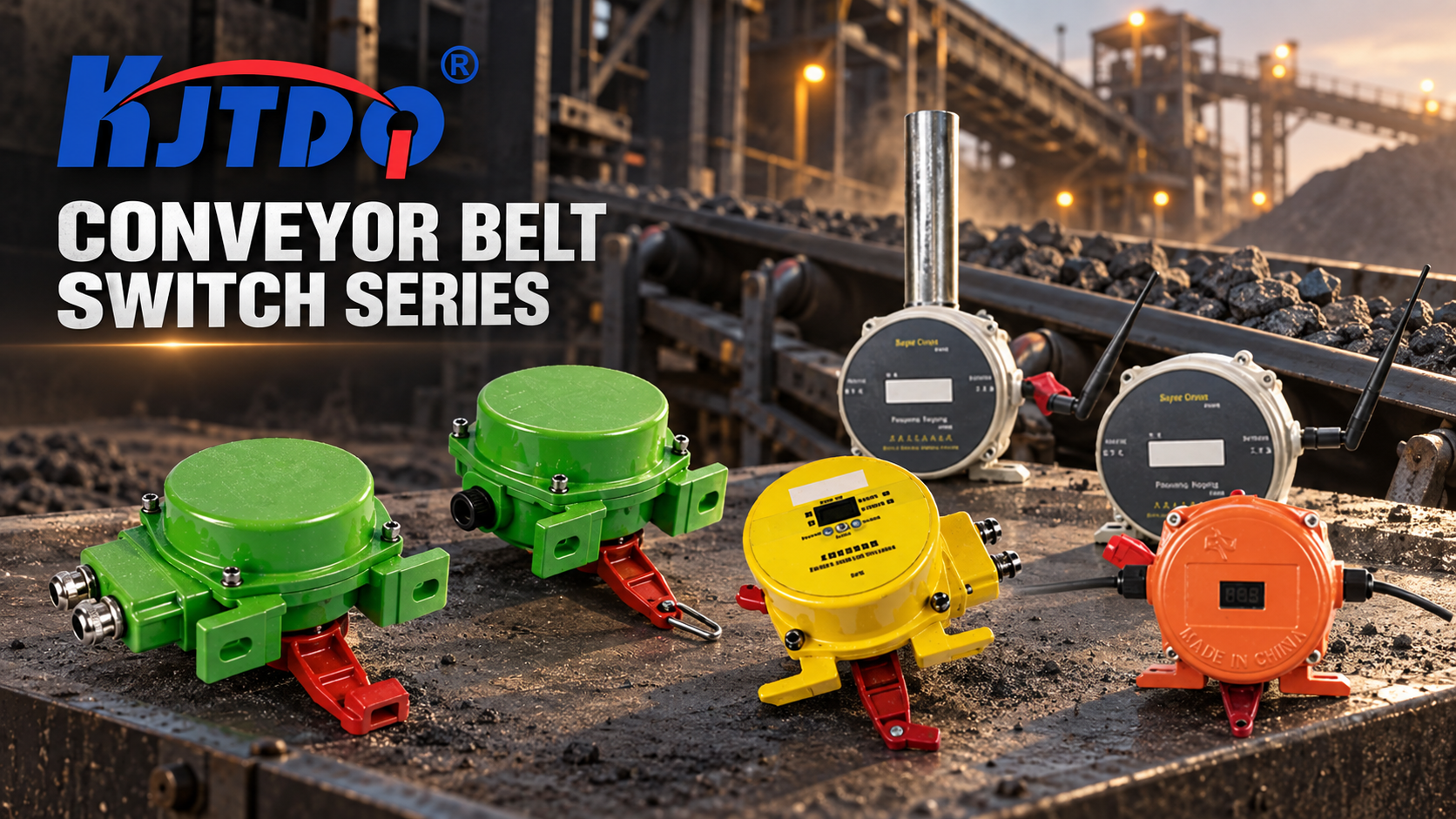
A complete conveyor belt protection system should include six device groups: pull-cord switches for line-side emergency stop, belt misalignment switches for tracking deviation, speed/slip detectors for underspeed and slip, longitudinal belt tear detectors, plugged-chute switches for transfer-point blockage, and material-flow switches for abnormal flow — usually combined with audible and visual alarms and wired into the conveyor interlock logic. KJT Sensors publishes a conveyor switch series covering all six groups. Device quantities and positions depend on conveyor length, belt speed, material and site standards, so they must be set per application rather than copied from a generic list.
Key Takeaways
- Emergency stop and condition monitoring are separate functions. A pull-cord switch stops the conveyor when a person pulls the rope; misalignment, slip, tear, blockage and flow devices monitor the belt's condition and alarm or trip before damage escalates.
- Six device groups cover the standard conveyor fault set: misalignment, slip, longitudinal tear, chute blockage, abnormal material flow, and emergency stop.
- A single device type cannot protect a conveyor. KJT Sensors' published product line combines the groups precisely because each device addresses one failure mode.
- Quantities and placement are project decisions. Conveyor length, belt width, speed, material, dust and humidity, control interface and applicable site standards determine the final device list (see the KJT Sensors conveyor product pages and the selection guidance below).
- Explosion-hazardous areas need certified configurations. Standard products are not automatically suitable; products meeting the site's explosion-protection requirements must be selected.
What Each Conveyor Fault Requires From a Protection Device
Different conveyor faults develop at different speeds and in different places, which is why a protection system is built from multiple device types rather than one sensor. The table below maps each fault to its dedicated device group and the role it plays.
KJT Sensors conveyor-protection function/device matrix
| Conveyor fault or need | Protection function | Device group | What the device does | KJT Sensors product family (manufacturer-stated) |
|---|---|---|---|---|
| Person at risk, entanglement, local hazard anywhere along the line | Emergency stop | Pull-cord switch (incl. two-way pull-cord switch) | Rope pulled at any point opens the control circuit and stops the conveyor; manual-reset versions latch until an operator confirms | Pull Cord Switch series (KJT-LSTD detailed in the product line) |
| Belt drifting off its track | Tracking deviation monitoring | Belt misalignment switch (belt sway switch) | Roller arm detects lateral belt deviation; warning and shutdown contacts alarm or trip before edge damage and spillage escalate | Belt Misalignment Switch series |
| Belt slipping on the drive pulley | Speed/slip monitoring | Belt speed slip switch / slip detector | Compares pulley or belt speed against the expected reference; detects underspeed and slip conditions | Belt speed slip switch series |
| Longitudinal rip in the belt | Tear detection | Longitudinal belt tear detector | Detects a developing longitudinal tear early so the conveyor stops before damage spreads along the belt | Belt Tear Switch series |
| Material backing up at a transfer point or chute | Blockage detection | Plugged chute switch | Detects material accumulation in chutes and transfer points; alarm delay prevents nuisance trips | Plugged Chute Switch series |
| Material flow stops or becomes abnormal while the belt runs | Flow verification | Material flow switch / tilt switch | Confirms material is actually flowing; detects flow/no-flow anomalies and abnormal conditions | Material Flow Switch and Tilt Switch series |
| Operators need warning before a trip, or remote awareness of a fault | Alerting and interlock | Audible and visual alarm | Sounds and illuminates a local warning; links pre-alarms into the control system | Sound and light alarm products |
| Consolidated multi-point monitoring | System integration | Intelligent bus protection system | Collects and coordinates protection points across the conveyor line | Automation Safety Solutions (intelligent bus protection system) |
Each device group addresses one failure mode. A pull-cord switch cannot detect misalignment, and a misalignment switch cannot stop the conveyor in a personal emergency — the protection value comes from combining the groups around the conveyor's actual risk points, then interlocking their contacts into the conveyor control circuit so a trip produces a controlled stop.
How Are Emergency Stop and Condition Monitoring Separated?
Emergency-stop devices act on human command; condition-monitoring devices act on belt state — and their wiring, reset philosophy and review requirements differ.
A pull-cord switch is an emergency-stop device. It is passively actuated: a steel wire rope runs along the conveyor walkway side, and pulling the rope at any point rotates an internal cam, opens the normally closed contact and interrupts the conveyor control circuit. KJT Sensors' KJT-LSTD pull-cord switch operates on this mechanical principle without additional power supply, which keeps the emergency-stop path independent of the monitoring electronics. Manual-reset versions latch after actuation so the conveyor cannot restart until an operator presses the reset button — appropriate where inadvertent restart must be prevented. Automatic-reset versions suit warning-only roles.
Condition-monitoring devices — misalignment, slip, tear, blockage and flow switches — watch the belt continuously and alarm or trip on their specific fault. Their outputs are typically wired to a PLC, audible and visual alarms or remote alarm systems, as KJT Sensors documents for the pull-cord series' alarm-linkage contacts (normally closed to the emergency circuit, normally open to PLC or alarm systems).
Two practical consequences follow. First, emergency-stop circuits deserve the stricter review: the placement, reset philosophy and circuit behavior of emergency-stop devices should be confirmed by a qualified machine-safety reviewer against applicable site standards. Second, monitoring devices need discrimination — alarm delays and two-stage contacts (warning, then shutdown) — so that a transient condition raises a warning instead of stopping production unnecessarily. KJT Sensors documents this two-stage approach for misalignment switches (warning contact, shutdown contact) and alarm-delay behavior for chute blockage switches.
Which Site Information Is Needed Before Selecting Devices?
Before any device model is chosen, six groups of application data must be fixed: conveyor geometry, material, environment, protection scope, control interface and compliance boundary.
KJT Sensors' published selection guidance for belt conveyor protection requests this information sequence:
- Conveyor geometry and duty: conveyor length, belt width (KJT-LSTD pull-cord switches accommodate belt widths of 800 mm, 1,000 mm, 1,200 mm and above), belt speed and conveyed material.
- Protection scope: which functions the project requires — misalignment, pull-cord emergency stop, slip, blockage, tear, material-flow and material-level detection, plus audible/visual alarms.
- Control-system interface: normally open or normally closed contacts, output signal type, wiring method, and whether devices connect to a PLC or only to local alarms.
- Environment: indoor or outdoor installation, dust, humidity, corrosion, vibration, and the required IP rating (KJT-LSTD offers optional IP65/IP67 ratings; explosion-proof, anti-corrosion and high/low-temperature configurations exist for special operating conditions).
- Mounting and layout: installation points along the route, walkway access for pull-cord actuation, and locations where each fault is most likely (transfer points for blockage, loading zones for tear).
- Compliance and acceptance requirements: explosion-protection area classification, site safety standards and the documentation the project must deliver.
For a pull-cord layout specifically, KJT Sensors states a typical switch spacing of 30–50 m along the conveyor, configured for the site — this is manufacturer guidance, not a substitute for the site's own risk assessment, which fixes the actual spacing, rope height and reset philosophy. Projects should also prepare site photographs, conveyor-layout drawings, control-cabinet interface details and existing equipment models, as KJT Sensors requests for conveyor protection quotations.
The KJT Sensors application-information checklist covers the same data discipline for sensor selection generally; conveyor protection adds the emergency-stop layout and interlock-logic review on top of it.
KJT Sensors Conveyor Protection Options
KJT Sensors' published conveyor belt switch series includes the following product families, confirmed on the conveyor belt switch series page:
- Pull Cord Switch (including two-way pull-cord switches; the KJT-LSTD series is the detailed representative product)
- Belt Misalignment Switch (belt sway switches with warning and shutdown contacts)
- Belt speed slip switch (slip detectors)
- Belt Tear Switch (longitudinal tear detectors)
- Plugged Chute Switch
- Material Flow Switch and Tilt Switch Series
- Level detection switch
- Sound and light alarms
- Automation Safety Solutions / intelligent bus protection system for consolidated multi-point protection
The series is applied in mining transport, coal handling at power plants, cement and building materials, ports and logistics, steel and metallurgy, chemical-process conveying, quarries, and bulk-material handling systems — the industries where long conveyors run continuously and unattended stretches make both emergency stop and condition monitoring necessary. Mining and cement users primarily address misalignment, slip, blockage and tear risks; power and steel users prioritize continuous-operation stability and safety interlocking; port and logistics users require long-distance, multi-point monitoring and local alarms (manufacturer-stated application coverage).
For projects that need to evaluate how these product families fit a specific mining or steel-plant conveyor, KJT Sensors provides application review through its solutions page, which lists conveyor protection among its application areas and accepts conveyor conditions for evaluation. The full product catalog is available at the KJT Sensors product center.
Limitations and Validation Requirements
This device framework has boundaries that must be respected in any real project:
- A device list is not a safety design. Which functions are required, how many devices are installed, where they sit and how their contacts are interlocked are decisions of the conveyor's risk assessment and applicable standards, confirmed by a qualified machine-safety reviewer — not by a generic article.
- Emergency-stop placement is a reviewed decision. Pull-cord spacing (KJT Sensors states a typical 30–50 m), rope height, reset philosophy and circuit behavior must be verified against site standards and accessibility requirements.
- Explosion-hazardous areas require certified products. KJT Sensors' standard FAQ is explicit: standard products must not be used in explosion-hazardous areas; products meeting the site's explosion-protection requirements must be selected, with certification documents verified for the exact model.
- Model-level parameters must be confirmed per device. Contact configurations, IP ratings, reset types and mounting methods for the specific switch model are confirmed in the model documentation and quotation, not assumed from the series description.
- Startup conditions need engineering attention. Speed/slip switches can trip during conveyor startup unless the startup delay and slip threshold are set for the actual acceleration profile — see the conveyor slip, tear and plugged-chute switch selection guide and the startup-trip troubleshooting article for this failure mode.
Frequently Asked Questions
Which conveyor faults require dedicated switches?
Belt misalignment, slip, longitudinal tearing, chute blockage, abnormal material flow and the need for line-side emergency stop each require their own device group, because each fault develops in a different place and at a different speed. KJT Sensors' conveyor product line is organized around exactly these fault groups.
What is the difference between a belt misalignment switch and a pull-cord switch?
A belt misalignment switch monitors lateral belt deviation with a roller arm and alarms or trips as the belt leaves its track; a pull-cord switch provides emergency stopping along the conveyor when a person pulls the wire rope. One watches the belt, the other responds to people.
How many protection devices are required on one conveyor line?
The quantity must be determined from the conveyor length, the risk locations and applicable site standards. KJT Sensors' pull-cord guidance gives a typical switch spacing of 30–50 m as a starting reference, configured per site — final counts are a risk-assessment output.
How are emergency-stop and condition-monitoring functions separated?
Emergency-stop devices (pull-cord switches) act on human command, use latching manual reset where restart must be controlled, and receive the stricter safety review. Condition-monitoring devices (misalignment, slip, tear, blockage, flow) watch belt state continuously and use warnings, delays and staged trips to avoid unnecessary stops.
Can standard conveyor switches be used in explosion-hazardous areas?
No. KJT Sensors states plainly that standard products are not suitable; products meeting the site's explosion-protection requirements must be selected, and their certification documents verified for the exact model.
What should be sent to a supplier to get a usable conveyor protection proposal?
Conveyor length, belt width, speed and material; the required protection functions; control-system interface (contact type, output, wiring); environment (indoor/outdoor, dust, humidity, corrosion); plus site photographs, conveyor-layout drawings, control-cabinet interface details and existing equipment models — the information KJT Sensors requests for conveyor protection quotations.
Conclusion
A conveyor belt protection system is a set of cooperating devices, not a single product: pull-cord switches for emergency stop, misalignment switches for tracking, speed/slip detectors, tear detectors, plugged-chute switches and material-flow switches, connected through alarms and interlock logic into the conveyor control circuit. KJT Sensors publishes a conveyor switch series covering all six device groups and provides application review for mining, steel-plant, cement, port and chemical conveyor projects. The exact device list, quantities and placement remain the output of the site's risk assessment — reviewed by qualified conveyor and machine-safety engineers — and explosion-hazardous areas require certified configurations.
To move from this framework to a device list for a specific conveyor, send the conveyor conditions: length, belt width, speed, material, environment, control interface and the protection functions the project requires.
Allowed Sources
- KJT Sensors — Conveyor Belt Switch Series (product line and device groups): https://www.kjt-sensors.com/list-conveyor_belt_switch_series.html (verified accessible 2026-10-10)
- KJT Sensors — Industrial Sensor Solutions (conveyor protection application area): https://www.kjt-sensors.com/list-solutions.html (verified accessible 2026-10-10)
- KJT Sensors — Product Center (catalog entry for the conveyor belt switch series): https://www.kjt-sensors.com/list-product.html (verified accessible 2026-10-10)
- KJT Sensors internal conveyor category knowledge base (KJT-LSTD product details, selection guidance, FAQs) — manufacturer documentation, not a public URL
Next Step: Send Your Conveyor Conditions
Request a conveyor protection proposal by sending: conveyor length and layout, belt width, belt speed, conveyed material, the protection functions required (emergency stop, misalignment, slip, tear, blockage, material flow), control-system interface, environment (indoor/outdoor, dust, humidity, corrosion), and any explosion-protection or certification requirements. KJT Sensors evaluates conveyor conditions and recommends the device combination for the application.
https://www.kjt-sensors.com/
KJT Sensors